Two taps before it enters the system
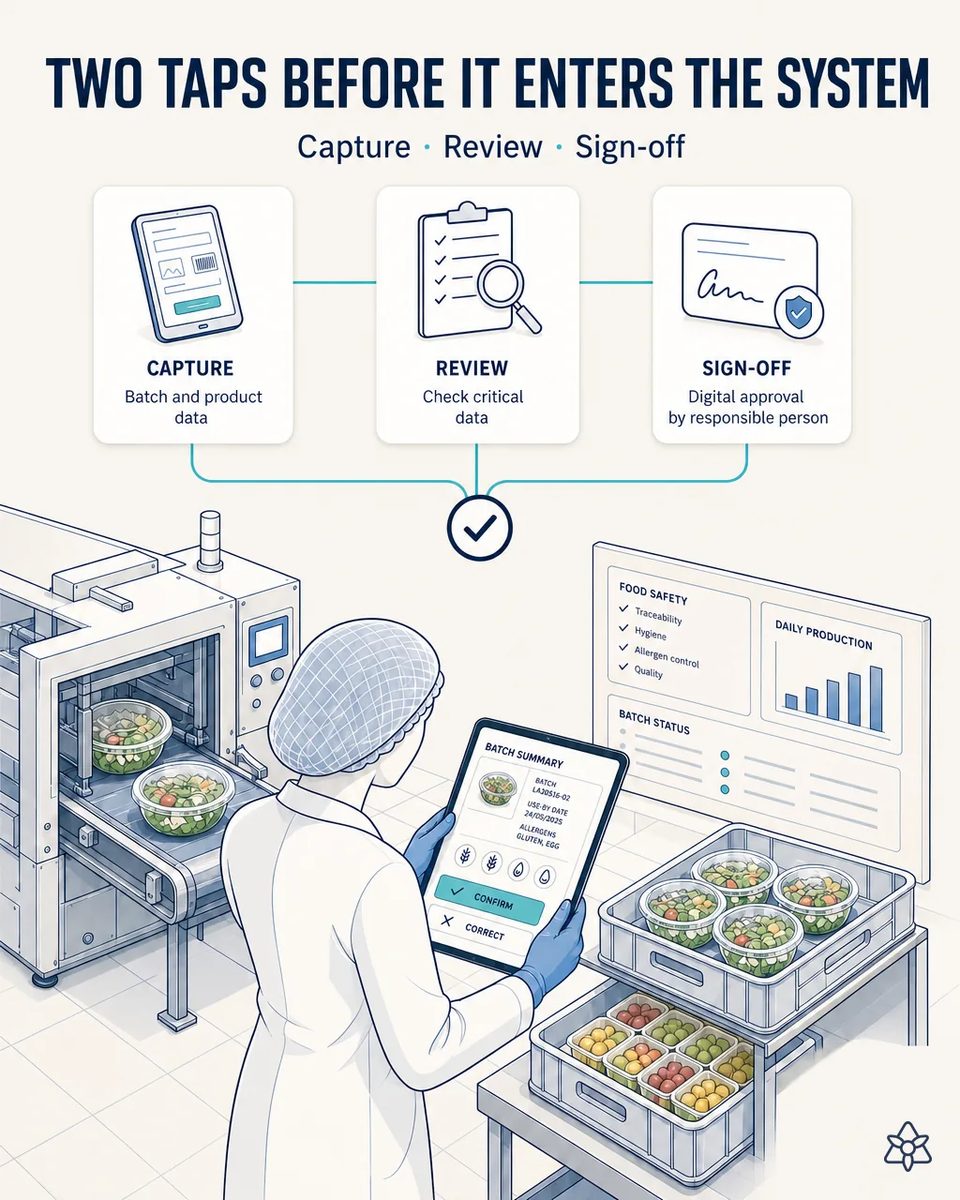
The main brake on digitizing a kitchen is the fear that a machine will enter data nobody checked, leaving the ERP to be cleaned up later. But operators do not want to type either. The operator checks what is critical for fresh product: correct batch, use-by date and recipe allergens. Confirm or correct with two taps. Only then does the data cross into the central system.
Nobody wants a machine writing into the ERP, and nobody wants to type either.
The main brake on digitizing a kitchen is the fear that a machine will enter data nobody checked, leaving the ERP to be cleaned up later. But operators do not want to type either.
- The main brake on digitizing a central kitchen is trust: the fear that an automatic capture enters data nobody checked, and the ERP master has to be cleaned up later.
- At the same time, operators at an assembly line with gloves on do not want forms. Every field they have to type is a field that ends up empty or wrong. Paper forms end in a drawer for the same reason.
- In fresh food the critical data is short but unforgiving: a wrong batch breaks traceability to the vending machine, a wrong use-by date leaves product on sale too long, a missing allergen is a consumer at risk.
- Without a clear checkpoint, every capture method, photo, voice or email, inherits the same suspicion and stalls.
Connect with human validation at the line — two taps, then the central system.
With iLEAN Connect, everything captured, whether a photo of the sheet, a voice note or a supplier email, appears on a line-side tablet as a two-second visual summary. The operator checks what is critical for fresh product: correct batch, use-by date and recipe allergens. Confirm or correct with two taps. Only then does the data cross into the central system. This is what sets iLEAN apart from an autonomous agent: nothing goes in without a person having seen it.
Everything captured, the production sheet photo, a voice note or a supplier email, arrives on a line-side tablet as a two-second summary. The operator confirms or corrects; only then does the data cross. That checkpoint is what separates iLEAN from an autonomous agent. It is not bureaucracy added to the line: it is the moment where the person keeps authority over what the system believes.
Unchecked capture versus the two-tap checkpoint
| Aspect | Today | With iLEAN Connect |
|---|---|---|
| Data entering the ERP | Typed late or not at all | Seen and confirmed first |
| Recipe allergens on the batch | Checked on paper, if checked | Shown as icons to confirm |
| Use-by date | Trusted to the label printer | Confirmed against the recipe |
| Operator effort | Forms with gloves on | Two taps |
| A capture that seems off | Discovered downstream | Corrected at the line |
| Trail of who confirmed | None | Person, time and line |
Unvalidated or uncaptured data → data captured and validated in seconds, clean master.
Impact estimate — to be validated as an enabling piece for the other cases.
The block below is an estimate to be validated against your plant's actual data. We put it forward so the committee has an order of magnitude; we refine it during the assessment.
- No standalone payback: this is the enabling piece the other cases are signed off on. We do not price it separately because its value is that the rest can be approved.
- Data captured and validated in seconds, with a clean master instead of a cleanup project later. IT stops treating every new capture as a risk to the master.
- Batch, use-by date and allergens checked by a person at the point where a mistake is cheapest to fix.
- And a trail of who confirmed what, which quality and auditors can read without asking.
Enabling piece · data validated in seconds, clean master (estimate to be validated). Data captured and validated in seconds, a clean master. It is the enabling piece the others are signed off on. Strategic value; estimate to be validated.
And the fair question from the production manager
“If a person confirms everything anyway, where is the saving?” — in what the person no longer does. They do not hunt for the batch or type fields; they read a summary and tap. The extraction behind that summary is an anchored task, where the best models drop below 1.5% error [1], so most of the time the tap is a confirmation, and when it is not, the mistake is stopped at the line instead of in the vending machine.
[1] OpenAI paper "Why Language Models Hallucinate", 2025 — on the reliability of AI in anchored tasks.
What people ask about the line-side verification tablet
How many seconds does it take the operator?
About two for a normal capture. The summary shows only what is critical for fresh product: batch, use-by date and recipe allergens. Anything outside the normal flow, such as a missing field, is highlighted so the operator does not have to search for it.
Why are allergens on the summary and not only in the recipe master?
Because the master can be right and the batch wrong: a recipe swapped mid-shift changes the allergens. Seeing them at the line is the last cheap moment to catch it. In vending that matters more than elsewhere, because the label is the only information the consumer has at the machine.
Can the tablet be used with gloves on?
Yes. The buttons are large and the screen is set for gloved use; nothing needs typing in the normal flow. It can be mounted at the end of the assembly line, at receiving or at dispatch, wherever the capture happens.
What if nobody confirms a capture?
It stays pending and visible to the shift lead. Nothing enters the ERP by default, which is the whole point of the checkpoint. The shift lead can see the pending list at any time and clear it before the batch leaves on a restocking route.
Does it have to be in place before the other cases?
It is usually deployed with the first one, because it is what lets quality and IT say yes to the rest. It also gives the first case a visible checkpoint from day one, which is what makes quality comfortable with the pilot.
More cases from this series
- Allergen recipe changeover validated by cameraEdge cameras validate clean-downs between allergen recipes; the line does not restart without visual OK…
- The food-safety audit, always readyiLEAN Agents organizes HACCP, cleaning and temperature evidence by batch: audits and tenders always…
- The blast chiller that now talksA camera reads the blast chiller panel and records each batch's chilling curve without replacing the…
- Fresh goods receiving with one photoFresh goods receiving with one photo: delivery note, batch, use-by and temperature into the ERP with one…
- From the HACCP spreadsheet to the ERP without retypingFrom the HACCP spreadsheet to the ERP without retyping, with human validation and up to 80% fewer…
- The kitchen lead speaks, iLEAN takes notesThe kitchen lead dictates with gloves on; iLEAN structures the issue and replies with support in…
Tell us what has stopped you from letting captured data into your ERP so far.
We work on your plant's real data, not ours. Assessment with no commitment.
Request estimated ROI within 48h ‹ See all cases of fresh-food vending See food industry