Guaranteed freshness from kitchen to machine
A fresh-food vending operator lives between two risks: product that expires in the machine and is thrown away, and product out of the cold chain or mislabeled that reaches the consumer. The first costs margin; the second costs contracts and reputation. Machine telemetry feeds the kitchen plan: you make what each route will sell, and supplier alerts replan in time.
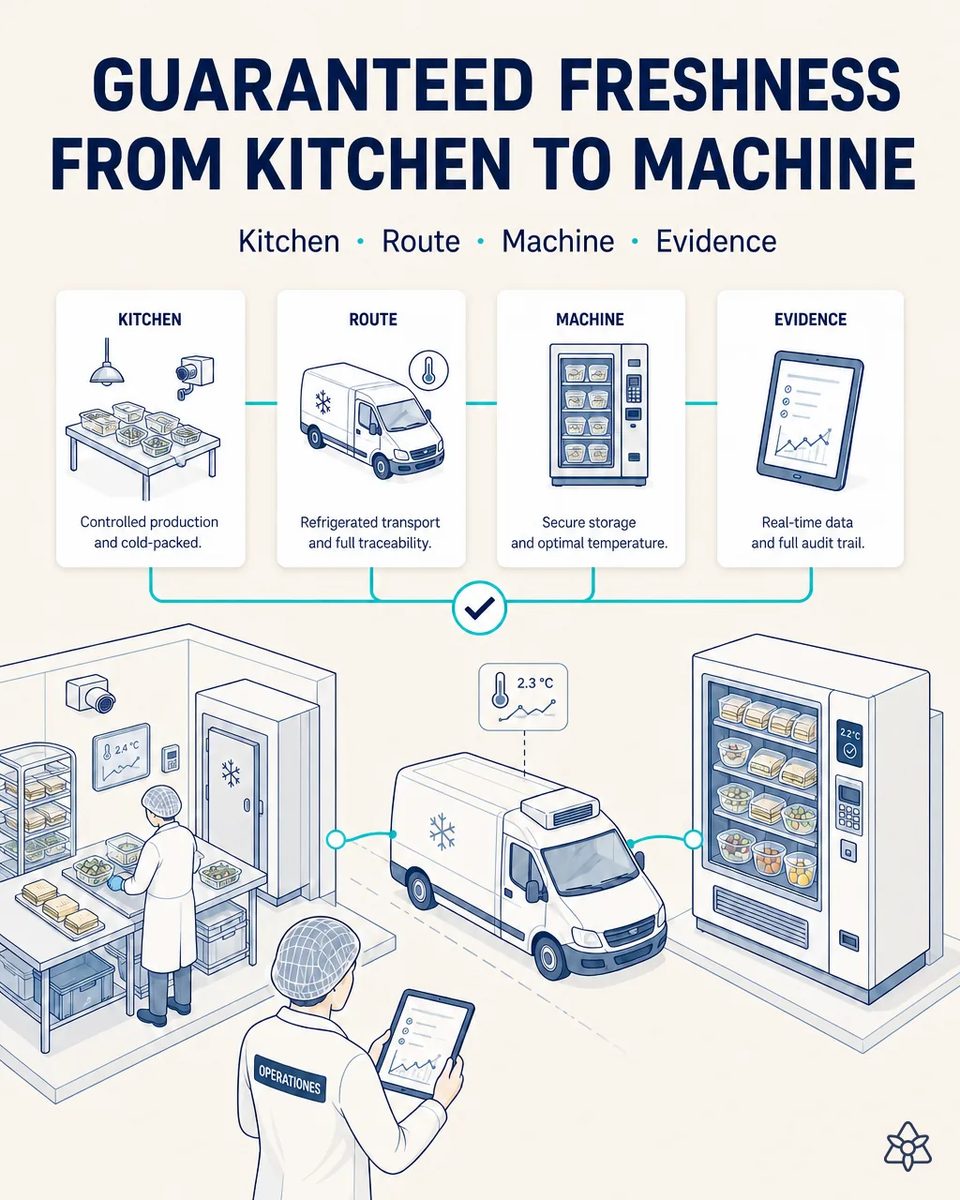
A fresh-food vending operator lives between two risks that pull in opposite directions.
A fresh-food vending operator lives between two risks: product that expires in the machine and is thrown away, and product out of the cold chain or mislabeled that reaches the consumer. The first costs margin; the second costs contracts and reputation.
- Product that expires in the machine and is thrown away costs margin. Expiry waste is the line that eats the business quietly, route by route.
- Product out of the cold chain or mislabeled that reaches the consumer costs contracts and reputation, especially with hospitals, companies and public bodies.
- Today the two are handled separately and after the fact: waste is counted when the route driver brings it back, and a cold-chain break is found when someone complains.
- Making more to avoid empty spirals raises waste; making less to cut waste raises empty spirals. Without data crossing kitchen, route and machine, every decision fixes one risk by worsening the other.
Agents coordinating three rings — kitchen, route and machine, cross-checked.
Production sheet by photo, chiller read by camera, allergen changeover validated by Edge and 100% pack inspection. Every batch leaves with its batch code, use-by date and evidence. Machine telemetry feeds the kitchen plan: you make what each route will sell, and supplier alerts replan in time. Van and machine temperature, and the route operator's scan at loading, are matched against each batch's use-by date. If something does not add up, iLEAN alerts before the product reaches the spiral. iLEAN Agents cross-checks the three rings, proposes withdrawals, production and route adjustments, and keeps the dossier ready. The operations lead decides.
No single case solves this, because each one sees only part of the journey. The strength is in the cross-check: when the batch's use-by date, the van temperature and the machine's sales stop agreeing, iLEAN alerts before the product reaches the spiral and the operations lead decides.
Three rings from kitchen to machine, and what each one closes
| Ring | Which cases it draws on | What it closes |
|---|---|---|
| 1 · Kitchen | Production sheet (1) + chiller (2) + changeover (10) + pack inspection (9) | Every batch leaves with batch code, use-by date and evidence |
| 2 · Route | Route driver scan at loading + van temperature | No batch loaded past its use-by or out of the cold chain |
| 3 · Machine | Telemetry plan (8) + supplier alerts (3) + machine temperature | Make what each route will sell; withdraw what will not |
| Agents on top | Evidence pack (11) | Withdrawal, production and route proposals, dossier ready |
| When kitchen and route disagree | JIDOKA AI | Alert before the product reaches the spiral |
| When a hospital customer asks | Agents | Batch history from kitchen to machine in minutes |
Waste and risk handled separately and after the fact → three coordinated rings that anticipate both; waste −20 to −40%.
Impact estimate — to be validated with operations and quality.
The block below is an estimate to be validated against your plant's actual data. We put it forward so the committee has an order of magnitude; we refine it during the assessment.
- Estimated payback 6-12 months.
- Estimated expiry waste reduction of 20 to 40%, from producing what each route will actually sell.
- Zero out-of-date or out-of-cold-chain product in machines as the operating target, enforced by the cross-check between rings.
- And the dossier for any batch, from kitchen to machine, ready when an institutional customer or an inspector asks.
Payback 6-12 months · waste -20 to -40% and zero out-of-date product in machines (estimate to be validated). Expiry waste cut by 20-40% and zero out-of-date or out-of-cold-chain product in machines. Estimated payback of 6 to 12 months. Estimate to be validated with operations and quality.
And the fair question from the production manager
“Do we have to deploy all twelve cases before this pays?” — no, and that framing would be the surest way never to start. The rings are built in layers and each case pays on its own; with the production sheet and machine telemetry you already have the ends of the chain. Each ring rests on anchored tasks where the best models drop below 1.5% error [1], and what the cross-check adds is that a failure in one ring is caught by another before the product reaches a machine.
[1] OpenAI paper "Why Language Models Hallucinate", 2025 — on the reliability of AI in anchored tasks.
What people ask about kitchen-to-machine freshness
Which case should a vending operator with its own kitchen deploy first?
Usually machine telemetry feeding the plan, because it has the shortest payback, together with the production sheet photo, which gives every batch its code and use-by date. Both pay on their own, and together they form the two ends of the chain that the other rings later connect.
How are the van and the route driver involved?
The route driver scans at loading and the van reports its temperature. Both are matched against each batch's use-by date, so nothing is loaded that should not be. If a batch is close to its use-by date or the van has been out of range, the alert arrives before the driver leaves the dock.
Can it withdraw product from a machine by itself?
No. It proposes withdrawals, production and route adjustments; the operations lead decides. Humans stay in command. Every proposal arrives with the reason behind it, so the lead can see why a withdrawal or a route change is suggested.
Does it replace our telemetry, ERP or route software?
No. It cross-checks them against each other and against what actually happens in the kitchen, on the route and in the machine. That is why it can start on top of the systems you have, without a migration project in the way.
Can the return be estimated before committing to all three rings?
Yes: with your current expiry waste, the number of routes and machines, and the cost of your last withdrawal or complaint, the return per ring is estimated before choosing the order. That is what the design session is for: a return per ring with your numbers before any commitment.
More cases from this series
- Allergen recipe changeover validated by cameraEdge cameras validate clean-downs between allergen recipes; the line does not restart without visual OK…
- The food-safety audit, always readyiLEAN Agents organizes HACCP, cleaning and temperature evidence by batch: audits and tenders always…
- The blast chiller that now talksA camera reads the blast chiller panel and records each batch's chilling curve without replacing the…
- Fresh goods receiving with one photoFresh goods receiving with one photo: delivery note, batch, use-by and temperature into the ERP with one…
- From the HACCP spreadsheet to the ERP without retypingFrom the HACCP spreadsheet to the ERP without retyping, with human validation and up to 80% fewer…
- The kitchen lead speaks, iLEAN takes notesThe kitchen lead dictates with gloves on; iLEAN structures the issue and replies with support in…
Tell us how much fresh product your route drivers bring back as expiry waste each week.
We work on your plant's real data, not ours. Assessment with no commitment.
Request estimated ROI within 48h ‹ See all cases of fresh-food vending See food industry