WMS and ERP finally talk to each other
The warehouse runs a modern WMS, in-house or the logistics provider's, and the company runs its ERP. Both have APIs, but there was never time to integrate them properly. iLEAN Connect plugs into both APIs and mirrors in one what happens in the other, replacing neither. The WMS stays the WMS and the ERP stays the ERP.
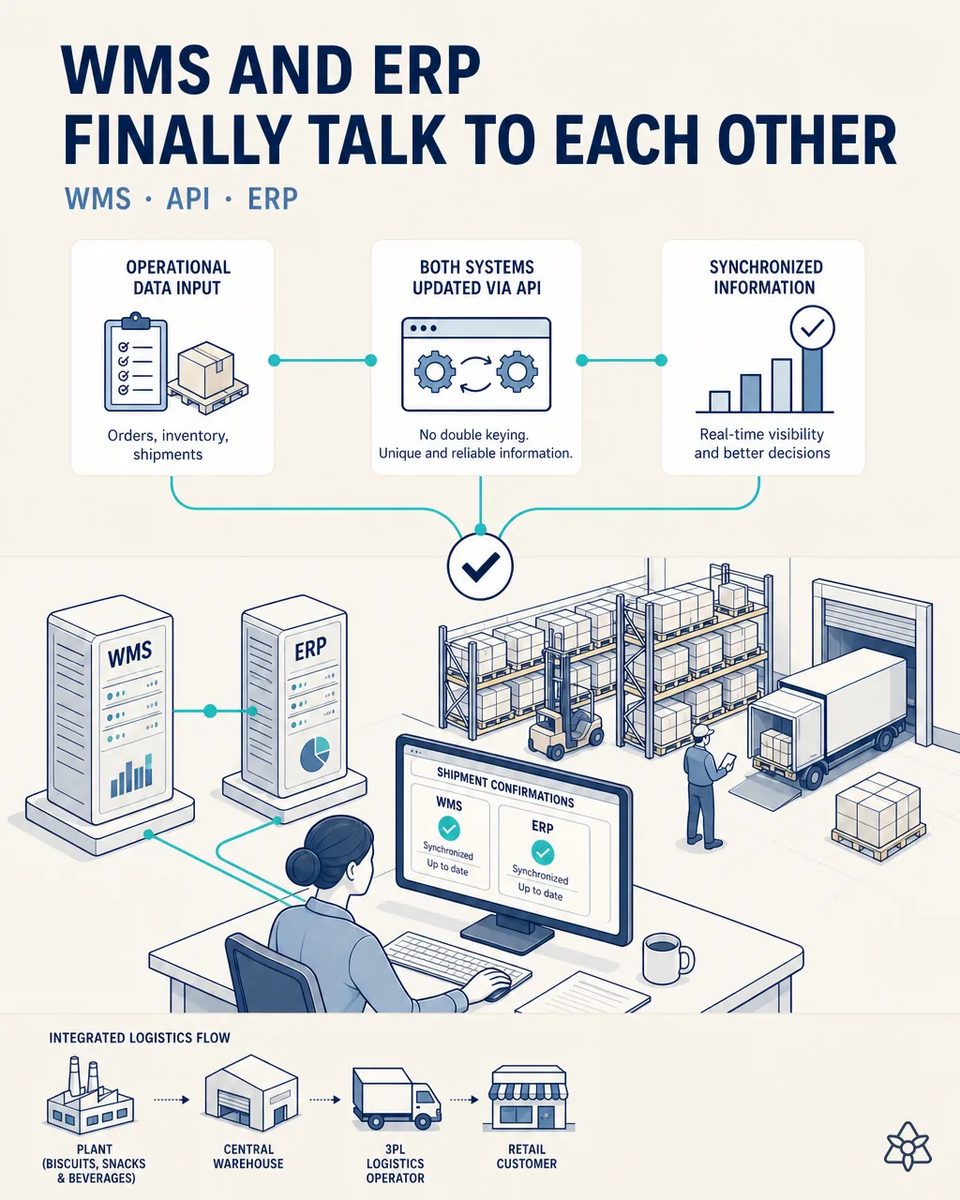
Two systems with APIs, joined by a person typing everything twice.
The warehouse runs a modern WMS, in-house or the logistics provider's, and the company runs its ERP. Both have APIs, but there was never time to integrate them properly. Result: someone types shipment and receipt confirmations into both systems. Errors, delays and an inventory that never matches between the warehouse and finance.
- The finished-goods warehouse runs a modern WMS, in-house or the logistics provider's, and the company runs its ERP. Both have APIs, but the integration project never got its turn.
- So someone types every shipment and receipt confirmation into both systems, at the end of the shift or the next morning, often from a printout of the WMS screen, while the warehouse has already moved on to the next wave.
- Each double entry is a chance for a wrong quantity or a lot swapped between two lines, and the inventory never quite matches between the warehouse and finance.
- When the provider upgrades its WMS or a new DC opens, the manual bridge gets longer, and nobody owns the differences it creates. Finance blames the warehouse, the warehouse blames the ERP, and the month closes with an adjustment.
Connect between both APIs — the WMS stays the WMS, the ERP stays the ERP.
iLEAN Connect plugs into both APIs and mirrors in one what happens in the other, replacing neither. The WMS stays the WMS and the ERP stays the ERP. What matches flows on its own; what does not reaches a person with full context to decide. The business rule is set by the team, not by the AI.
This is not a new system or a migration: iLEAN mirrors in one what happens in the other and replaces neither. What matches flows by itself; what does not reaches a person with both versions side by side. The rule for what counts as a match is written by your team, not by the AI. And because neither system is replaced, there is no migration, no parallel run and no go-live weekend: confirmations start flowing as soon as both APIs are connected and the rules are agreed.
The manual bridge between WMS and ERP versus the API bridge
| Aspect | Today | With iLEAN Connect |
|---|---|---|
| Shipment and receipt confirmations | Keyed twice | Mirrored once, automatically |
| Lag between warehouse and finance | A shift or a day | Minutes |
| Mismatched quantity or lot | Found at month-end | Sent to a person with both versions |
| Business rule for a WMS-ERP match | In someone's head | Written by your team |
| Analyst hours per week | Spent retyping | Recovered |
| WMS or ERP replacement project | — | Not needed |
Payback 4-9 months · no double keying of shipment and receipt confirmations
Impact estimate — to be validated with your numbers.
The block below is an estimate to be validated against your plant's actual data. We put it forward so the committee has an order of magnitude; we refine it during the assessment.
- Estimated payback 4-9 months, depending on the volume of confirmations keyed twice today and on how many sites run their own WMS.
- No more double keying of shipment and receipt confirmations, at the plant warehouse or at the logistics provider.
- Consistent inventory between the warehouse system and the ERP, which is what finance and S&OP both look at, so the month-end goods-in-transit adjustment shrinks.
- And analyst hours recovered every week, redirected to the exceptions that actually need judgment, such as a short shipment or a lot the warehouse substituted.
No more double keying, consistent inventory across systems and analyst hours recovered every week. Estimated payback of four to nine months, an estimate to be validated.
And the fair question from the production manager
“What if it posts a confirmation the ERP should have rejected?” — matching a WMS confirmation to its ERP order by document, item, lot and quantity is an anchored task, where the best models drop below 1.5% error [1]. And only exact matches under the rule your team defines flow on their own; anything else waits for a person with full context and both versions in front of them. Every decision taken on a mismatch is logged, so the rule can be refined where the same exception keeps returning.
[1] OpenAI paper "Why Language Models Hallucinate", 2025 — on the reliability of AI in anchored tasks.
What people ask about connecting the WMS and the ERP
Isn't this the integration project IT never had time for?
It covers the same need without the same size: iLEAN uses the APIs both systems already expose and starts with shipment and receipt confirmations, which is where the double keying hurts. Other flows are added once those run cleanly.
Does it work with the logistics provider's WMS, not just ours?
Yes, as long as the provider exposes an API or a regular export. Many 3PL contracts already include that access and it is simply not used. When there is only a file export, it is read on arrival like any other file.
Who decides what counts as a match between WMS and ERP?
Your team. Tolerances, mandatory fields and which differences must stop for review are configured as business rules, and the AI applies them. Changing a rule is a configuration change, not a development.
What happens when one of the APIs is down?
Confirmations queue up and are mirrored in order when the API returns, so nothing is lost and nothing is posted twice. The team is told how many confirmations are waiting and since when.
Does it also carry stock transfers between plant and DC?
Yes, once confirmations are flowing. Transfers between the plant warehouse and external DCs are a natural next step because they suffer the same double entry and the same goods-in-transit gaps at month-end.
More cases from this series
- The 3PL inventory spreadsheet, straight into the ERPThe 3PL inventory spreadsheet, straight into the ERP. Payback 3-7 months · from N to 1 inventory-module…
- The carrier alert that replans in timeThe carrier alert that replans in time. Payback 3-8 months · reaction to transport incidents from hours…
- Evidence pack for every delivery, ready for audits and disputesEvidence pack for every delivery, ready for audits and disputes. Payback 3-8 months · undue chargebacks…
- Dock loading sheet in the system instantlyDock loading sheet in the system instantly. Payback 4-9 months · shipment confirmation from 4-8 h…
- Inventory count validated before it touches the ERPInventory count validated before it touches the ERP. Payback 4-9 months · inventory adjustments with…
- S&OP on live shop-floor data against empty shelvesS&OP on live shop-floor data against empty shelves. Payback 6-12 months · better OTIF and lower safety…
Tell us how many confirmations your team keys into both the WMS and the ERP each day.
We work on your plant's real data, not ours. Assessment with no commitment.
Request estimated ROI within 48h ‹ See all cases of supply chain See food industry