The 3PL inventory spreadsheet, straight into the ERP
External logistics providers send their inventory, receipts and shipments every day as a spreadsheet in a shared folder. It is the live data of much of the network. Connect in listen-inwards mode observes the shared folder: as soon as the 3PL saves the file, it reads it, parses it with a grounded model and reconciles it with the ERP line by line.
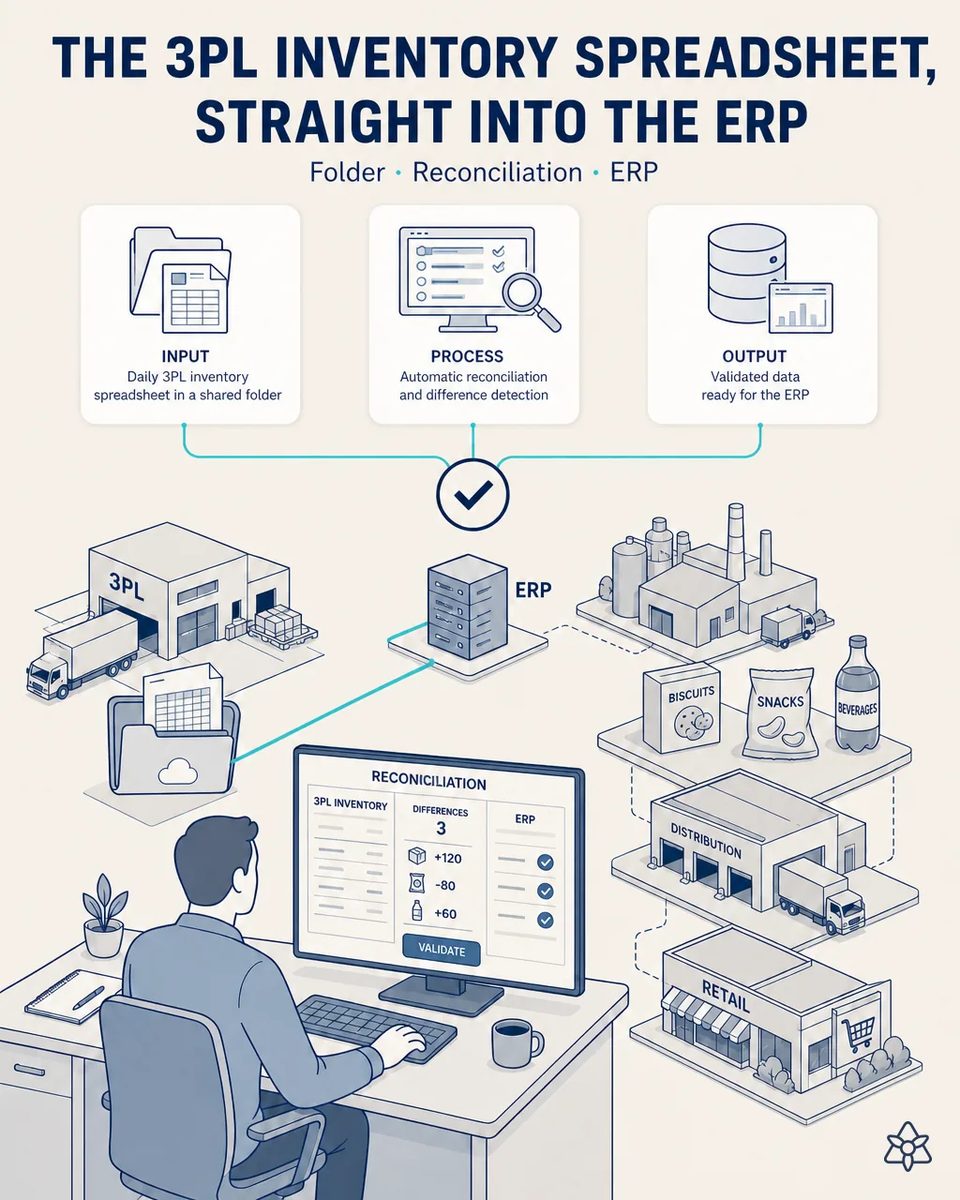
Half the network's inventory arrives as a spreadsheet, a day late.
External logistics providers send their inventory, receipts and shipments every day as a spreadsheet in a shared folder. It is the live data of much of the network. A team of analysts opens those files, compares them with the ERP and keys in the differences. Half a day lost every day, and the ERP is always a day behind the external warehouse.
- Each external logistics provider sends its inventory, receipts and shipments every day as a spreadsheet in a shared folder, each with its own layout, product codes and date format.
- A team of analysts opens those files every morning, renames columns, converts codes, compares them with the ERP line by line and keys in the differences. Half a day lost, every day, on work that requires no judgment.
- The ERP is always a day behind the external warehouse, so S&OP and replenishment decide on stock that has already moved: a DC looks short when the goods are there, or looks covered when the last receipt never arrived.
- And several people hold an inventory-module license in the ERP only to do that reconciliation, a recurring cost finance sees renewed every year.
Connect listening to the 3PL folder — it reads the file the moment it is saved.
Connect in listen-inwards mode observes the shared folder: as soon as the 3PL saves the file, it reads it, parses it with a grounded model and reconciles it with the ERP line by line. The analyst only reviews the differences iLEAN highlights and validates. After sign-off, Connect posts to the ERP via API. CFO angle: if five people hold an inventory-module license just to reconcile, it drops to one; typical savings of fifty to eighty percent on those licenses.
Nobody asks the logistics provider to change anything: they keep saving the same spreadsheet in the same folder. What changes is who opens it. iLEAN does, the moment it lands, and the analyst starts the day with the differences already highlighted instead of five files to compare. The ERP stops being a day behind the external warehouse, and the provider sees fewer calls asking it to explain a number.
The 3PL file reconciled by hand versus the file reconciled on arrival
| Aspect | Today | With iLEAN Connect |
|---|---|---|
| 3PL inventory in the ERP | One day behind | Updated as each file lands |
| Daily reconciliation with the 3PL | Half a day of analysts | Automatic, differences highlighted |
| Different layouts per provider | Each analyst knows their own | Each layout learned once |
| Posting differences to the ERP | Keyed by hand | Via API after sign-off |
| Inventory-module licenses | N people reconciling | One person validating |
| What the logistics provider changes | — | Nothing |
Payback 3-7 months · from N to 1 inventory-module license · automatic daily reconciliation
Impact estimate — to be validated with your numbers.
The block below is an estimate to be validated against your plant's actual data. We put it forward so the committee has an order of magnitude; we refine it during the assessment.
- Estimated payback 3-7 months, to be validated against your ERP vendor's price list.
- Automatic daily reconciliation and 3PL inventory that is up to date when S&OP or replenishment look at it.
- CFO angle: if five people hold an inventory-module license just to reconcile, it drops to one, with typical savings of 50 to 80% on those licenses.
- And analysts move from copying lines to investigating the differences that actually matter, such as a receipt the 3PL never confirmed or a lot blocked at the provider that the ERP still shows as available.
Automatic daily reconciliation, up-to-date 3PL inventory and recurring license savings. Estimated payback of three to seven months, an estimate to be validated against the ERP price list.
And the fair question from the production manager
“The providers' spreadsheets are messy — will it really parse them?” — reading a recurring file whose columns are known and checking each line against the ERP is an anchored task, where the best models drop below 1.5% error [1]. And nothing is posted before the analyst validates the highlighted differences; a file whose layout changes overnight is flagged instead of parsed blindly. Product codes that do not exist in the ERP are also stopped, so a new reference at the provider never creates phantom stock.
[1] OpenAI paper "Why Language Models Hallucinate", 2025 — on the reliability of AI in anchored tasks.
What people ask about reconciling 3PL inventory files
Does each logistics provider have to adopt our template?
No. Each provider keeps its own layout, codes and date format. The layout is learned once and mapped to your ERP's product and location codes. A new provider is added by showing it a few of its files, not by an IT project.
Where do the inventory license savings come from?
Today several people need an ERP inventory license only to key in reconciliation differences. When iLEAN posts via API after sign-off, one validator is enough and the other licenses can be released at the next renewal. Finance can check the figure against the ERP vendor's price list before deciding.
What if the 3PL saves a corrected file later the same day?
The new version is detected, compared with the one already processed and only the changes are offered for validation, so nothing is posted twice. The version history stays available if the provider and the plant disagree later.
Does it cover 3PL receipts and shipments, not just stock on hand?
Yes. Receipts and shipments are what explain the stock differences, so they are reconciled too, and that is where most of today's half day goes. A receipt missing on one side is flagged the same morning, not at month-end.
Can we test it on past 3PL files before going live?
Yes, and it is the recommended start: running a few weeks of past files against the ERP shows the differences you would have caught and the time it would have saved. It also shows which provider generates most of the differences.
More cases from this series
- The carrier alert that replans in timeThe carrier alert that replans in time. Payback 3-8 months · reaction to transport incidents from hours…
- Evidence pack for every delivery, ready for audits and disputesEvidence pack for every delivery, ready for audits and disputes. Payback 3-8 months · undue chargebacks…
- Dock loading sheet in the system instantlyDock loading sheet in the system instantly. Payback 4-9 months · shipment confirmation from 4-8 h…
- Inventory count validated before it touches the ERPInventory count validated before it touches the ERP. Payback 4-9 months · inventory adjustments with…
- S&OP on live shop-floor data against empty shelvesS&OP on live shop-floor data against empty shelves. Payback 6-12 months · better OTIF and lower safety…
- Every pallet inspected before it shipsEvery pallet inspected before it ships. Payback 4-10 months · customer rejections and damage chargebacks…
Tell us how many 3PL files your team reconciles by hand every morning.
We work on your plant's real data, not ours. Assessment with no commitment.
Request estimated ROI within 48h ‹ See all cases of supply chain See food industry