S&OP on live shop-floor data against empty shelves
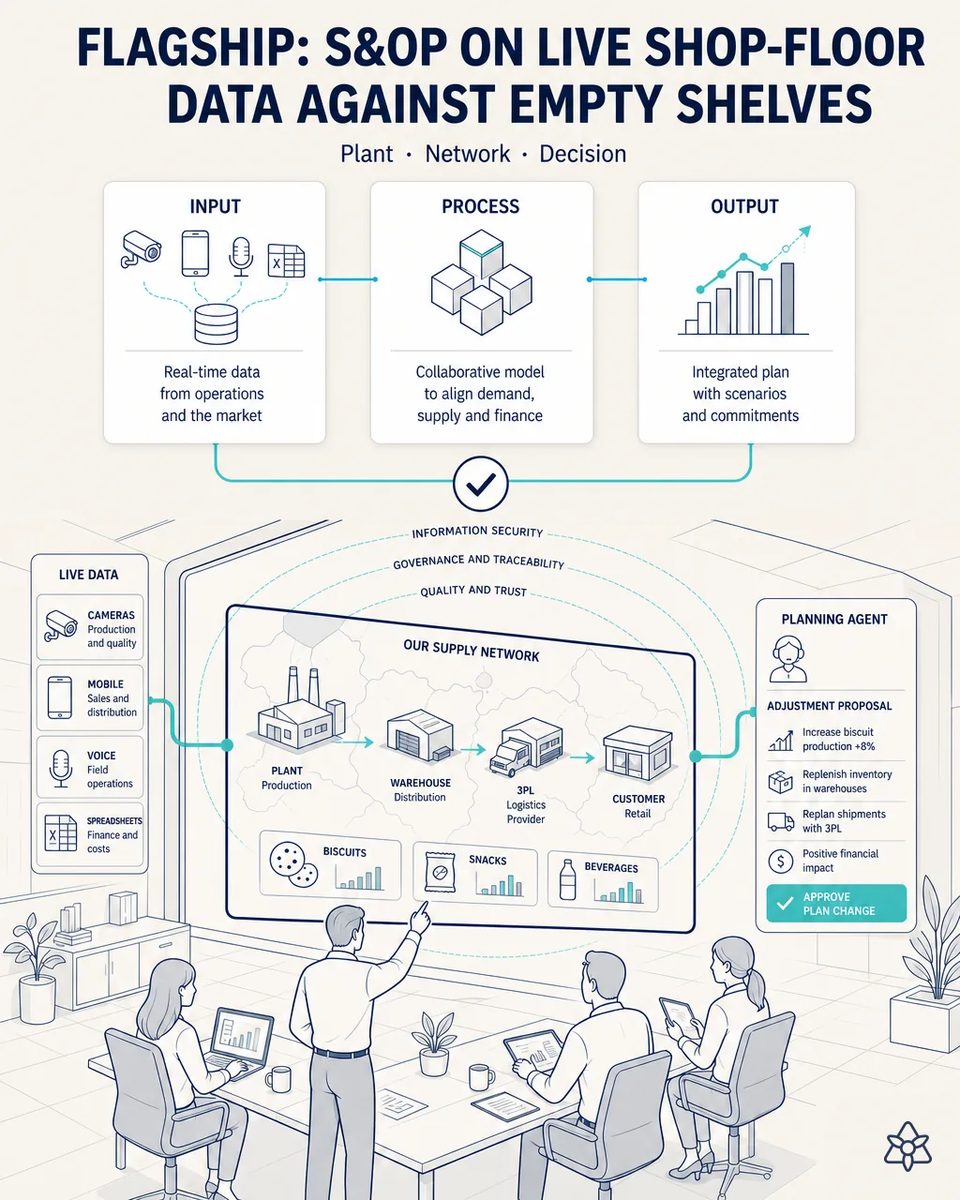
In FMCG food the pain every director mentions is the same: out-of-stocks on the customer's shelf while there is spare inventory elsewhere in the network. S&OP decides every month with data that arrives late and wrong. Edge cameras ensure every pallet and every trailer ships right and leaves evidence. What the plan promises, operations deliver, with three safety rings running in parallel.
Empty shelves at one customer, spare stock at another DC, and an S&OP that sees it a month late.
In FMCG food the pain every director mentions is the same: out-of-stocks on the customer's shelf while there is spare inventory elsewhere in the network. S&OP decides every month with data that arrives late and wrong. Everything we have seen adds up: dock sheets, machine panels, carrier alerts, the warehouse lead's voice, the 3PL spreadsheet and supplier delivery notes reach central memory the same day, validated by people.
- The pain every FMCG food director names is the same: out-of-stocks on the retail shelf while there is spare inventory elsewhere in the network.
- S&OP and IBP decide once a month on data that arrives late and wrong: shipments confirmed hours after they leave, production declared at shift end, 3PL stock a day behind.
- So the plan compensates with safety stock, and still misses OTIF when a carrier fails or a line stops, because nobody sees the deviation until the next cycle.
- The data needed already exists in dock sheets, machine panels, carrier messages, the warehouse lead's voice, 3PL spreadsheets and supplier delivery notes. It just never reaches planning on time, or reaches it as a spreadsheet someone has already summarized.
Agents on live network data — three safety rings feeding a plan people approve.
Edge cameras ensure every pallet and every trailer ships right and leaves evidence. What the plan promises, operations deliver, with three safety rings running in parallel. iLEAN Agents cross-checks those signals with the plan and spots deviations earlier: it proposes reallocating inventory, bringing production forward or changing transport. The planning team approves or corrects; humans in command.
Everything in the previous cases adds up here: the network's signals reach central memory the same day, validated by people, and Edge makes sure every pallet and trailer ships right. Agents cross-checks that reality with the plan and proposes; the planning team approves or corrects. What the plan promises, operations deliver, and the monthly meeting stops spending its first hour arguing about which numbers are right.
What each signal brings to S&OP, and which cases feed it
| Signal into the plan | Cases that feed it | What planning gains |
|---|---|---|
| Real shipments | Dock sheet (1) + trailer check (10) | Goods issued the same hour, not the next day |
| Finished goods produced | Palletizer panel (2) | Production visible pallet by pallet |
| Transport incidents | Carrier alert (3) | Deviations seen while slots can still be saved |
| Warehouse reality | Lead's voice (4) + count validation (5) | Holds and adjustments signed by a person |
| External stock and confirmations | 3PL file (6) + WMS-ERP (8) | 3PL and DC inventory without a day's lag |
| Inputs and outbound quality | Receiving (7) + pallet inspection (9) + evidence pack (11) | Supply risk and rejections in the same picture |
Payback 6-12 months · better OTIF and lower safety stock, estimate to be validated
Impact estimate — to be validated with your numbers.
The block below is an estimate to be validated against your plant's actual data. We put it forward so the committee has an order of magnitude; we refine it during the assessment.
- Estimated payback 6-12 months, to be validated against your network KPIs.
- Better OTIF, because deviations are detected in hours and corrected before the slot or the shelf is lost.
- Less safety stock for the same service level, once the plan stops compensating for data it cannot trust.
- And an S&OP that reacts in hours, not weeks, with proposals to reallocate inventory, bring production forward or change transport that the team approves.
S&OP that reacts in hours, not weeks, better OTIF and less safety stock for the same service level. Estimated payback of six to twelve months, an estimate to be validated against network KPIs.
And the fair question from the production manager
“Isn't this an autonomous planner making decisions over our heads?” — no. Agents cross-checks validated signals with the plan and proposes; every proposal shows its reason and its impact, and the planning team approves or corrects. Detecting that actual shipments, production or 3PL stock deviate from the plan is an anchored task on data people have already validated, where the best models drop below 1.5% error [1]. Humans stay in command of the plan.
[1] OpenAI paper "Why Language Models Hallucinate", 2025 — on the reliability of AI in anchored tasks.
What people ask about running S&OP on live network data
Do we need all twelve cases before S&OP benefits?
No. Each case pays on its own, and planning gains from the first ones: with the dock loading sheet and the 3PL file, shipments and external stock already reach the plan the same day. The rest add precision layer by layer.
Does it replace our IBP or S&OP tool?
No. It feeds the planning tool or the spreadsheet plan you already use with fresher, validated data and flags deviations between cycles. The process, its calendar and its meetings stay yours.
What are the three safety rings in this supply chain flagship?
Capture validated by people at the source, Edge checking that each pallet and trailer ships right, and Agents cross-checking all of it with the plan. They run in parallel, so a gap in one is caught by another.
What kind of proposals does the planning agent make?
Reallocating inventory between DCs, bringing a production run forward or changing a transport, each with the orders affected and the expected effect on service. The team accepts, adjusts or discards, and the reason is stored so the next proposal is better.
Which network KPIs are used to size the return?
OTIF, out-of-stock history, safety stock levels and current chargebacks. With them, the return of each layer is estimated before deciding where to start. Most networks begin where the data arrives latest.
More cases from this series
- The 3PL inventory spreadsheet, straight into the ERPThe 3PL inventory spreadsheet, straight into the ERP. Payback 3-7 months · from N to 1 inventory-module…
- The carrier alert that replans in timeThe carrier alert that replans in time. Payback 3-8 months · reaction to transport incidents from hours…
- Evidence pack for every delivery, ready for audits and disputesEvidence pack for every delivery, ready for audits and disputes. Payback 3-8 months · undue chargebacks…
- Dock loading sheet in the system instantlyDock loading sheet in the system instantly. Payback 4-9 months · shipment confirmation from 4-8 h…
- Inventory count validated before it touches the ERPInventory count validated before it touches the ERP. Payback 4-9 months · inventory adjustments with…
- Every pallet inspected before it shipsEvery pallet inspected before it ships. Payback 4-10 months · customer rejections and damage chargebacks…
Tell us how often your S&OP learns about an out-of-stock after the shelf is already empty.
We work on your plant's real data, not ours. Assessment with no commitment.
Request estimated ROI within 48h ‹ See all cases of supply chain See food industry