The carrier alert that replans in time
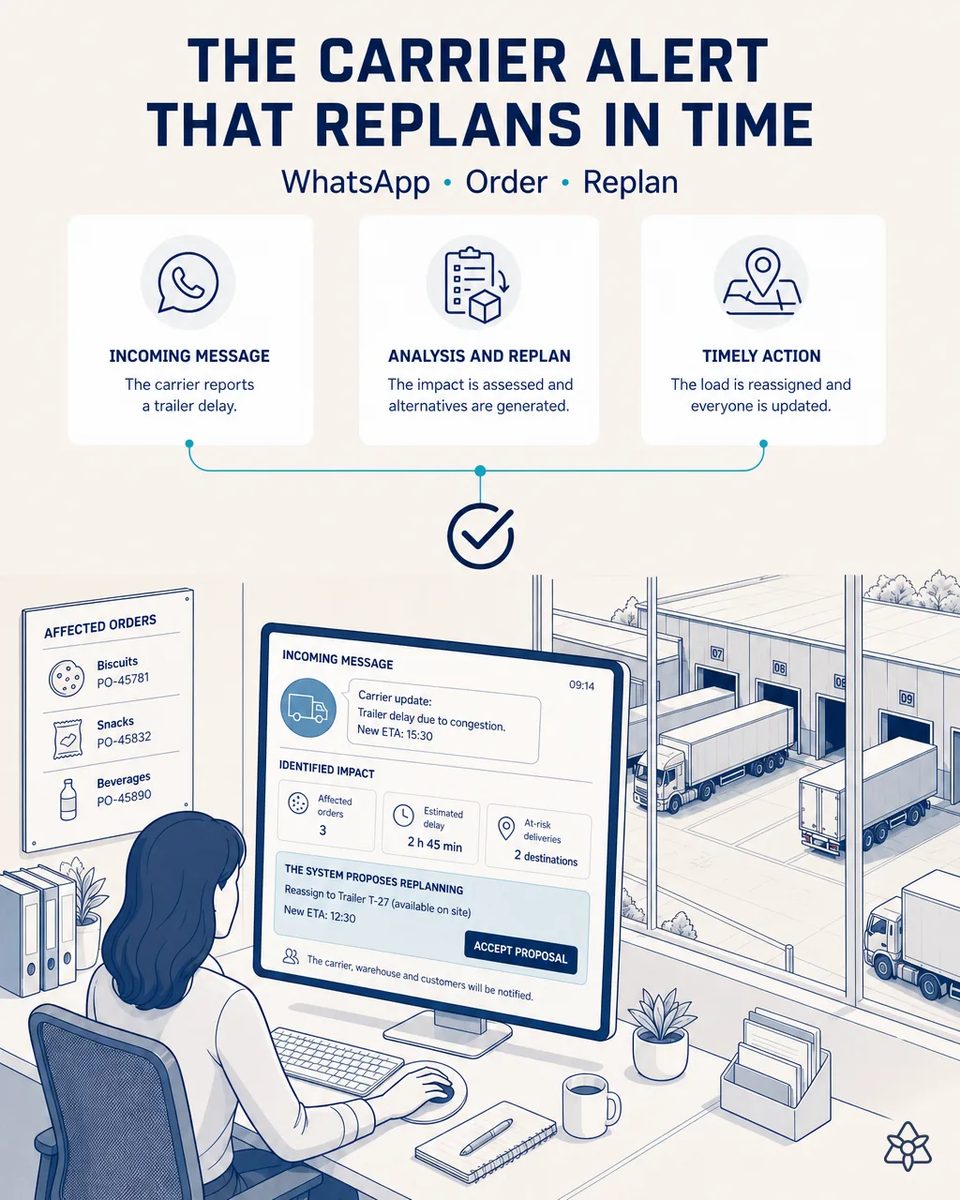
A carrier warns on WhatsApp that the trailer will miss its slot, a retail customer changes an order by email, a packaging supplier delays a delivery. It reaches one person, who reads it when it is already too late. Connect sits in copy on the traffic mailbox and WhatsApp number, around the clock. As soon as a message arrives it extracts the intent, identifies the affected shipment and orders and cross-checks them with the ERP and TMS.
The warning arrived in time. It reached the wrong inbox at the wrong hour.
A carrier warns on WhatsApp that the trailer will miss its slot, a retail customer changes an order by email, a packaging supplier delays a delivery. It reaches one person, who reads it when it is already too late. By the time someone replans, the slot at the customer's distribution center is gone. The result is a late delivery, a fine and an empty shelf.
- A carrier writes on WhatsApp that the trailer will miss its appointment slot, a retail customer changes quantities by email, a packaging supplier pushes a delivery back a day. All of it lands on one person's phone or mailbox.
- Those messages come in free text, buried among a hundred others, often at night or at the weekend, with no order number and no link to the TMS, sometimes as a voice note or a blurry photo of a delivery slip.
- By the time someone reads and replans, the slot at the retail DC is gone: the next free window is tomorrow, the delivery is late and the customer applies its OTIF fine.
- And the cost is not only the fine: it is an empty shelf during a promotion, which is what the commercial team will hear about at the next business review with that retailer.
Connect in silent copy on the traffic mailbox and WhatsApp line — reading around the clock.
Connect sits in copy on the traffic mailbox and WhatsApp number, around the clock. As soon as a message arrives it extracts the intent, identifies the affected shipment and orders and cross-checks them with the ERP and TMS. The system alerts the coordinator with a concrete proposal: switch carrier, bring another order forward, notify the customer. The coordinator decides with one tap; humans in command.
Nobody needs to watch the traffic phone at three in the morning. Every message is read when it arrives, matched to the shipment it affects and turned into a concrete proposal with its consequences. The coordinator still decides; they just decide while there is still a slot to save. Over time, the history of incidents by carrier and route also shows where the network is fragile.
Today's transport incident versus the incident read on arrival
| Aspect | Today | With iLEAN Connect |
|---|---|---|
| Time to react to a trailer delay | Hours, when someone reads it | Minutes, any hour |
| Link to shipment and orders | Searched by hand in the TMS | Identified automatically |
| Messages without an order number | Wait for the person who knows | Matched by plate, carrier and route |
| What the traffic coordinator receives | A raw message | A proposal with its impact |
| Appointment at the retail DC | Lost before anyone reacts | Rebooked or protected in time |
| Who decides the replan | Whoever happens to read it | The coordinator, with one tap |
Payback 3-8 months · reaction to transport incidents from hours to minutes, better OTIF
Impact estimate — to be validated with your numbers.
The block below is an estimate to be validated against your plant's actual data. We put it forward so the committee has an order of magnitude; we refine it during the assessment.
- Estimated payback 3-8 months from avoided OTIF fines and recovered deliveries.
- Reaction to transport incidents goes from hours to minutes, including nights and weekends, when today nobody is reading.
- Deliveries that are lost today because the slot expired are recovered by switching carrier or bringing another order forward.
- And the retail customer is notified before its own receiving team notices the gap, which changes the conversation about the fine and protects the relationship with the account.
Reaction time drops from hours to minutes and deliveries that are lost today are recovered. Estimated payback of three to eight months from avoided fines and better OTIF, an estimate to be validated.
And the fair question from the production manager
“What if it misunderstands a message and replans the wrong order?” — extracting the intent and the shipment from a carrier message and checking them against the TMS is an anchored task, where the best models drop below 1.5% error [1]. And it never replans on its own: it proposes, shows which orders and slots are affected, and the coordinator accepts or discards with one tap. A message it cannot match with confidence is flagged as unmatched, not forced onto a shipment.
[1] OpenAI paper "Why Language Models Hallucinate", 2025 — on the reliability of AI in anchored tasks.
What people ask about reading carrier and retailer alerts
Does it read the coordinators' personal WhatsApp?
No. It sits in copy only on the traffic mailbox and the operational WhatsApp number you designate, the same channels carriers and suppliers already use with your network. What it reads is limited to operational messages about shipments, orders and deliveries.
How does it know which shipment a voice note or a photo refers to?
Voice notes are transcribed and photos read like any message, then matched by plate, carrier, route and time window against the TMS. When there is doubt, it asks the coordinator instead of guessing, and the answer is remembered for the next message from that carrier.
Does it rebook the slot at the retail DC by itself?
No. It proposes the option and prepares the notice, and the coordinator decides whether to rebook, switch carrier or bring another order forward. The confirmation to the retailer goes out only once the coordinator approves it.
Can it rank alerts by the customer's penalty or the promotion at stake?
Yes, if those rules are given to it: a delay on a promotional order for a large account is shown before a routine replenishment that still has slack. Without rules, alerts are ordered by delivery time and the size of the order.
Do carriers have to change how they communicate with our traffic team?
No. They keep writing as they do today. Forcing a portal on dozens of carriers, many of them small owner-operators, is exactly what has failed before.
More cases from this series
- The 3PL inventory spreadsheet, straight into the ERPThe 3PL inventory spreadsheet, straight into the ERP. Payback 3-7 months · from N to 1 inventory-module…
- Evidence pack for every delivery, ready for audits and disputesEvidence pack for every delivery, ready for audits and disputes. Payback 3-8 months · undue chargebacks…
- Dock loading sheet in the system instantlyDock loading sheet in the system instantly. Payback 4-9 months · shipment confirmation from 4-8 h…
- Inventory count validated before it touches the ERPInventory count validated before it touches the ERP. Payback 4-9 months · inventory adjustments with…
- S&OP on live shop-floor data against empty shelvesS&OP on live shop-floor data against empty shelves. Payback 6-12 months · better OTIF and lower safety…
- Every pallet inspected before it shipsEvery pallet inspected before it ships. Payback 4-10 months · customer rejections and damage chargebacks…
Tell us how many retail DC slots you lost last month because a warning was read late.
We work on your plant's real data, not ours. Assessment with no commitment.
Request estimated ROI within 48h ‹ See all cases of supply chain See food industry