Inventory count validated before it touches the ERP
In an FMCG supply chain, inventory is the starting point of the replenishment plan and of S&OP. One wrong adjustment in the ERP spreads everywhere: orders, production, customer promises. The supervisor sees the count summary on a tablet: location, lot, expected and counted quantity, difference highlighted. Two taps to confirm or correct. Only then does the adjustment reach the ERP.
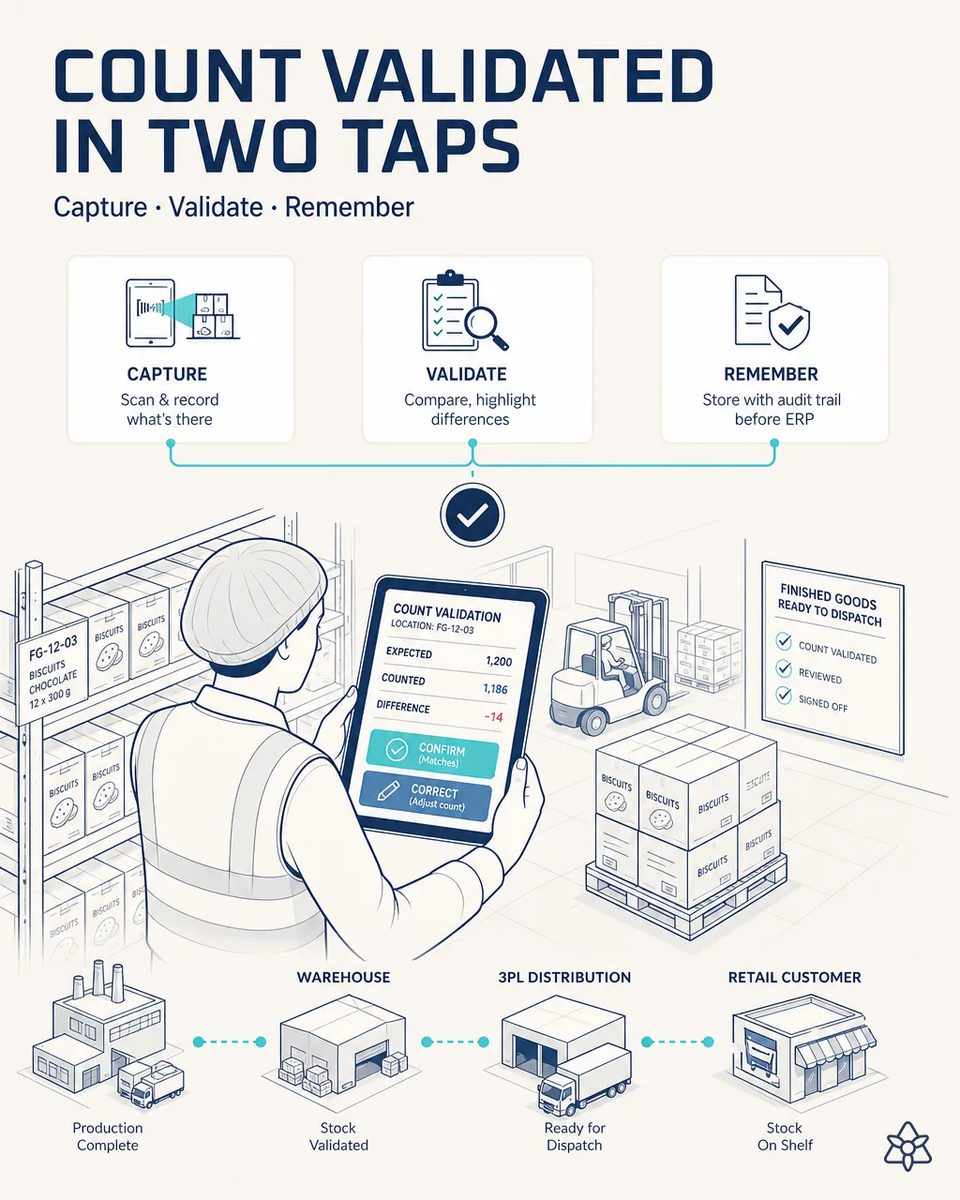
One wrong adjustment travels from the ERP into the whole plan.
In an FMCG supply chain, inventory is the starting point of the replenishment plan and of S&OP. One wrong adjustment in the ERP spreads everywhere: orders, production, customer promises. That is why whatever iLEAN captures, whether a label photo, a voice note or a cycle count, never goes into the ERP on its own. That is the difference with an autonomous agent writing into master data unseen.
- Inventory is where the replenishment plan, the production plan and S&OP start. One wrong adjustment in the ERP becomes a wrong order proposal, a production run nobody needed or a promise to a retail customer that cannot be kept.
- Cycle counts are done under time pressure, between picking waves, and differences are often posted in bulk at the end of the count, with no photo and no reason attached. Nobody can later tell a real loss from a miscount, a mislabeled pallet or stock sitting in the wrong location.
- At month-end the controller chases gaps between the warehouse, the ERP and finance, and has to rebuild which count, which location and which person produced each movement.
- The risk grows as more data is captured automatically: an agent writing adjustments into master data unseen would spread errors faster than any manual process ever did.
Connect with early human verification — two taps before any adjustment is posted.
The supervisor sees the count summary on a tablet: location, lot, expected and counted quantity, difference highlighted. Two taps to confirm or correct. Only then does the adjustment reach the ERP. Every adjustment keeps its photo, its count, who validated it and when. The controller no longer chases differences at month-end: the evidence for every movement is there.
This is the rule behind every case in this matrix, made visible: whatever iLEAN captures, a label photo, a voice note or a cycle count, does not go into the ERP on its own. The supervisor sees the difference highlighted and signs. That two-second gesture is what makes the rest of the network trust the inventory: planners, the controller and the retail customer who receives a promise based on it. It is also what lets an auditor follow every adjustment back to a person.
Today's count adjustment versus the validated adjustment
| Aspect | Today | With iLEAN Connect |
|---|---|---|
| Cycle count difference | Posted in bulk at the end | Shown line by line, highlighted |
| Who approved each adjustment | Unclear afterwards | Name and time recorded |
| Evidence behind an adjustment | None | Photo, count and validation |
| Month-end reconciliation with finance | Days of chasing gaps | Evidence already attached |
| Wrong adjustment spreading to the plan | Discovered at the next S&OP | Stopped before posting |
| Supervisor's effort per count | — | Two taps per difference |
Payback 4-9 months · inventory adjustments with evidence and sign-off, fewer month-end gaps
Impact estimate — to be validated with your numbers.
The block below is an estimate to be validated against your plant's actual data. We put it forward so the committee has an order of magnitude; we refine it during the assessment.
- Estimated payback 4-9 months, to be validated against your history of inventory adjustments.
- Fewer inventory differences, because only reviewed adjustments reach the ERP and each one carries its reason.
- Faster month-end closes: the controller finds the photo, the count and the approver of every movement instead of reconstructing them.
- And a replenishment plan and an S&OP built on inventory the planning team can actually trust, without padding it with extra safety stock to cover for numbers nobody believes.
Fewer inventory differences, faster closes and a plan built on reliable data. Estimated payback of four to nine months, an estimate to be validated against adjustment history.
And the fair question from the production manager
“If a person has to confirm everything, where is the automation?” — the capture and the comparison are automatic; what stays human is the signature. Comparing a counted quantity against the expected one by location and lot is an anchored task, where the best models drop below 1.5% error [1], so the supervisor only looks at the highlighted differences, not at every line. Matching lines are confirmed together, and the person signs only what changes the books. A difference beyond the tolerance you define can also require a recount before it can be signed.
[1] OpenAI paper "Why Language Models Hallucinate", 2025 — on the reliability of AI in anchored tasks.
What people ask about validating cycle counts before the ERP
How long does validating a cycle count take?
Seconds per difference. Lines that match can be confirmed together, so the supervisor's attention goes only to the locations where expected and counted quantities disagree. A typical count of a finished-goods zone is validated in minutes, not in an afternoon.
Can the system post an inventory adjustment without anyone confirming?
No, and that is the design choice. Nothing captured by iLEAN writes to inventory in the ERP until a person has seen it and signed. That holds for counts, labels, voice notes and spreadsheets alike.
What is kept for each adjustment?
The photo or capture, the expected and counted quantity, the lot and location, who validated it and when. That is what the controller and the external auditor ask for, and it is ready without anyone rebuilding it.
Does it apply to counts done at the 3PL too?
Yes. External warehouses can feed counts through the same validation, so differences at the logistics provider follow the same rule as those at the plant. The network's inventory gets one standard of evidence, wherever the stock sits.
Does a corrected count teach the system anything?
Yes. Every corrected value is stored with its context, which helps spot recurring causes such as a location that is always miscounted or two pack sizes that get confused. Those causes are fixed at the source instead of corrected every month.
More cases from this series
- The 3PL inventory spreadsheet, straight into the ERPThe 3PL inventory spreadsheet, straight into the ERP. Payback 3-7 months · from N to 1 inventory-module…
- The carrier alert that replans in timeThe carrier alert that replans in time. Payback 3-8 months · reaction to transport incidents from hours…
- Evidence pack for every delivery, ready for audits and disputesEvidence pack for every delivery, ready for audits and disputes. Payback 3-8 months · undue chargebacks…
- Dock loading sheet in the system instantlyDock loading sheet in the system instantly. Payback 4-9 months · shipment confirmation from 4-8 h…
- S&OP on live shop-floor data against empty shelvesS&OP on live shop-floor data against empty shelves. Payback 6-12 months · better OTIF and lower safety…
- Every pallet inspected before it shipsEvery pallet inspected before it ships. Payback 4-10 months · customer rejections and damage chargebacks…
Tell us how many inventory adjustments you post per month without a photo or a reason.
We work on your plant's real data, not ours. Assessment with no commitment.
Request estimated ROI within 48h ‹ See all cases of supply chain See food industry