Dock loading sheet in the system instantly
At the dock of an FMCG food plant, every trailer is still closed out on a paper sheet: pallets, lots, seal, plates, departure time. That sheet is the truth of what left the plant. With iLEAN Connect the dock supervisor takes a photo of the sheet when the trailer is closed. The system recognizes the structure, extracts pallets, lots and seal, and stores them in central memory in seconds, with no change to the routine.
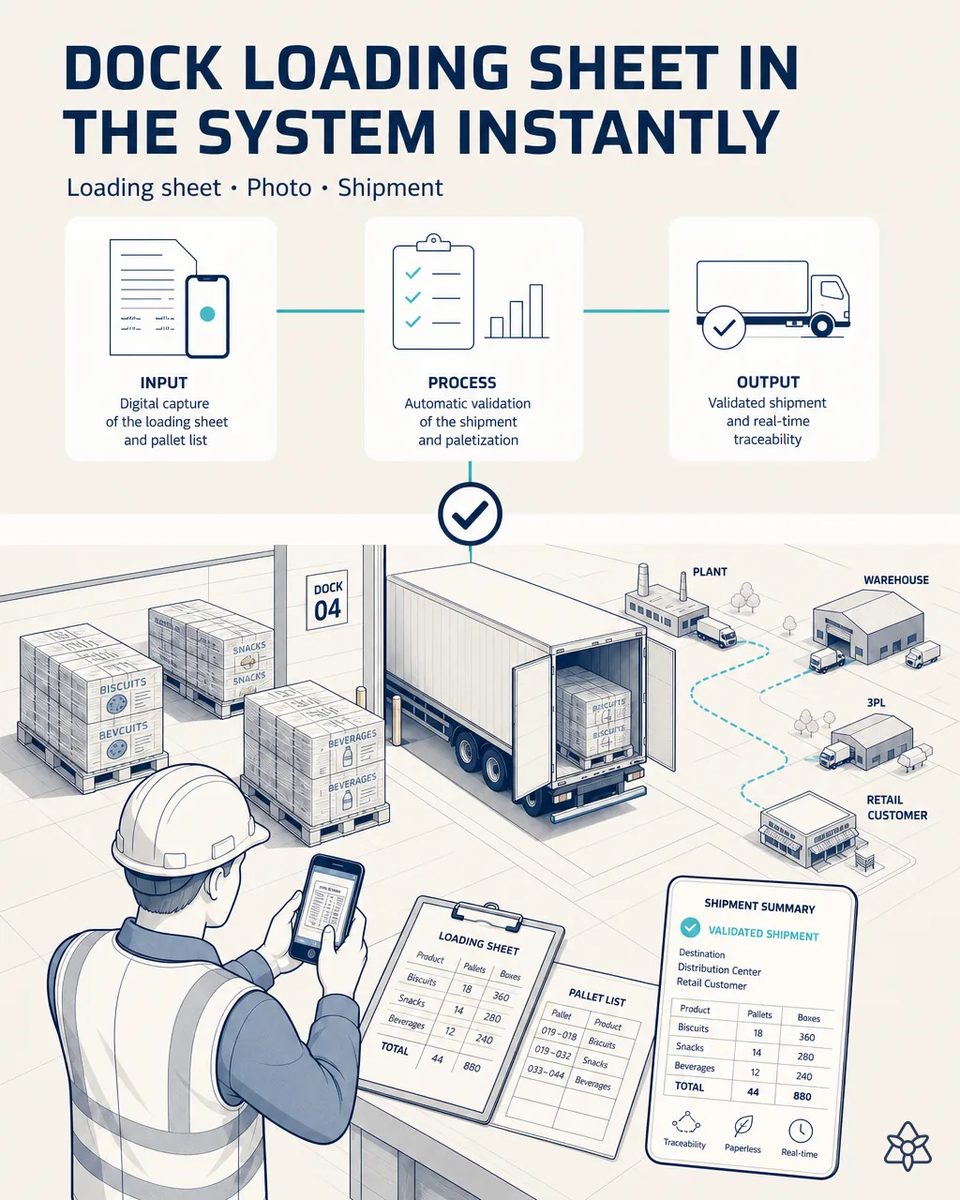
The truth of what shipped spends half a shift on a clipboard.
At the dock of an FMCG food plant, every trailer is still closed out on a paper sheet: pallets, lots, seal, plates, departure time. That sheet is the truth of what left the plant. The problem is that this truth takes four to eight hours to reach the system. Someone keys it in at the end of the shift, with errors, while inventory, planning and the customer work with stale data.
- Every trailer leaving the plant is closed out by hand: pallet count, lot numbers, seal number, license plates and departure time. That sheet, not the ERP, is the real record of the goods issue.
- It reaches the system four to eight hours later, keyed in by someone at shift close who never saw the trailer and has to decipher handwriting, crossed-out lots and a seal number written in a hurry.
- Meanwhile finished-goods inventory still shows pallets that are already on the road, so the planner promises stock that is gone and customer service cannot confirm a shipment the retail DC is already asking about.
- When a lot is questioned weeks later, the only proof of which trailer carried it is a sheet in a binder at the dock office, filed by date if you are lucky, and pulling it out means someone walking to the dock with a phone to photograph it anyway.
Connect in photo mode — the dock supervisor closes the trailer exactly as before.
With iLEAN Connect the dock supervisor takes a photo of the sheet when the trailer is closed. The system recognizes the structure, extracts pallets, lots and seal, and stores them in central memory in seconds, with no change to the routine. Nothing reaches the ERP without the supervisor seeing it first: two taps on the phone to confirm, and only then is the shipment posted. AI assists, the person signs.
The loading sheet already holds everything the network needs to know about a shipment; it just arrives half a shift late. One photo at trailer close turns it into a goods issue that the planner, customer service and the retail customer can rely on within minutes. The supervisor signs as always, with two taps instead of a pen.
The loading sheet in a binder versus the loading sheet in the system
| Aspect | Today | With iLEAN Connect |
|---|---|---|
| Shipment confirmation | 4-8 h after the trailer leaves | Minutes after trailer close |
| Lots and seal number per trailer | Handwritten, keyed in at shift close | Extracted and tied to the shipment |
| Finished-goods stock after dispatch | Still shows pallets on the road | Drops when the trailer is confirmed |
| What customer service tells the retail DC | An answer from memory | Confirmed lots, seal and departure time |
| Proof of which trailer carried a lot | A binder at the dock office | One query by lot or seal |
| Dock supervisor's routine | — | Same sheet, one photo, two taps |
Payback 4-9 months · shipment confirmation from 4-8 h latency to minutes
Impact estimate — to be validated with your numbers.
The block below is an estimate to be validated against your plant's actual data. We put it forward so the committee has an order of magnitude; we refine it during the assessment.
- Estimated payback 4-9 months, to be validated against the plant's daily shipment volume and the number of people keying loading sheets today.
- Shipment confirmation goes from 4-8 hours of latency to minutes, so the goods issue is posted while the trailer is still on the plant's access road.
- End-of-shift keying disappears, along with the transcription errors on lots and seal numbers that otherwise surface weeks later in a complaint.
- And the planner sees real finished-goods inventory, not the stock that was there before the last six trailers left the dock.
Shipment confirmation goes from hours to minutes, end-of-shift keying disappears and the planner sees real inventory. Estimated payback of four to nine months, an estimate to be validated against the plant's shipment volume.
And the fair question from the production manager
“What if it misreads a lot number or the seal?” — reading fields from a loading sheet whose layout the plant itself designed is an anchored task, where the best models drop below 1.5% error [1]. And there is a second net: nothing is posted until the dock supervisor sees the summary on the phone and confirms it with two taps, and the pallet count is cross-checked against the shipment order before it is even offered for confirmation.
[1] OpenAI paper "Why Language Models Hallucinate", 2025 — on the reliability of AI in anchored tasks.
What people ask about photographing the dock loading sheet
Do we have to redesign the loading sheet our docks use?
No. The model learns the sheet your plant already prints or fills in by hand, including crossed-out lots and the seal number written in a corner. Redesigning it would only add friction at the dock, and the sheet would drift back to the old habit within weeks.
Who takes the photo of the loading sheet, and when exactly?
The dock supervisor, at the moment the trailer door is closed and sealed. That is when the sheet reflects what actually left, and it is the same moment they already sign it today.
Is the shipment posted to the ERP automatically?
Only after the supervisor confirms the summary on the phone. AI extracts and checks against the shipment order; the person signs, and only then is the goods issue posted.
What if one trailer carries pallets for several retail orders?
Each line on the sheet is matched to its order and delivery, so a mixed trailer becomes one shipment with several confirmed deliveries instead of a page someone has to split by hand.
Does it work across plants with different loading sheet layouts?
Yes. Each layout is learned once, and every plant's shipments land in the same central memory, which is what the network planner actually needs to see. Differences between plants in how sheets are filled become visible too.
More cases from this series
- The 3PL inventory spreadsheet, straight into the ERPThe 3PL inventory spreadsheet, straight into the ERP. Payback 3-7 months · from N to 1 inventory-module…
- The carrier alert that replans in timeThe carrier alert that replans in time. Payback 3-8 months · reaction to transport incidents from hours…
- Evidence pack for every delivery, ready for audits and disputesEvidence pack for every delivery, ready for audits and disputes. Payback 3-8 months · undue chargebacks…
- Inventory count validated before it touches the ERPInventory count validated before it touches the ERP. Payback 4-9 months · inventory adjustments with…
- S&OP on live shop-floor data against empty shelvesS&OP on live shop-floor data against empty shelves. Payback 6-12 months · better OTIF and lower safety…
- Every pallet inspected before it shipsEvery pallet inspected before it ships. Payback 4-10 months · customer rejections and damage chargebacks…
Tell us how many hours a trailer takes to exist in your ERP after it leaves the dock.
We work on your plant's real data, not ours. Assessment with no commitment.
Request estimated ROI within 48h ‹ See all cases of supply chain See food industry