Every pallet inspected before it ships
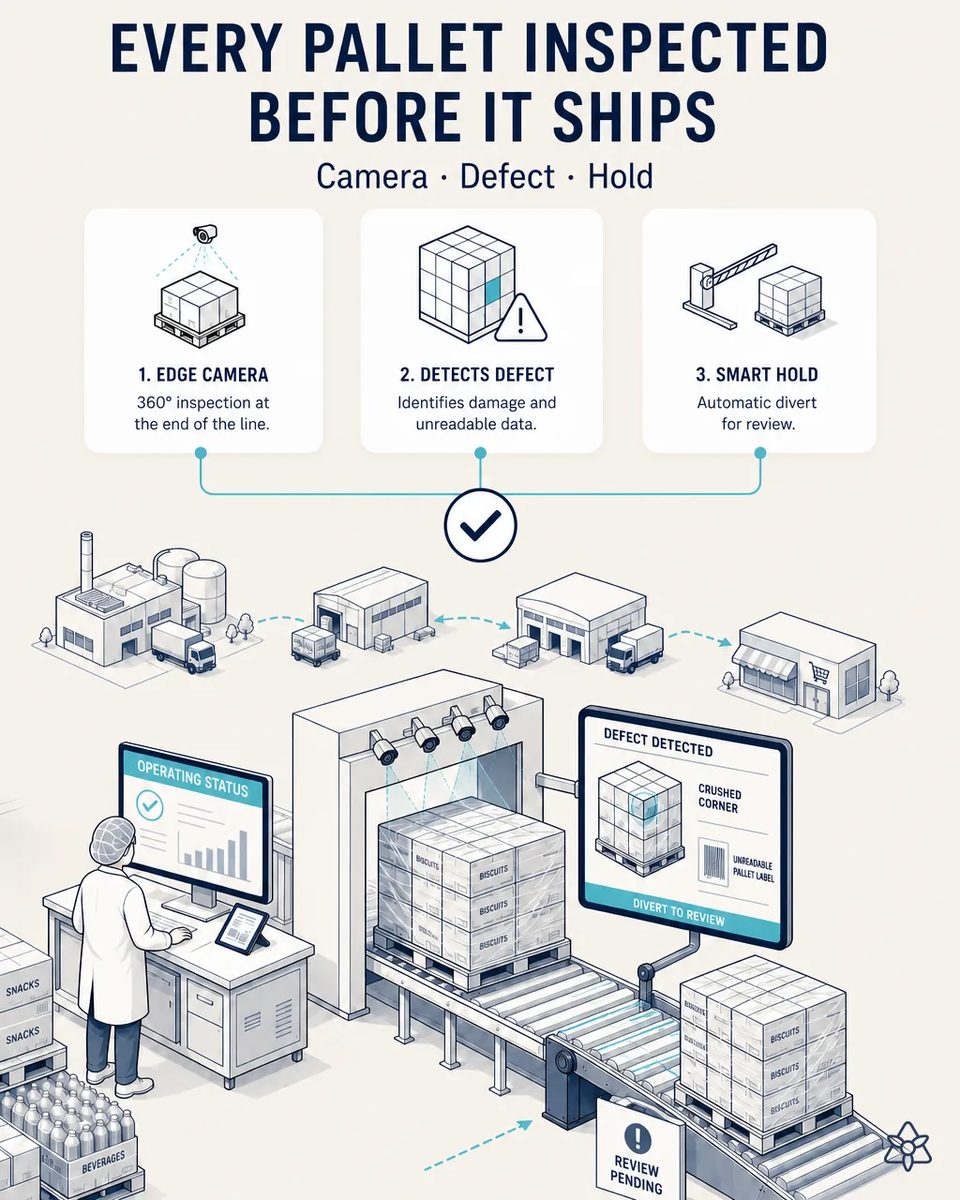
Large grocery customers reject or fine pallets with crushed cases, torn film, out-of-spec height or an unreadable logistics label. Every rejection is a wasted trip, a chargeback and an empty shelf. iLEAN places Edge cameras at a pallet pass-through point. A model trained on this plant's good and bad pallets detects damaged cases, torn film, height and unreadable labels in milliseconds.
The retail DC inspects every pallet. The plant does not have time to.
Large grocery customers reject or fine pallets with crushed cases, torn film, out-of-spec height or an unreadable logistics label. Every rejection is a wasted trip, a chargeback and an empty shelf. At the pace of a palletizing line nobody checks every face of every pallet. Defects are found at the customer's distribution center, when it is too late.
- Large grocery customers reject or charge back pallets with crushed cases, torn film, out-of-spec height or an unreadable logistics label at their receiving dock.
- Every rejection is a wasted trip, a deduction on the next invoice and, worst of all, an empty shelf the retailer blames on the supplier.
- At the pace of a palletizing line nobody checks every face of every pallet, and the operator at the wrapper is watching the machine, not the load. A fork strike on a lower corner or a label printed over the stretch film goes out unnoticed, and so does a pallet that leans after a hard stop on the conveyor.
- The defect is found at the customer's distribution center, hundreds of miles away, when there is nothing left to do but pay, and the plant has no image to prove the pallet left intact.
Edge at the pallet pass-through — every face inspected in milliseconds.
iLEAN places Edge cameras at a pallet pass-through point. A model trained on this plant's good and bad pallets detects damaged cases, torn film, height and unreadable labels in milliseconds. If there is a defect, the pallet is diverted to review and the operator decides: rework, relabel or release with a reason. The camera sees, the person decides.
The plant finally sees each pallet the way the retail DC will see it, but before it leaves. The camera does not decide the fate of the pallet: it diverts it, and the operator chooses between rework, relabel or release with a reason. Every decision is stored, and that record is also the plant's defense in a dispute. Over weeks, the defect history also points to the cause upstream: a wrapper setting, a pallet pattern or a forklift route that keeps hitting the same corner.
Outbound pallets checked by eye versus pallets inspected by Edge
| Aspect | Today | With iLEAN Edge |
|---|---|---|
| Faces checked per outbound pallet | One, if any | All, at line pace |
| Crushed cases and torn film | Found at the retail DC | Detected before loading |
| Pallet height out of spec | Measured occasionally | Checked on every pallet |
| Unreadable logistics label | Rejected at receiving | Diverted to relabel |
| Decision on a defective pallet | Nobody sees it | Operator: rework, relabel or release |
| Evidence of how the pallet left | None | Image stored per pallet |
Payback 4-10 months · customer rejections and damage chargebacks down ≥30%
Impact estimate — to be validated with your numbers.
The block below is an estimate to be validated against your plant's actual data. We put it forward so the committee has an order of magnitude; we refine it during the assessment.
- Estimated payback 4-10 months, to be validated against your rejection and chargeback history by retail account.
- Estimated reduction of at least 30% in customer rejections and damage chargebacks.
- Fewer returns and wasted trips, and fewer empty shelves blamed on the plant during a promotion, when a rejected pallet hurts the most.
- And an image of every outbound pallet, which turns a disputed damage claim into a question of evidence instead of goodwill.
Estimated reduction of at least thirty percent in rejections and damage chargebacks, and fewer returns. Estimated payback of four to ten months, an estimate to be validated against rejection history.
And the fair question from the production manager
“What if it diverts good pallets and slows the line?” — classifying a known set of defects (crushed corner, torn film, height, unreadable label) on this plant's own pallets is an anchored task, where the best models drop below 1.5% error [1]. The model is trained on your good and bad pallets under that point's lighting, a diverted pallet goes to a review lane without stopping the conveyor, and the operator's decision feeds back into training. The divert threshold is tuned with your team during the first weeks.
[1] OpenAI paper "Why Language Models Hallucinate", 2025 — on the reliability of AI in anchored tasks.
What people ask about inspecting finished-goods pallets at dispatch
Where are the pallet inspection cameras placed?
At a pass-through point after stretch wrapping and labeling, usually an arch over the conveyor or the exit of the wrapper, so every face and the label are seen before the pallet is staged for loading. Installing it does not require stopping the line for more than a short planned window.
Does it read the logistics label or just check that it is there?
It checks that the label is present, in the right place and readable, and can read the SSCC to tie each image to its shipment. A label that fails here would fail at the retailer's scanner too.
How many pallets are needed to train the model?
Fewer than expected, because the defect catalog is short: a few hundred good and bad pallets of your own formats is usually where it starts. Every operator decision after go-live keeps improving it.
Do the pallet images go to the cloud?
Inference is local at the line and resolves in milliseconds. Only the images of diverted pallets and the evidence per shipment are stored centrally. The line does not depend on the plant network or the internet to keep inspecting.
Can the images be used in a retail chargeback dispute?
Yes, and that is a large part of the value: an image of the pallet leaving intact, with time and shipment, is what the retailer's claim is answered with. The evidence pack case files it with the rest of the shipment.
More cases from this series
- The 3PL inventory spreadsheet, straight into the ERPThe 3PL inventory spreadsheet, straight into the ERP. Payback 3-7 months · from N to 1 inventory-module…
- The carrier alert that replans in timeThe carrier alert that replans in time. Payback 3-8 months · reaction to transport incidents from hours…
- Evidence pack for every delivery, ready for audits and disputesEvidence pack for every delivery, ready for audits and disputes. Payback 3-8 months · undue chargebacks…
- Dock loading sheet in the system instantlyDock loading sheet in the system instantly. Payback 4-9 months · shipment confirmation from 4-8 h…
- Inventory count validated before it touches the ERPInventory count validated before it touches the ERP. Payback 4-9 months · inventory adjustments with…
- S&OP on live shop-floor data against empty shelvesS&OP on live shop-floor data against empty shelves. Payback 6-12 months · better OTIF and lower safety…
Tell us how many pallets retail customers rejected or charged back last quarter.
We work on your plant's real data, not ours. Assessment with no commitment.
Request estimated ROI within 48h ‹ See all cases of supply chain See food industry