The warehouse lead talks to AI while walking
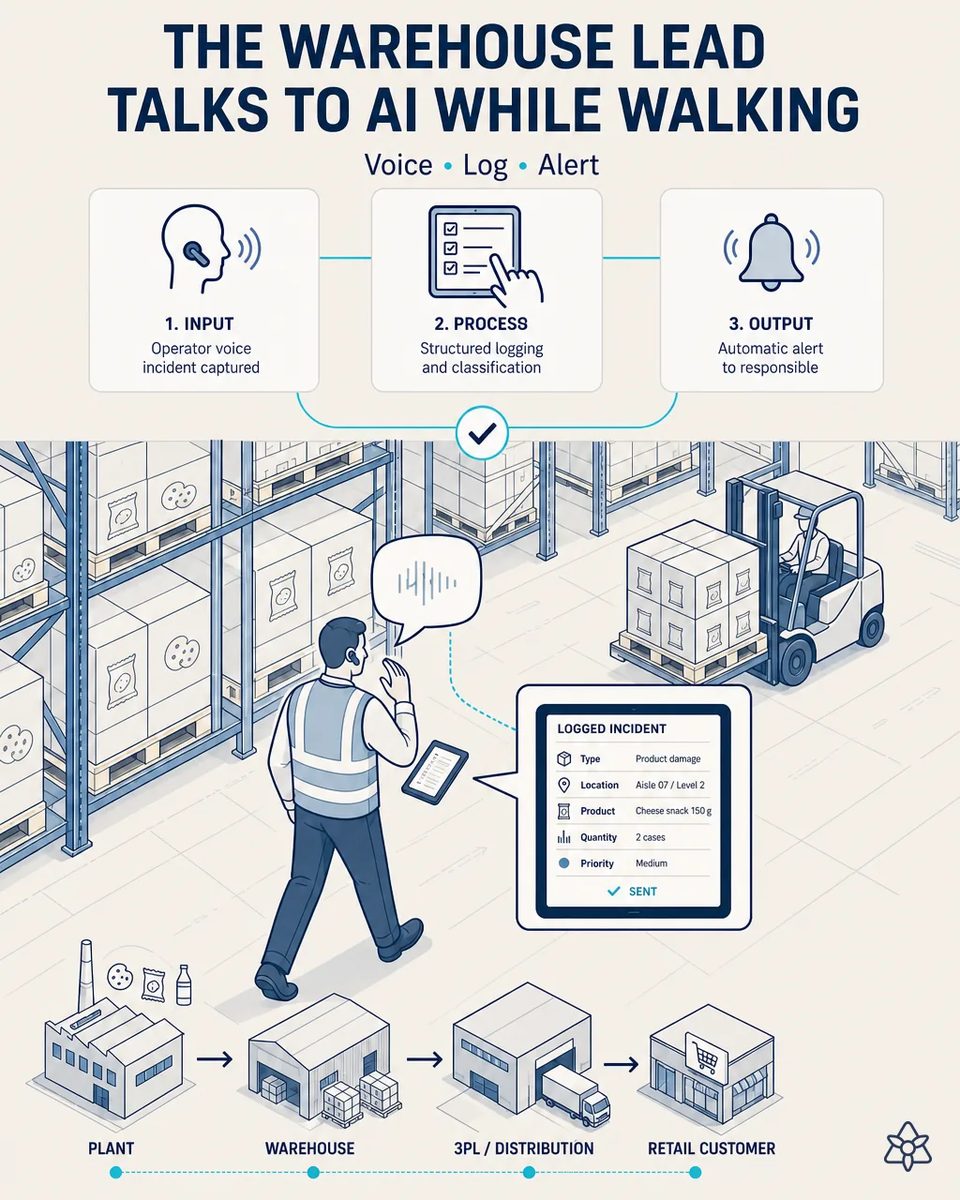
The warehouse lead covers racks, docks and the yard all shift with busy hands. They know which pallet is damaged, which location is blocked, which load is late, but cannot type it. With a Bluetooth earpiece and iLEAN Connect in voice mode, they speak while walking: note that rack twelve has three pallets with torn film. The system listens, structures and logs the incident with location and time.
The warehouse lead knows where the network is leaking. Nobody else does by the next shift.
The warehouse lead covers racks, docks and the yard all shift with busy hands. They know which pallet is damaged, which location is blocked, which load is late, but cannot type it. That knowledge stays in their head or in a chat group. The next shift starts without it and the same problems are discovered twice.
- The lead crosses racks, docks and the yard all shift with a scanner in one hand and a radio in the other. They see the pallet with torn film, the blocked location, the load that has not been picked yet.
- None of it gets typed, because stopping to write means stopping the round. It stays in their head, in a radio call or in a chat group that scrolls away within the hour.
- The next shift starts blind: the same damaged pallets are found again, the blocked location is discovered when a forklift arrives, and the late load surprises the dock when the trailer is already waiting.
- For quality the delay matters most: a damaged food pallet that is not put on hold in time can still be picked into a retail order and travel to the customer, where it comes back as a rejection or a chargeback.
Connect in voice mode — the lead talks while walking and confirms by voice.
With a Bluetooth earpiece and iLEAN Connect in voice mode, they speak while walking: note that rack twelve has three pallets with torn film. The system listens, structures and logs the incident with location and time. iLEAN replies on the spot: quality has been notified and those lots are on hold in the ERP pending your confirmation. They confirm by voice; the decision stays theirs.
The lead already says all of this out loud, to a colleague or on the radio. The change is that iLEAN listens, structures it with location and time, notifies the right person and asks for confirmation before anything changes in the ERP. The round does not slow down and the knowledge stops evaporating at shift change. The night shift finally knows what the afternoon shift saw.
The shift round on the radio versus the round logged by voice
| Aspect | Today | With iLEAN Connect |
|---|---|---|
| Damaged pallet spotted on the round | Mentioned on the radio | Logged with rack, lot and time |
| Quality hold on affected lots | When someone remembers | Proposed on the spot, confirmed by voice |
| Blocked rack location | Found again by the next forklift | Flagged to the WMS team |
| Handover between warehouse shifts | Partial, from memory | Complete list of open incidents |
| Time spent hunting for information | Calls and chat scrolling | One query by location or lot |
| The warehouse lead's hands | Busy and staying busy | Still busy: nothing to type |
Payback 4-9 months · warehouse incidents logged on the spot, nothing lost between shifts
Impact estimate — to be validated with your numbers.
The block below is an estimate to be validated against your plant's actual data. We put it forward so the committee has an order of magnitude; we refine it during the assessment.
- Estimated payback 4-9 months, mostly from recovered time and incidents that stop being discovered twice.
- Warehouse incidents logged on the spot, with location and time, instead of reconstructed at the end of the shift.
- Complete shift handovers: the next lead starts with the list of open incidents, not with a blank page and a chat history to scroll through.
- And less time hunting for information across radios, chat groups and phone calls, which in a busy finished-goods warehouse adds up to hours a week.
Incidents logged in the moment, complete shift handovers and less time hunting for information. Estimated payback of four to nine months, an estimate to be validated.
And the fair question from the production manager
“Will it understand rack numbers and lot codes in the middle of forklift noise?” — turning a short dictated note into fields such as rack, quantity and defect is an anchored task, where the best models drop below 1.5% error [1]. And the lead hears back what was understood before anything happens: the hold on those lots is proposed, not applied, until they confirm by voice.
[1] OpenAI paper "Why Language Models Hallucinate", 2025 — on the reliability of AI in anchored tasks.
What people ask about voice logging in the finished-goods warehouse
Does it work with forklift horns, reversing beepers and dock doors?
Yes, with an earpiece that has a noise-canceling microphone, the kind already used with radios. The model is also tuned to your warehouse vocabulary: rack names, product families, pack formats and defect types.
What does the warehouse lead hear back after dictating?
A short confirmation of what was logged and what will happen next, for example that quality has been notified and those lots are pending hold. One word confirms or corrects, and the lead keeps walking without looking at a screen.
Can it put lots on hold in the ERP?
It prepares the hold and asks for confirmation. The decision stays with the lead, and the change is posted only after they confirm. Quality receives the incident with the rack, the lots and the time, so the hold can be lifted just as quickly if the damage is cosmetic.
Is everything the lead says on shift recorded?
No. It only listens after an activation word, so radio chatter and conversations with the team stay out of the record. Only the structured incident and the confirmation are stored.
What gets dictated most once it is in place?
Damaged pallets, blocked locations, late or incomplete loads and short picks. Within weeks the pattern of recurring problems by aisle and shift becomes visible, which is what the warehouse manager needs to fix racking, damage at put-away or a recurring late load.
More cases from this series
- The 3PL inventory spreadsheet, straight into the ERPThe 3PL inventory spreadsheet, straight into the ERP. Payback 3-7 months · from N to 1 inventory-module…
- The carrier alert that replans in timeThe carrier alert that replans in time. Payback 3-8 months · reaction to transport incidents from hours…
- Evidence pack for every delivery, ready for audits and disputesEvidence pack for every delivery, ready for audits and disputes. Payback 3-8 months · undue chargebacks…
- Dock loading sheet in the system instantlyDock loading sheet in the system instantly. Payback 4-9 months · shipment confirmation from 4-8 h…
- Inventory count validated before it touches the ERPInventory count validated before it touches the ERP. Payback 4-9 months · inventory adjustments with…
- S&OP on live shop-floor data against empty shelvesS&OP on live shop-floor data against empty shelves. Payback 6-12 months · better OTIF and lower safety…
Tell us how many incidents your warehouse lead passes on by radio in a single shift.
We work on your plant's real data, not ours. Assessment with no commitment.
Request estimated ROI within 48h ‹ See all cases of supply chain See food industry