Trailer validated before loading
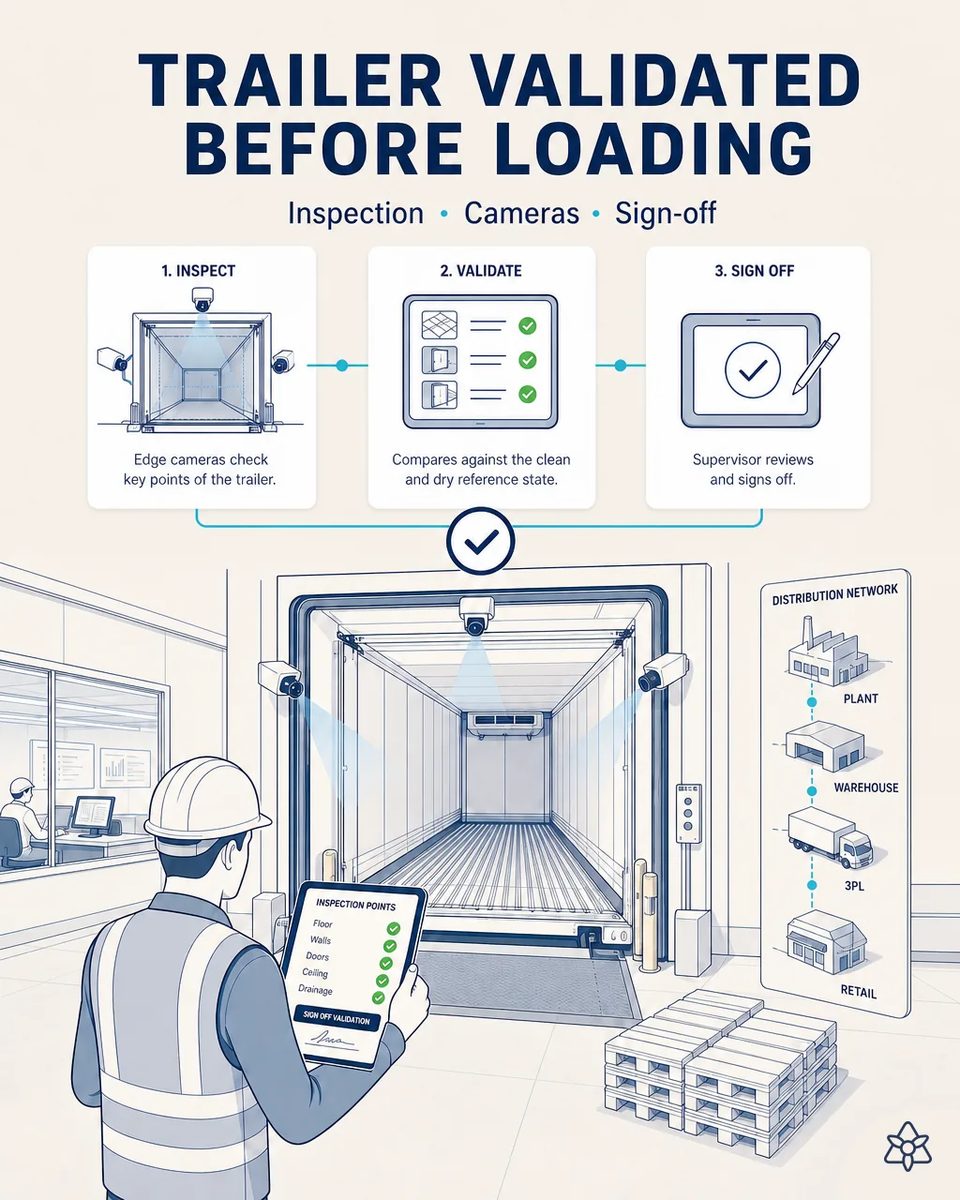
Before loading food, the trailer box must be clean, dry, odor-free, undamaged and at the right temperature. And when it is closed, the load must match the order exactly. iLEAN installs Edge cameras on the dock frame that compare the trailer with its reference state and count the pallets loaded against the order. It is Jidoka AI applied to logistics.
The trailer checklist is signed. The trailer was never really checked.
Before loading food, the trailer box must be clean, dry, odor-free, undamaged and at the right temperature. And when it is closed, the load must match the order exactly. Inspection is a paper checklist signed in a hurry. If the trailer was unfit or the load was wrong, it is discovered at destination: full rejection and a wasted trip.
- Before loading food, the trailer box has to be clean, dry, odor-free, undamaged and at the right temperature. When it is closed, the load has to match the order exactly.
- Today that is a paper checklist signed in a hurry, at night or in the rain, while the driver waits and the next trailer is already backing in. Nobody climbs in to check the ceiling or the drainage.
- If the trailer was unfit or a pallet was left behind, it is discovered at destination: full rejection, a wasted trip and the whole load to bring back, with the shelf at the retailer empty in the meantime.
- And when a retailer or an auditor asks how the trailer was checked, the answer is a ticked box with no evidence behind it, signed by someone who had three other trailers waiting.
Edge on the dock frame with JIDOKA AI — no seal without OK and a signature.
iLEAN installs Edge cameras on the dock frame that compare the trailer with its reference state and count the pallets loaded against the order. It is Jidoka AI applied to logistics. The trailer is not released until the cameras give OK and the shipping supervisor signs on the tablet. If something fails, the system says what and where, and the person decides.
Jidoka applied to logistics: the trailer does not leave until the cameras give OK and the shipping supervisor signs. If something fails, the system says what and where, so the decision is quick and informed. The person still decides; they just decide on evidence. And the photos of each trailer, before loading and before sealing, are stored with the shipment, ready for the evidence pack if a retailer or an auditor asks how the load left the plant.
The paper trailer checklist versus the camera-checked trailer
| Aspect | Today | With iLEAN Edge |
|---|---|---|
| Trailer box condition | Ticked on paper | Compared with its reference state |
| Pallets loaded against the order | Counted from memory | Counted by camera before sealing |
| Trailer unfit for food | Found at destination | Stopped at the dock |
| Missing or extra pallet in the trailer | Discovered by the customer | Flagged before the door closes |
| Evidence per trailer shipped | A signature | Photos and the supervisor's sign-off |
| Trailer release decision | Under time pressure | Supervisor, on the tablet |
Payback 4-9 months · no loads in unfit trailers, correct load verified before sealing
Impact estimate — to be validated with your numbers.
The block below is an estimate to be validated against your plant's actual data. We put it forward so the committee has an order of magnitude; we refine it during the assessment.
- Estimated payback 4-9 months, depending on trailers per day and on current rejections at destination for trailer or load reasons.
- Rejections from unfit trailers or wrong loads practically eliminated, together with the return freight and the rework of a full load.
- Photo evidence for every shipment: trailer condition before loading and load count before sealing, stored with the shipment for as long as you need it.
- And a trailer inspection record that holds up in front of a retail customer or a food safety auditor.
Rejections from unfit trailers or wrong loads practically eliminated, with photo evidence for every shipment. Estimated payback of four to nine months, an estimate to be validated.
And the fair question from the production manager
“What if the camera blocks a trailer that was fine and the driver waits?” — comparing a trailer box with its reference state and counting pallets against an order is an anchored task, where the best models drop below 1.5% error [1]. When something fails, the system shows what and where, and the shipping supervisor decides on the tablet: clean, reject the trailer or release with a reason. It stops on a visible discrepancy, not on doubt. The check itself takes seconds while the dock plate is lowered, so a fit trailer is not delayed.
[1] OpenAI paper "Why Language Models Hallucinate", 2025 — on the reliability of AI in anchored tasks.
What people ask about checking trailers at the loading dock
What does the camera check inside the trailer box?
Floor, walls, doors, ceiling and drainage against the clean and dry reference state: residues, moisture, damage and anything that should not be there. The points are agreed with your quality team at commissioning.
Does it check the reefer temperature before loading?
If the reefer display or a dock probe is visible to the camera, the reading is captured with the inspection and checked against the setpoint before release. If neither is visible, the supervisor records the reading on the tablet as part of the sign-off.
How does it count the pallets loaded into the trailer?
The dock frame camera counts pallets as they enter the trailer and compares the total with the order before the door is closed and the seal is applied. A missing pallet is found while it is still a few yards away on the dock.
Does it replace the shipping supervisor's signature?
No. The signature stays; what changes is that it is given on photos and a count, not on a ticked box. The release stays a human decision, now with evidence attached.
Does it work with trailers from many different carriers?
Yes. The reference is the clean, empty box, not a specific trailer, so it works across carriers once each trailer type has been learned. Refrigerated and dry vans are handled as separate references.
More cases from this series
- The 3PL inventory spreadsheet, straight into the ERPThe 3PL inventory spreadsheet, straight into the ERP. Payback 3-7 months · from N to 1 inventory-module…
- The carrier alert that replans in timeThe carrier alert that replans in time. Payback 3-8 months · reaction to transport incidents from hours…
- Evidence pack for every delivery, ready for audits and disputesEvidence pack for every delivery, ready for audits and disputes. Payback 3-8 months · undue chargebacks…
- Dock loading sheet in the system instantlyDock loading sheet in the system instantly. Payback 4-9 months · shipment confirmation from 4-8 h…
- Inventory count validated before it touches the ERPInventory count validated before it touches the ERP. Payback 4-9 months · inventory adjustments with…
- S&OP on live shop-floor data against empty shelvesS&OP on live shop-floor data against empty shelves. Payback 6-12 months · better OTIF and lower safety…
Tell us how many loads were rejected at destination last year because of the trailer.
We work on your plant's real data, not ours. Assessment with no commitment.
Request estimated ROI within 48h ‹ See all cases of supply chain See food industry