Supplier delivery note and lot labels into the ERP with one photo
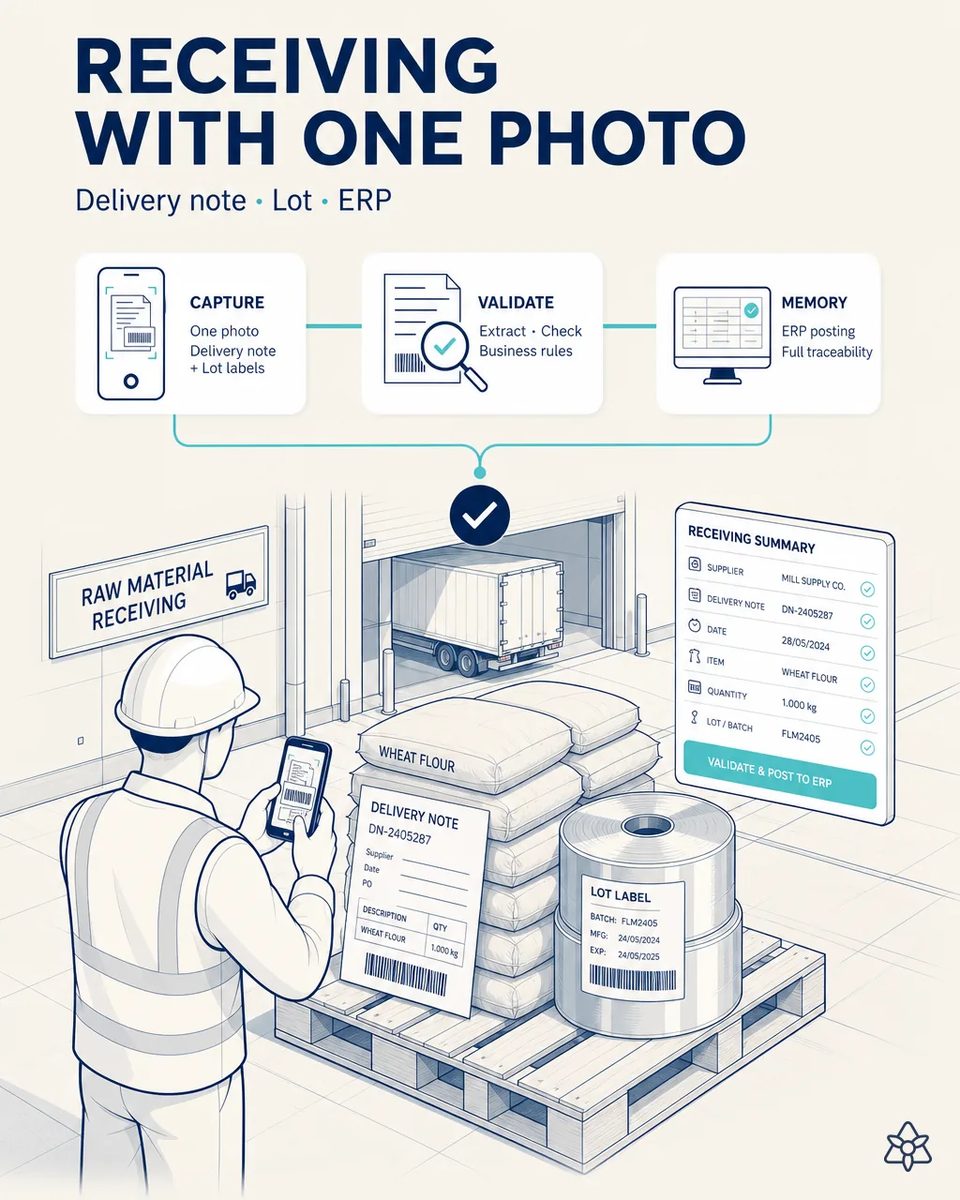
Flour, sugar, oil and packaging reels arrive with a delivery note of twelve to twenty lines and lot labels on every pallet. The receiving supervisor must sign and also key every line into the ERP. With iLEAN Connect the supervisor photographs the delivery note and the labels: the system reads GS1-128, barcodes, QR and plain text, and builds the full receipt with lot and expiry.
Lot traceability is decided at the receiving dock, against the clock.
Flour, sugar, oil and packaging reels arrive with a delivery note of twelve to twenty lines and lot labels on every pallet. The receiving supervisor must sign and also key every line into the ERP. Either the carrier waits forty-five minutes charging detention, or the data is keyed in a rush and lots are traced badly. That shows up weeks later, when quality needs to know which flour lot went into which production run.
- Flour, sugar, oil and packaging reels arrive with a delivery note of twelve to twenty lines and a lot label on every pallet. The receiving supervisor has to check, sign and also key every line into the ERP.
- Either the carrier waits forty-five minutes and charges detention, or the lines are keyed in a rush and lots, quantities or expiry dates go in wrong.
- The error does not show at receiving. It shows weeks later, when quality needs to know which flour lot went into which production run and the ERP points to the wrong one.
- In a food plant that question comes with a deadline: a supplier alert or a customer complaint needs the affected lots in hours, not after a manual search through delivery notes.
Connect in photo mode at receiving — delivery note and lot labels, read together.
With iLEAN Connect the supervisor photographs the delivery note and the labels: the system reads GS1-128, barcodes, QR and plain text, and builds the full receipt with lot and expiry. The summary appears on screen, the supervisor validates with one tap and Connect posts it to the ERP via API. CFO angle: receiving-module licenses typically drop by fifty to seventy percent, because only one person validates.
The supervisor keeps doing what the food safety system requires: check the goods and sign. The keying is what disappears. One photo of the delivery note and the labels builds the receipt with lot and expiry, the supervisor validates and the truck leaves, with traceability that starts right. When a flour or oil supplier issues an alert, the affected lots are known before the call ends.
Raw material receiving by keyboard versus receiving by photo
| Aspect | Today | With iLEAN Connect |
|---|---|---|
| Time the carrier waits | Around 45 min, detention charged | Minutes, no detention |
| Lot and expiry per pallet | Keyed under pressure | Read from GS1-128 and QR labels |
| Delivery note against purchase order | Compared by eye | Checked line by line |
| Which flour lot went into which run | A manual search weeks later | One query from the supplier lot |
| Licenses in the ERP receiving module | Everyone who keys receipts | One person validating |
| Ingredient supplier's paperwork | — | Unchanged |
Payback 3-8 months · from N to 1 receiving-module license · no carrier detention
Impact estimate — to be validated with your numbers.
The block below is an estimate to be validated against your plant's actual data. We put it forward so the committee has an order of magnitude; we refine it during the assessment.
- Estimated payback 3-8 months from faster receiving and detention that is no longer paid.
- Lot-to-lot traceability from the supplier, with expiry dates read from the label instead of retyped.
- CFO angle: receiving-module licenses typically drop by 50 to 70%, because only one person validates.
- And when quality needs the affected lots for a supplier alert, the answer is a query, not a search through binders of delivery notes.
Faster receiving, no paid detention and lot-to-lot traceability from the supplier. Estimated payback of three to eight months, an estimate to be validated.
And the fair question from the production manager
“What if it reads an expiry date or a lot number wrong?” — reading GS1-128 barcodes, QR codes and the printed text of a label is an anchored task, where the best models drop below 1.5% error [1], and a barcode carries its own check digit. On top of that, the delivery note is checked against the purchase order and the supervisor validates the summary before the receipt is posted. A low-confidence field is highlighted for them to check on the physical label.
[1] OpenAI paper "Why Language Models Hallucinate", 2025 — on the reliability of AI in anchored tasks.
What people ask about receiving raw materials and packaging by photo
Will our flour, sugar and packaging suppliers have to change their delivery notes?
No. Each supplier's delivery note is read as it comes today. Asking dozens of suppliers to change format is a project that never finishes. Each new delivery note layout is learned from the first few receipts.
Which codes on the supplier lot label does it read?
GS1-128, standard barcodes, QR codes and the plain printed text, which matters when a label is torn or a supplier prints only text. Lot and expiry are taken from the barcode when it exists and from the text when it does not.
What if the truck brings fewer pallets than the delivery note says?
The difference against the note and the purchase order is shown before validation, so the supervisor records the shortage while the carrier is still at the dock and can sign for it. The same applies to a wrong item or an expiry date shorter than your acceptance rule.
How do the receiving license savings work?
Today everyone who keys receipts needs a license in the ERP's receiving module. When one supervisor validates and iLEAN posts via API, the others are no longer needed. The figure depends on your ERP vendor's price list and is checked before committing.
Can it capture the receiving temperature of chilled ingredients?
If the temperature appears on the delivery note or on a probe display in the photo, it is read with the rest and attached to the lot as evidence for the food safety system. If it is not, the supervisor can add it by voice or by hand.
More cases from this series
- The 3PL inventory spreadsheet, straight into the ERPThe 3PL inventory spreadsheet, straight into the ERP. Payback 3-7 months · from N to 1 inventory-module…
- The carrier alert that replans in timeThe carrier alert that replans in time. Payback 3-8 months · reaction to transport incidents from hours…
- Evidence pack for every delivery, ready for audits and disputesEvidence pack for every delivery, ready for audits and disputes. Payback 3-8 months · undue chargebacks…
- Dock loading sheet in the system instantlyDock loading sheet in the system instantly. Payback 4-9 months · shipment confirmation from 4-8 h…
- Inventory count validated before it touches the ERPInventory count validated before it touches the ERP. Payback 4-9 months · inventory adjustments with…
- S&OP on live shop-floor data against empty shelvesS&OP on live shop-floor data against empty shelves. Payback 6-12 months · better OTIF and lower safety…
Tell us how long a raw material truck waits at your receiving dock today.
We work on your plant's real data, not ours. Assessment with no commitment.
Request estimated ROI within 48h ‹ See all cases of supply chain See food industry