The legacy palletizer that now reports to inventory
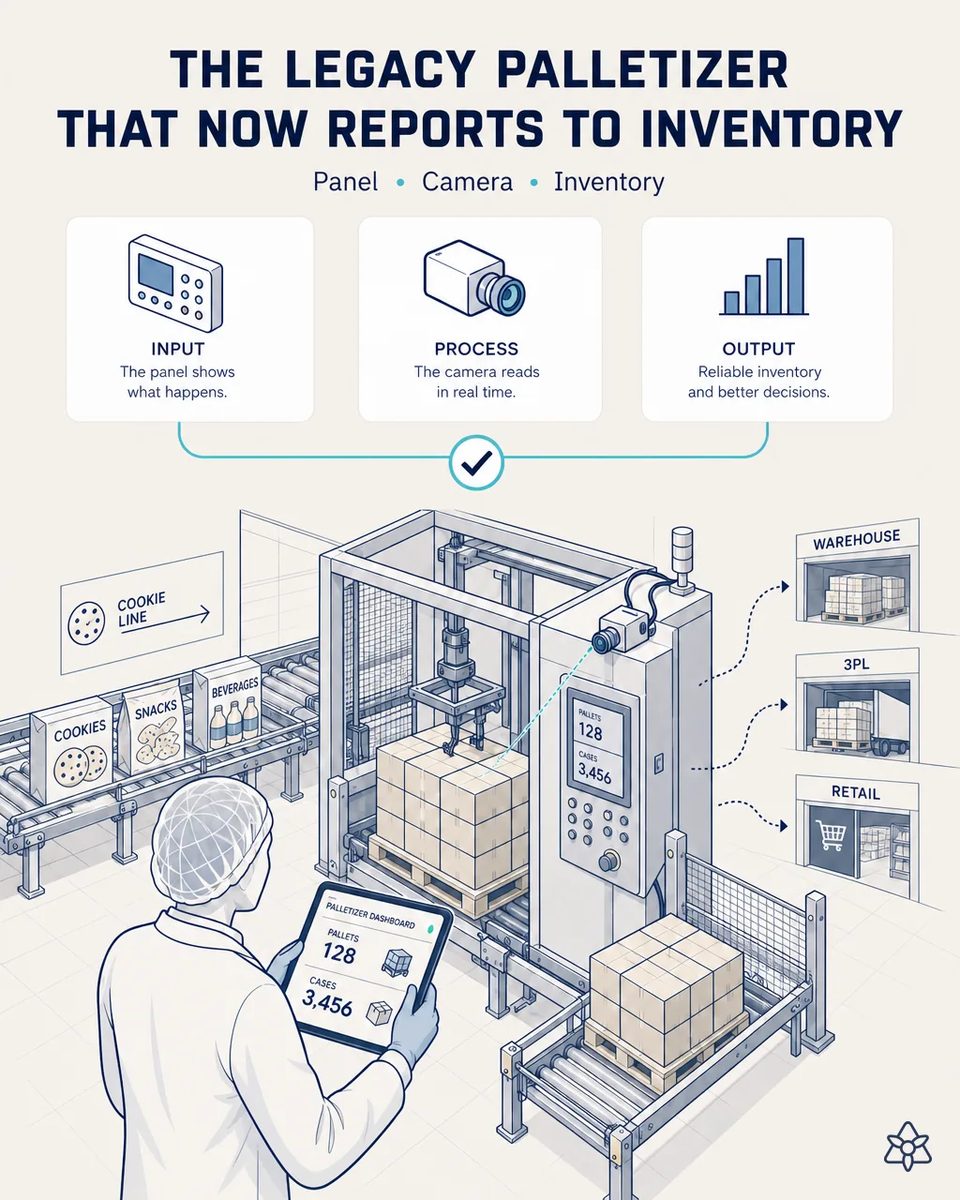
At the end of every line there is a palletizer or stretch wrapper fifteen or twenty years old with a proprietary panel and no network. Its screen shows how many cases and pallets have been closed, plus stops and alarms. iLEAN places an external camera in front of the panel. Connect reads the screen every few seconds with OCR and a grounded model, without touching the machine or its program. The machine is still itself, but now it talks.
The end of the line knows exactly what was produced. The ERP finds out at shift end.
At the end of every line there is a palletizer or stretch wrapper fifteen or twenty years old with a proprietary panel and no network. Its screen shows how many cases and pallets have been closed, plus stops and alarms. That count feeds finished-goods inventory and the replenishment plan. Today someone writes it on paper and declares it at the end of the shift: the planner decides on production they cannot see.
- The palletizer or stretch wrapper at the end of each line is often fifteen or twenty years old, with a proprietary panel and no network port anyone dares to open.
- Its screen shows cases and pallets closed, plus stops and alarms, in real time. Yet the count reaches finished-goods inventory only when someone copies it onto paper and declares it at shift end.
- Between the closed pallet and the declaration, the replenishment plan works blind: the planner allocates stock to retail orders without knowing whether the line is ahead, behind or stopped.
- At month-end the gap shows up as inventory differences between production declarations, the warehouse and finance, and nobody can say which shift or which line caused it. The adjustment gets posted to close the month, and the cause stays open.
Connect reading the palletizer panel — an external camera, the machine untouched.
iLEAN places an external camera in front of the panel. Connect reads the screen every few seconds with OCR and a grounded model, without touching the machine or its program. The machine is still itself, but now it talks. Every closed pallet is declared in central memory with its lot and time, and the supervisor confirms it on a tablet before it reaches the ERP. Stops are logged with their cause.
The machine keeps doing what it has done for twenty years; the only change is that what it shows on its screen stops dying there. Every closed pallet becomes a finished-goods declaration with lot and time, confirmed by the supervisor on a tablet. That turns the replacement project into a choice instead of an urgency, and gives the planner a live view of each line's output without waiting for the shift report.
The silent palletizer versus the palletizer being read
| Aspect | Today | With iLEAN Connect |
|---|---|---|
| Finished-goods declaration | On paper, at shift end | Per pallet, in real time |
| Lot and time of each closed pallet | Approximated afterwards | Stamped at closing |
| Palletizer stops and alarms | Remembered, if noted | Logged with their cause |
| What the planner sees mid-shift | Yesterday's declaration | Pallets closed so far, line by line |
| Month-end gaps in finished goods | Hunted line by line | Fewer, traceable to a shift |
| End-of-line machine and its program | — | Untouched, no retrofit |
Payback 5-10 months · finished goods declared in real time without replacing the machine
Impact estimate — to be validated with your numbers.
The block below is an estimate to be validated against your plant's actual data. We put it forward so the committee has an order of magnitude; we refine it during the assessment.
- Estimated payback 5-10 months, depending on the number of lines and on how late finished goods are declared today.
- Finished goods visible in real time, so allocation to retail orders works on what has actually been palletized, not on yesterday's figure.
- Fewer inventory differences at month-end between production declarations, warehouse stock and finance.
- And a palletizer replacement driven only by the lack of connectivity can be postponed, which frees capex for something that adds capacity.
Finished goods visible in real time, fewer inventory differences at month-end and a machine replacement that can be postponed. Estimated payback of five to ten months, an estimate to be validated.
And the fair question from the production manager
“Can a camera reading a screen really feed inventory?” — reading counters that always appear in the same place on a fixed panel is an anchored task, where the best models drop below 1.5% error [1]. Two more nets sit on top: a count that jumps backwards or beyond the line's physical rate is discarded instead of accepted, and the supervisor confirms each declaration on the tablet before it reaches the ERP.
[1] OpenAI paper "Why Language Models Hallucinate", 2025 — on the reliability of AI in anchored tasks.
What people ask about reading a legacy palletizer panel
Does the palletizer builder have to be involved?
No. Nothing is installed on the palletizer, no port is opened and the program is not touched, so the machine's warranty and settings stay exactly as they are. Maintenance only needs to agree where the camera bracket goes so it does not get in the way of the guarding.
How is each closed pallet tied to its lot?
The active production order and lot are taken from the line's plan, and every pallet the panel closes is stamped with that lot and the exact time. A lot change on the line starts a new series, so a pallet never ends up declared under the previous lot because someone forgot to update a sheet.
What happens when the panel shows an alarm screen instead of the counter?
The alarm itself is read and logged as a stop with its time, and counting resumes when the counter screen returns. A screen the model does not recognize is flagged, never guessed.
Does it also work on stretch wrappers and case packers?
Yes, on any end-of-line machine with a readable display. Starting at the palletizer makes sense because that is where the finished-goods unit the warehouse handles is born. Case counts upstream can be added later if planning needs them.
Do we still need someone to declare production at the end of the line?
Someone confirms, which takes seconds per pallet batch, but nobody copies counts onto paper or keys them in at shift end anymore. The declaration exists before the pallet reaches the finished-goods warehouse.
More cases from this series
- The 3PL inventory spreadsheet, straight into the ERPThe 3PL inventory spreadsheet, straight into the ERP. Payback 3-7 months · from N to 1 inventory-module…
- The carrier alert that replans in timeThe carrier alert that replans in time. Payback 3-8 months · reaction to transport incidents from hours…
- Evidence pack for every delivery, ready for audits and disputesEvidence pack for every delivery, ready for audits and disputes. Payback 3-8 months · undue chargebacks…
- Dock loading sheet in the system instantlyDock loading sheet in the system instantly. Payback 4-9 months · shipment confirmation from 4-8 h…
- Inventory count validated before it touches the ERPInventory count validated before it touches the ERP. Payback 4-9 months · inventory adjustments with…
- S&OP on live shop-floor data against empty shelvesS&OP on live shop-floor data against empty shelves. Payback 6-12 months · better OTIF and lower safety…
Tell us how long a closed pallet takes to appear in your finished-goods inventory.
We work on your plant's real data, not ours. Assessment with no commitment.
Request estimated ROI within 48h ‹ See all cases of supply chain See food industry