Let your mill grow without growing your headcount
Expanding milling capacity multiplies the volume of batches, blends and receipts to trace. iLEAN coordinates 4 verification rings so that traceability scales without more people.
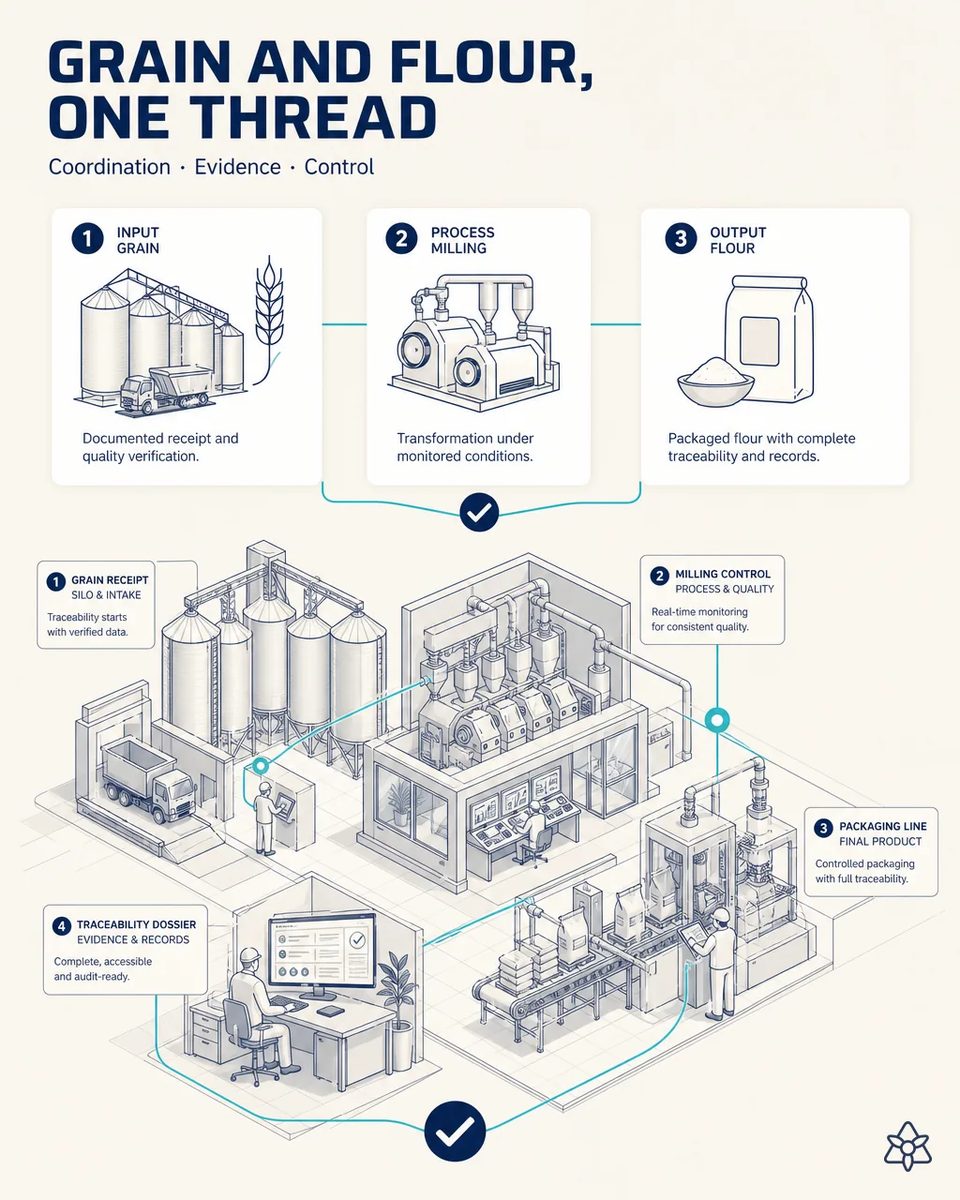
More tonnage means more traceability work — and the team cannot grow at the same pace.
With no process change, more production volume means more people doing the same manual traceability work -the worst-case scenario for an administrative team that can't grow at the same pace as the plant.
- A capacity expansion multiplies everything that has to be traced: wheat receipts, silo movements, blends, batches, lab results, bagging runs and shipments. Every one of them is a record somebody has to create, check and file today.
- With no change in process, more volume means more people doing the same manual traceability work. Hiring takes months; the new line starts producing on day one.
- That is the worst scenario for an administrative and quality team that cannot grow as fast as the plant.
- And the risk does not grow linearly: more batches with the same people means more gaps, and gaps are what an IFS Food audit or a customer complaint finds. Hiring to cover them comes late and costs more than the expansion planned.
Four coordinated rings — everything above, orchestrated.
4 coordinated rings — Connect on the floor (blend and alerts captured and validated at zero lag), Connect-to-ERP (lab and receiving flow in with no double-keying and fewer licenses), Edge on the line (packaging and recipe changes visually validated, JIDOKA AI halts on mismatch) and Agents (an evidence pack crossing the three previous rings, ready for IFS Food or any customer). SMED AI speeds up recipe changeovers so coordination doesn't cost the new line's productivity.
No ring is enough alone: each one closes a stretch of the chain from grain to flour. The value is that the four agree with each other, so the traceability of a batch exists without anybody assembling it. That is what lets the same team trace twice the tonnage.
The four rings, and what each one closes at the flour mill
| Ring | Which cases it draws on | What it closes |
|---|---|---|
| 1 · Connect on the floor | Wheat blend (1) + supplier alert (3) + headset (4) | Blend and alerts captured and validated at zero lag |
| 2 · Connect to ERP | Lab (6) + wheat receiving (7) + bagging (8) | Data flows in with no double-keying and fewer licenses |
| 3 · Edge on the line | Bag defects (9) + recipe changeover (10) | JIDOKA AI halts on a verified mismatch |
| 4 · Agents | IFS Food evidence pack (11) | Dossier crossing the three previous rings |
| Cross-cutting · SMED AI | Recipe changeover (10) | Faster changeovers on the new line |
| Base · Human validation | Tablet validation (5) | Nothing enters the ERP unconfirmed |
From traceability that needs more people to scale with volume, to traceability that scales with the same headcount, coordinated automatically.
Impact estimate — to be validated with your numbers.
The block below is an estimate to be validated against your plant's actual data. We put it forward so the committee has an order of magnitude; we refine it during the assessment.
- Estimated payback 6-12 months, to be validated with quality and finance leadership.
- The capacity expansion is absorbed without proportional growth in administrative headcount. The team that traces today's tonnage traces the expanded one.
- SMED AI speeds up recipe changeovers so traceability does not cost the new line its productivity. Changeovers are prepared and verified rather than improvised.
- And grain-to-flour traceability stays complete at the new volume, ready for IFS Food or any customer that asks.
Estimated payback of 6-12 months. Capacity expansion gets absorbed without proportional growth in administrative headcount. Estimate to validate with quality and finance leadership.
And the fair question from the production manager
"Do we need to deploy all twelve cases before seeing any of this?" — no, and framing it that way would be the way never to start. The rings are built in layers and each case pays on its own. Each piece runs on anchored tasks — reading a sheet, a panel, a delivery note — where the best models drop below 1.5% error [1], so reliability does not depend on deploying everything at once. And human validation stays at the base of every ring.
[1] OpenAI paper "Why Language Models Hallucinate", 2025 — on the reliability of AI in anchored tasks.
What people ask about traceability through an expansion
Where should a mill start?
Usually with the wheat blend sheet and wheat receiving: they have the fewest dependencies and they open ring 1 and half of ring 2. Each layer pays on its own, so the order can follow your priorities.
Does it replace our ERP or our SCADA?
No. iLEAN connects what you already have and makes the systems agree with each other and with what actually happens on the floor. The investment already made in those systems is protected.
What does SMED AI add to the expansion?
It shortens recipe changeovers by preparing and verifying them, so the extra coordination does not cost the new line milling hours. That matters most in the first months, when the new line is still finding its rhythm.
What if two rings disagree about a batch?
JIDOKA AI stops on a verified discrepancy between sources and escalates it to a person, who decides with the evidence of both. The discrepancy and the decision are stored in the dossier. Over time, recurring discrepancies show where the process itself needs fixing.
Can the return be estimated before committing at the flour mill?
Yes. With your current tonnage, the planned expansion and the hours spent on traceability today, the return per layer is estimated before choosing the order. We do that calculation with your quality and finance leadership. The figures used are yours, and so are the assumptions, so the result can be challenged line by line.
More cases from this series
- Lab data, from spreadsheet to ERP with no transcriptioniLEAN reads the quality lab's spreadsheet and pushes it validated into the ERP, saving up to 80% on…
- Wheat receiving, from double-keying to one tapA photo of the delivery note and analysis report: iLEAN pushes it to the ERP with the silo already…
- What the mill supervisor notices no longer gets lostA headset and Connect voice mode capture what the mill supervisor observes while walking the floor,…
- The packaging line and the ERP stop typing separatelyiLEAN stitches the automatic packaging and palletizing line to the ERP, replacing nothing, and ends…
- The mill's control panel, untouched, now talksAn external camera reads the milling line's control panel without touching it: tonnage, extraction and…
- The wheat supplier alert, handled at zero lagiLEAN reads a wheat supplier's alert at zero lag, cross-checks it against the planned blend and suggests…
Book a session to walk us through your mill's expansion plan.
We work on your plant's real data, not ours. Assessment with no commitment.
Request estimated ROI within 48h ‹ See all cases of flour milling See food industry