The IFS Food audit dossier, always ready
On IFS Food audit day, rebuilding grain-to-flour traceability can take weeks. With iLEAN, every critical change builds its own dossier automatically, organized by Agents.
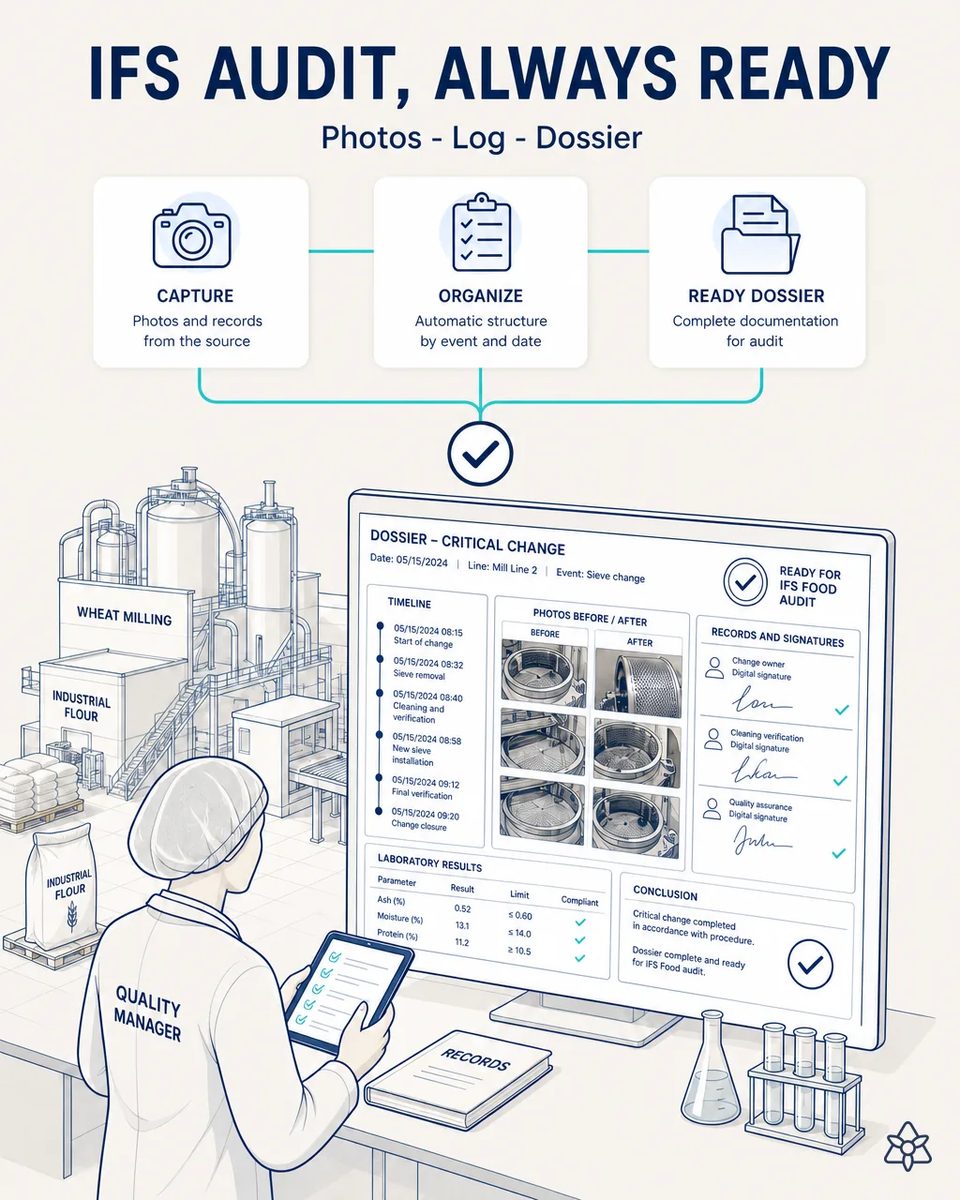
Before every IFS Food audit, the quality team rebuilds the mill's history by hand.
Manually rebuilding traceability for IFS Food consumes weeks of quality-team work and leaves documentation gaps that trigger nonconformities.
- IFS Food asks the mill to show grain-to-flour traceability: which wheat lots, which silos, which blend, which batch, which bags, which customer. In both directions, and within the time the auditor allows.
- That evidence exists, but scattered across receiving notes, blend sheets, lab spreadsheets, cleaning records and the ERP. Each source is complete on its own; nobody has ever joined them.
- Rebuilding it takes the quality team 1 to 2 weeks before each audit, and repeats for every customer audit.
- And the gaps found while rebuilding — a missing signature, a sieve change with no record — are exactly the ones that end in a nonconformity. Gaps that would have been easy to close if somebody had noticed them at the time.
Edge captures at every critical change; Agents organizes the dossier.
Edge captures photos and data at every critical change; Agents organizes the dossier by certification standard and period, ready to download from the web.
The dossier is not assembled before the audit: it closes at the moment each change happens. Anything rebuilt afterwards inherits the gaps of whatever nobody wrote down at the time. That is why the audit stops being a project and becomes a download.
Audit preparation today versus the permanent dossier at the flour mill
| Aspect | Today | With iLEAN Edge + Agents |
|---|---|---|
| Preparation before IFS Food | 1-2 weeks of rebuilding | Dossier available on the spot |
| Sieve or magnet change | A line in a logbook | Photos before and after, signed |
| Lab results per batch | In a separate spreadsheet | Attached to the change |
| Documentation gaps at the flour mill | Found by the auditor | Detected when they occur |
| Customer audits | Rebuilt again each time | Same evidence, another view |
| Access for the auditor | Printed folders | Filtered download by period |
From 1-2 weeks of pre-audit document rebuilding, to a dossier available on the spot.
Impact estimate — to be validated with your numbers.
The block below is an estimate to be validated against your plant's actual data. We put it forward so the committee has an order of magnitude; we refine it during the assessment.
- Estimated payback 6-12 months, depending on how many audits the mill goes through each year.
- From 1-2 weeks of document rebuilding before each audit to a dossier available on the spot. The quality team spends its time on improvement instead of archaeology.
- Fewer nonconformities caused by documentation gaps, which are detected when they happen. A missing signature is chased the same day, while everybody remembers.
- And continuous protection of the IFS Food certification, which is the foundation of the commercial relationship with industrial customers.
Estimated payback of 6-12 months depending on audit frequency, continuously protecting the IFS Food certification. Estimate to validate.
And the fair question from the production manager
"Isn't this just another document management system?" — the difference is direction. A document system stores what someone decides to upload after the fact. Here Edge captures at the moment of the change, and indexing each record against the IFS Food clauses is an anchored task, where the best models drop below 1.5% error [1]. The quality manager reviews the dossier before it goes to the auditor. If a record is missing, Agents flags it the day it should have been generated, not the day of the audit.
[1] OpenAI paper "Why Language Models Hallucinate", 2025 — on the reliability of AI in anchored tasks.
What people ask about the IFS Food dossier
Which critical changes are captured?
Those defined in your HACCP plan and IFS Food scope: sieve and magnet checks, recipe changeovers, cleaning, maintenance on product-contact equipment. The list is agreed with your quality manager before the first capture.
Can the same dossier serve a customer audit?
Yes. The evidence is the same; Agents reorganizes it against the customer's questionnaire instead of the IFS Food clauses. The quality team stops preparing the same evidence twice. And each customer receives it in the structure their questionnaire expects.
Does it include mycotoxin and lab results?
Yes. Lab data per batch and mycotoxin results per wheat lot are attached automatically to the traceability chain. A batch can be traced back to the wheat lot and its analysis in one query. That is the exercise auditors most often ask to see live, and it takes minutes.
Does the auditor need access to our systems?
No. They receive a view limited to the period and scope of the audit, where they can filter and download. Your systems remain closed to them. The same view can be shared with a customer's quality team for their own supplier audit.
What about records from before iLEAN?
They stay where they are. The dossier builds from day one forward, and loading history is optional. Most mills see the benefit at the first audit after go-live. The difference is clearest in the traceability exercise, which stops being a race.
More cases from this series
- Lab data, from spreadsheet to ERP with no transcriptioniLEAN reads the quality lab's spreadsheet and pushes it validated into the ERP, saving up to 80% on…
- Wheat receiving, from double-keying to one tapA photo of the delivery note and analysis report: iLEAN pushes it to the ERP with the silo already…
- What the mill supervisor notices no longer gets lostA headset and Connect voice mode capture what the mill supervisor observes while walking the floor,…
- The packaging line and the ERP stop typing separatelyiLEAN stitches the automatic packaging and palletizing line to the ERP, replacing nothing, and ends…
- The mill's control panel, untouched, now talksAn external camera reads the milling line's control panel without touching it: tonnage, extraction and…
- The wheat supplier alert, handled at zero lagiLEAN reads a wheat supplier's alert at zero lag, cross-checks it against the planned blend and suggests…
Tell us how many weeks your quality team spent preparing the last IFS Food audit.
We work on your plant's real data, not ours. Assessment with no commitment.
Request estimated ROI within 48h ‹ See all cases of flour milling See food industry