JIDOKA AI: no startup until clean and validated
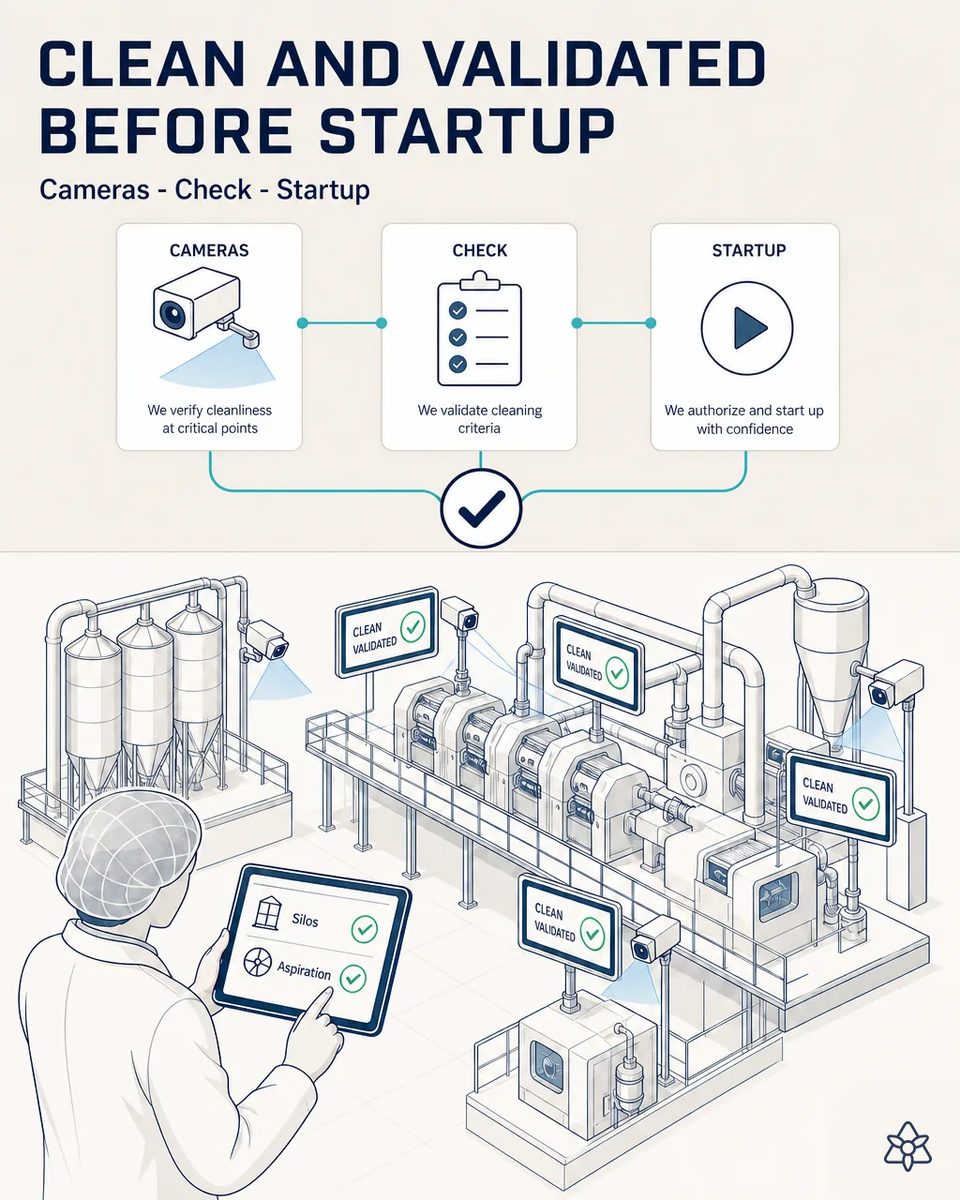
Changing recipes on the milling line requires cleaning and recalibration. Today it relies on a sign-off with no objective proof. With Edge, cameras at critical points verify the state before allowing startup.
A recipe change is signed off from memory.
Switching from a standard bread flour to a specialty pastry flour requires cleaning and recalibration lasting 30 minutes to 2 hours, today signed off from memory by the mill supervisor.
- Switching the milling line from a standard flour to a high-strength specialty flour means cleaning and recalibrating: hoppers, roller mills, plansifters, spouts. Every mill has its own sequence, refined over years by the head miller.
- It takes 30 minutes to 2 hours, and today it ends with a sign-off by the mill supervisor based on memory, not on proof. Under time pressure, because the line is not producing while it is being cleaned.
- If residue of the previous flour stays in a sifter or a spout, the first tons of the new recipe carry it, and the W or the gluten of the batch drifts.
- When a customer complains about a specialty flour, the investigation finds a signature and no evidence of what the line looked like. The mill can neither prove the cleaning nor learn from what went wrong.
Edge with JIDOKA AI — the line does not start without visual evidence and a signature.
Edge cameras at critical points (hopper, sifters, bagging spout) compare the current state against the "clean/ready" reference. iLEAN won't allow startup until all cameras give the OK and the quality manager signs off. JIDOKA AI.
The camera does not replace the quality manager's decision: it gives them evidence to decide on. What changes is not who signs, but what they sign. A signature backed by images of each critical point can be defended in front of a customer or an auditor.
Recipe changeover today versus changeover validated by Edge
| Aspect | Today | With iLEAN Edge |
|---|---|---|
| Sign-off after cleaning | From memory | Against reference images |
| Hopper, sifters, bagging spout | Checked if there is time | Each point verified by camera |
| Residue of the previous flour | Found in the first batch | Detected before startup |
| Startup permission | The supervisor's word | All cameras OK plus quality sign-off |
| Evidence for a complaint | A signature | Photos of every point, timestamped |
| Cross-contamination between recipes | Assumed low | Measured and documented |
From a sign-off with no objective proof, to verified visual evidence at every point before startup.
Impact estimate — to be validated with your numbers.
The block below is an estimate to be validated against your plant's actual data. We put it forward so the committee has an order of magnitude; we refine it during the assessment.
- Estimated payback 6-11 months.
- Lower risk of cross-contamination between recipes, especially on high-value specialty flours. Those are the flours where a drift in W or gluten costs most.
- Fewer complaints because a batch did not match the customer's spec sheet after a changeover. The customer of a specialty flour notices before anybody else.
- And a startup backed by visual evidence at every critical point instead of a signature with nothing behind it.
Estimated payback of 6-11 months from lower cross-contamination risk between recipes and fewer spec-sheet complaints. Estimate to validate.
And the fair question from the production manager
"What if the camera blocks the restart for nothing and we lose an hour?" — that is the right objection, because the changeover is on the critical path. Comparing a point against its clean reference image is an anchored task, where the best models drop below 1.5% error [1]. And in case of doubt the system does not block silently: it shows the image to the quality manager, who decides on the evidence. The line stops on a verified mismatch, not on the model's uncertainty.
[1] OpenAI paper "Why Language Models Hallucinate", 2025 — on the reliability of AI in anchored tasks.
What people ask about validating a recipe changeover
Which points of the line are checked?
The ones defined with your team at commissioning, usually hoppers, plansifter inlets and outlets, spouts and the bagging spout. Each point gets a reference image of the clean state for each recipe family. New recipe families are added by photographing the line once in its validated state.
Can a camera see inside a plansifter?
Not inside the sieves, but it can see inspection openings and the outlets where residue accumulates. Points that cannot be seen remain manual checks, recorded as such. The tablet lists them alongside the camera checks. Nothing is left as an unrecorded assumption.
Does it make the changeover longer at the flour mill?
The check takes seconds per point. What lengthens changeovers today is the safety margin added because there is no evidence. With evidence, that margin can come down safely. Over time, the images also show which points take longest to clean, which is where SMED work starts.
Is it relevant for allergen or organic flour changes?
Yes, and that is where the evidence matters most, because a customer of organic or allergen-free flour will ask for it. The evidence is attached to the first batch of the new recipe.
Can startup be forced in an emergency?
Yes, with an exception signed by a named person and recorded. What cannot happen is a startup with no trace of who decided it. The exception then appears in the dossier for review. Quality management sees how often it happens and on which recipe changes, and can act on the pattern.
More cases from this series
- Lab data, from spreadsheet to ERP with no transcriptioniLEAN reads the quality lab's spreadsheet and pushes it validated into the ERP, saving up to 80% on…
- Wheat receiving, from double-keying to one tapA photo of the delivery note and analysis report: iLEAN pushes it to the ERP with the silo already…
- What the mill supervisor notices no longer gets lostA headset and Connect voice mode capture what the mill supervisor observes while walking the floor,…
- The packaging line and the ERP stop typing separatelyiLEAN stitches the automatic packaging and palletizing line to the ERP, replacing nothing, and ends…
- The mill's control panel, untouched, now talksAn external camera reads the milling line's control panel without touching it: tonnage, extraction and…
- The wheat supplier alert, handled at zero lagiLEAN reads a wheat supplier's alert at zero lag, cross-checks it against the planned blend and suggests…
Tell us how many recipe changes your milling line runs per week.
We work on your plant's real data, not ours. Assessment with no commitment.
Request estimated ROI within 48h ‹ See all cases of flour milling See food industry