The wheat blend, digitized from minute one
Every flour batch in a mill starts as a precise blend of wheat lots from different silos. That recipe is written today on a paper sheet. With iLEAN Connect, a phone photo is enough for the exact blend to exist in the central system at zero lag.
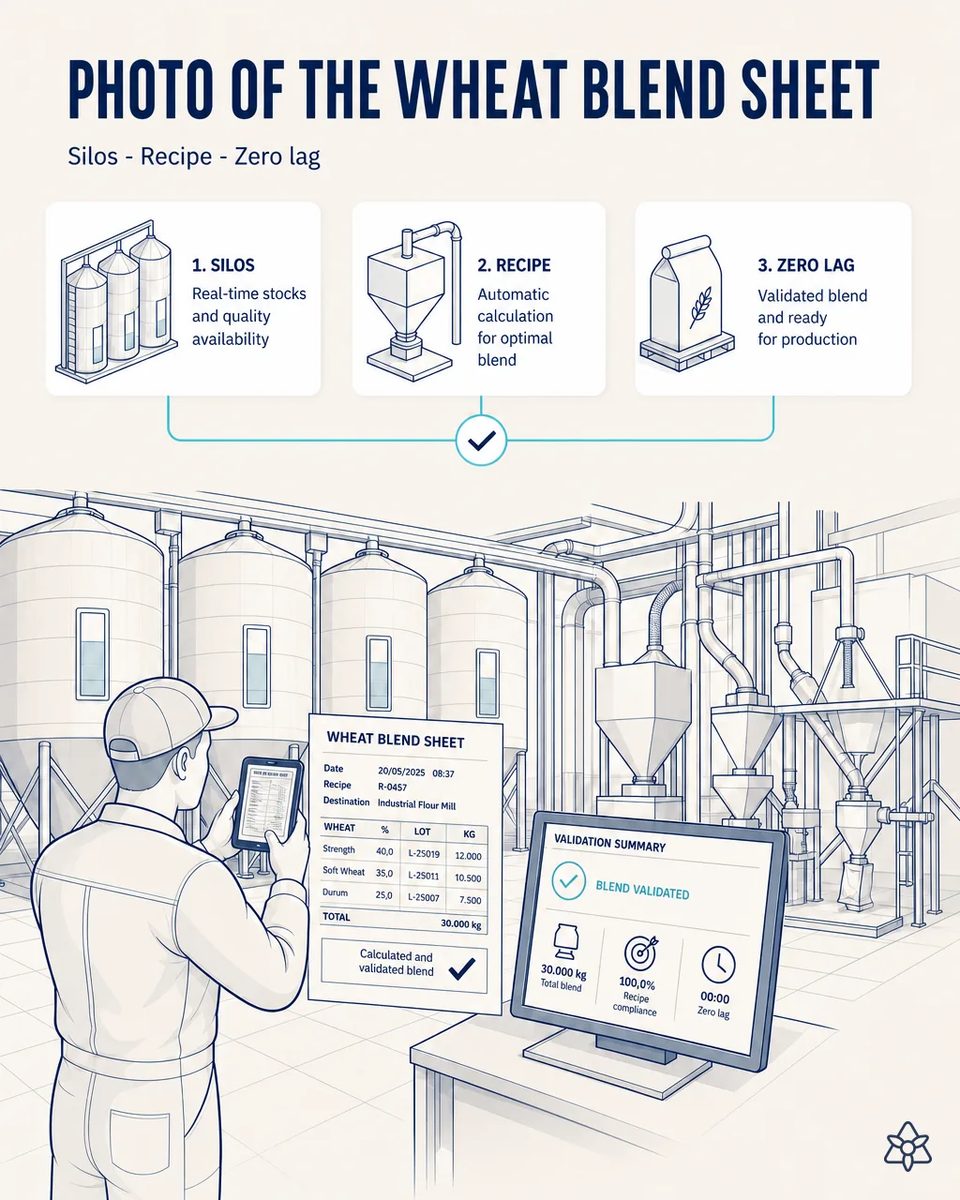
The recipe that defines the flour is written on a sheet nobody can query.
The blend sheet links source silo, ratio, moisture and target protein for the batch. Today it lives on paper in the milling control room and gets transcribed -if at all- hours later, when it's too late to correlate a quality incident with the actual blend used.
- Every batch starts as a precise blend of wheat lots from different silos: source silo, percentage, moisture after conditioning and the target protein and strength (W) the flour has to hit.
- That sheet lives on paper in the milling control room. It gets transcribed hours later, if at all, by somebody who was not there when the blend was set.
- When the alveograph or the falling number of a batch comes out off-spec, the first question is which silos fed it — and the answer is in a folder, not in a system.
- Without the actual blend tied to the batch, every quality incident is argued from memory, and the head miller's experience never turns into data the next shift can use. Two years later, nobody can say which wheat combination produced the best-performing flour of the season.
Connect in photo mode — the miller keeps writing the blend by hand.
Connect photo mode. A grounded LLM extracts structured fields (silos, ratios, target protein/strength, start time) from the sheet photo. The mill supervisor validates with two taps on a tablet before the data crosses into the central system.
Nothing changes in the control room: the sheet is filled in exactly as today and one photo is added. That is why it is usually the first case approved in a mill — it asks nobody to learn a screen. And because every batch from then on carries its blend, the rest of the traceability chain has something to hang from.
The blend on paper versus the blend captured
| Aspect | Today, on paper | With iLEAN Connect |
|---|---|---|
| Silos and percentages per batch | A sheet in the control room | Structured fields in the central system |
| Capture latency at the flour mill | Hours, or never | Zero lag |
| Target protein and W | Handwritten next to the ratios | Stored per batch and queryable |
| Off-spec alveograph result | Which blend? Hunt for paper | One query by batch |
| Validation | Nobody checks the transcription | Two taps from the mill supervisor |
| Miller's routine | — | Unchanged: one photo |
From hours of latency until manual transcription, to zero lag. From a quality incident with no linked blend, to full lot-blend traceability from minute one.
Impact estimate — to be validated with your numbers.
The block below is an estimate to be validated against your plant's actual data. We put it forward so the committee has an order of magnitude; we refine it during the assessment.
- Estimated payback 4-9 months, depending on the number of batches blended per day.
- Transcription time recovered by the mill supervisor, who stops retyping sheets at the end of the shift.
- From hours of latency down to zero lag: the blend exists in the system before milling starts.
- And lot-to-blend traceability from minute one, which is what makes any later root-cause analysis possible.
Estimated payback of 4-9 months depending on daily batch volume, recovering the mill supervisor's transcription time. Estimate to validate.
And the fair question from the production manager
"What if it misreads a percentage and the blend in the system is wrong?" — reading fields from a sheet with a known structure is an anchored task, where the best models drop below 1.5% error [1]. And there is a second net: the percentages must add up to 100 and the silos must exist, and the mill supervisor confirms or corrects the summary on the tablet before anything crosses into the central system. A wrong silo number is caught at that moment, not when the batch is already in the bin.
[1] OpenAI paper "Why Language Models Hallucinate", 2025 — on the reliability of AI in anchored tasks.
What people ask about digitizing the wheat blend sheet
Do we need to redesign the blend sheet?
No. Vision reads the sheet as it is today, including the columns your head miller added over the years. Changing the format is optional, never a precondition. The only thing we ask at the start is a dozen past sheets to map where each field sits.
Does it read handwritten corrections on the sheet?
Yes, and they are the most valuable part: a silo swapped at the last minute or a ratio adjusted after conditioning is exactly what is missing when an incident is investigated. A low-confidence value is flagged for the mill supervisor instead of being guessed.
Can it tie the blend to the silo stock levels?
Yes, once the silos are mapped in the central memory. The photo then also updates how much of each wheat lot is left after the blend is drawn. That gives purchasing a live picture of which wheat qualities are running short before the next contract.
What happens on night shifts with nobody in the office?
Nothing changes: the photo is taken by the miller on shift and the batch exists in the system at that moment, not the next morning. Night and weekend batches stop being the ones with the weakest records.
Is integration with the ERP needed to start?
No. The case runs from day one against iLEAN's central memory; the push to the ERP is connected later, once the value has been shown. Many mills run several months on the central memory before deciding which ERP fields to feed.
More cases from this series
- Lab data, from spreadsheet to ERP with no transcriptioniLEAN reads the quality lab's spreadsheet and pushes it validated into the ERP, saving up to 80% on…
- Wheat receiving, from double-keying to one tapA photo of the delivery note and analysis report: iLEAN pushes it to the ERP with the silo already…
- What the mill supervisor notices no longer gets lostA headset and Connect voice mode capture what the mill supervisor observes while walking the floor,…
- The packaging line and the ERP stop typing separatelyiLEAN stitches the automatic packaging and palletizing line to the ERP, replacing nothing, and ends…
- The mill's control panel, untouched, now talksAn external camera reads the milling line's control panel without touching it: tonnage, extraction and…
- The wheat supplier alert, handled at zero lagiLEAN reads a wheat supplier's alert at zero lag, cross-checks it against the planned blend and suggests…
Send us a photo of one of your wheat blend sheets and we will show you what it turns into.
We work on your plant's real data, not ours. Assessment with no commitment.
Request estimated ROI within 48h ‹ See all cases of flour milling See food industry