Zero cross-contamination, end to end
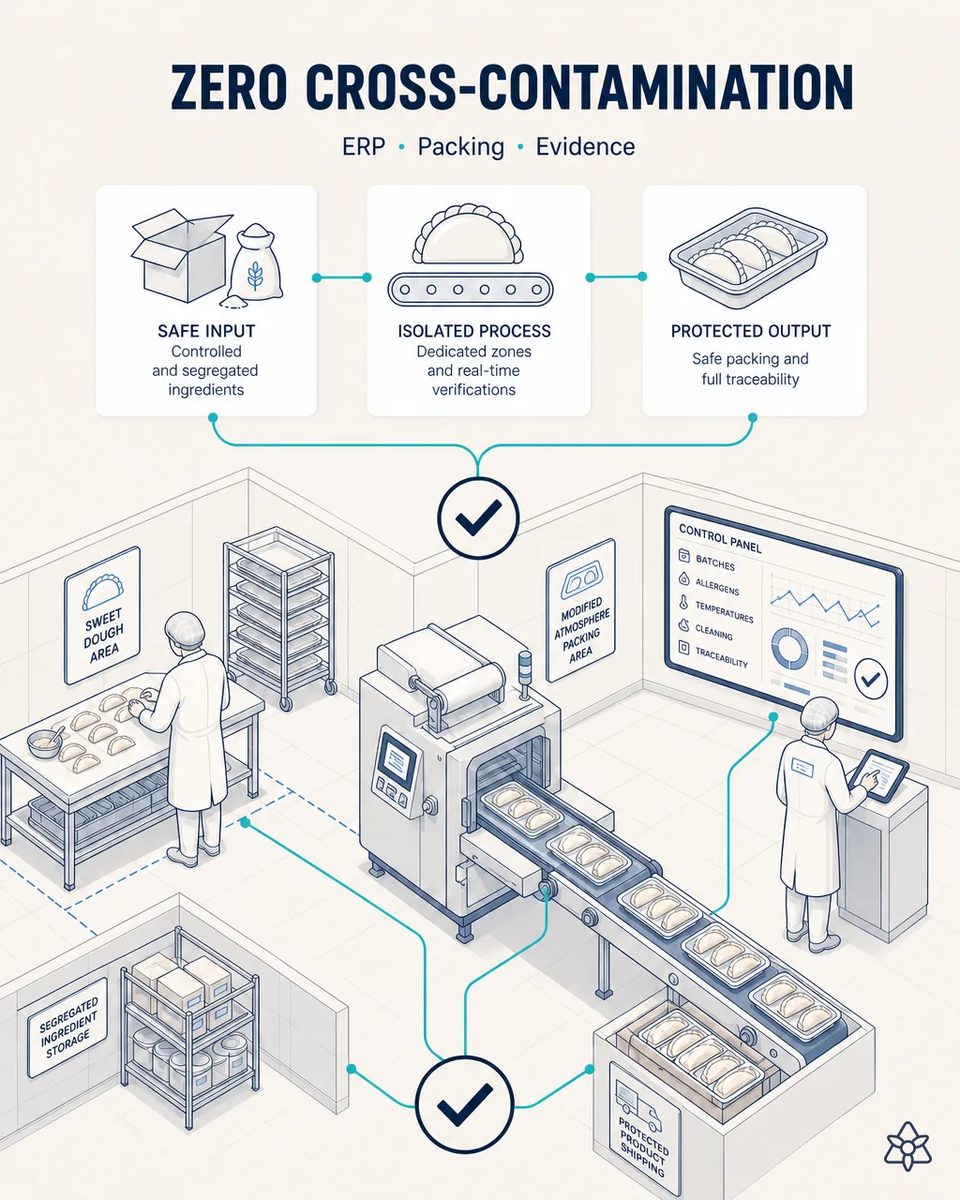
The capital pain of any plant running several formulas on the same lines is always the same: zero cross-contamination between fillings and allergens, zero batch or expiry errors. iLEAN's flagship system coordinates the ERP, packer, Edge vision, and evidence pack in cross-checking rings, and stops the line if anything doesn't match.
A formula error is almost never a single failure.
A formula, allergen, or batch error in a multi-reference environment (in-house brand plus private label) is the sub-sector's biggest reputational and contractual risk. Each incident costs tens to hundreds of thousands of euros directly, plus potentially irreversible damage to the relationship with the client who buys that formula.
- It is the chain of them: an order misread at start-up, a formula change signed in a hurry, a doser dragging leftovers of the previous filling and a label typed by hand on the packer.
- Each link on its own looks acceptable and passes its individual check. Together they produce the tray that reaches the shelf declaring allergens that are not the ones inside.
- In a multi-reference environment — in-house brand and third-party development on the same lines — that is the sub-sector's biggest reputational and contractual risk.
- Each incident costs tens to hundreds of thousands of euros directly, plus potentially irreversible damage to the relationship with the client who buys that formula. And a chain that pulls a reference over an undeclared allergen rarely gives volume back to the same supplier.
Four crossing rings — it is everything above, orchestrated.
The four coordinated rings: the ERP defines the active formula (ring 1); the packer prints exactly what the ERP publishes with no typing (ring 2, legacy integration); the Edge camera reads what's being packed and cross-checks it against the order, locking out via JIDOKA AI if it doesn't match (ring 3); and the evidence pack certifies the three prior rings on every tray (ring 4). SMED AI speeds up formula changeovers so coordination doesn't cost productivity.
No ring on its own solves the problem: each already exists today in some form and the tray still escapes. The strength is in the cross-check, because what gives the chain of failures away is four independent sources ceasing to agree. When the order says one formula, the camera sees another and the packer prints a third, the line stops by itself.
The four rings, and what each one closes
| Ring | Which cases it comes from | What it closes |
|---|---|---|
| 1 · Formula | Batch start-up (1) + receiving (7) | Which formula, which allergens and which lots make up the order |
| 2 · Label | MAP packer (8) + tablet validation (5) | Batch, expiry and allergens printed with no typing |
| 3 · Line | Seal defect (9) + allergen changeover (10) | What actually leaves the forming machine, piece by piece |
| 4 · Evidence | Audit dossier (11) + forming machine panel (2) | The proof of the three prior rings, tray by tray |
| Cross-check between rings | JIDOKA AI | Stops the line when two sources disagree |
| Formula changeovers | SMED AI | Speeds up the change so coordination costs no productivity |
Recurring incidents with partial-recall risk → zero. Discrepancies caught on the line, not at the customer.
Impact estimate — to be validated with quality and management.
The block below is an estimate to be validated against your plant's actual data. We put it forward so the committee has an order of magnitude; we refine it during the assessment.
- Estimated payback 6-12 months, counted against the first recall avoided.
- Protection against a recall, whose single-event impact can exceed €100,000 between sorting, reverse logistics, destruction and penalties.
- Protection of the relationship with private-label clients, which is what governs contract renewals.
- And the discrepancy is caught on the line, not at the customer: incidents carrying partial-recall risk taken to zero.
Protection against recall (single-event impact potentially >€100K) and against losing private-label client relationships. Estimated payback 6-12 months against the first recall avoided. *Estimate to validate* with quality and management.
And the fair question from the production manager
“Do we have to deploy all twelve cases to get this?” — no, and framing it that way would be the way never to start. The rings are built in layers and each case pays for itself from the first month. With batch start-up and the packer you already have ring 1 and ring 2, which is where half the allergen risk sits. And in every layer the extractions are anchored tasks, where the best models drop below 1.5% error [1], with human validation before anything is written.
[1] OpenAI paper "Why Language Models Hallucinate", 2025 — on the reliability of AI in anchored tasks.
What people ask about the complete system
Where do you start?
With the case that has fewest dependencies and the shortest deployment, which in this matrix is the photo of the production order at batch start-up, with tablet validation alongside it. What matters is that each layer pays for itself without waiting for the next.
What does the cross-check give that each control alone does not?
Exactly what escapes today: the chain of failures. A cleaning signed in haste passes its check, a typed label passes its own, and the tray that adds the two together is the one that ends in a recall.
What if a ring flags a false discrepancy?
JIDOKA AI stops on a checkable discrepancy between two sources, not on a model's uncertainty. When the doubt belongs to the model, the case is escalated to a person.
Doesn't stopping the line on every discrepancy hurt productivity?
That is why SMED AI is in there: it speeds up formula changeovers to compensate. And a stoppage of minutes over a discrepancy bears no comparison with the cost of a recall.
Does it replace the ERP we already have?
No. Ring 1 rests precisely on the ERP production order being the truth about which formula and which allergens are due to be produced. iLEAN crosses the systems with each other and with what actually happens on the line, which is what nobody compares today.
More cases from this series
- Photo of the production order at batch start-upHow an empanada plant gets the production order and filling sheet into the central system in zero…
- Photo of the delivery note, no typing while the cold chain waitsPhoto of the delivery note and the raw-material labels: full traceability without sacrificing cold-chain…
- The forming machine panel, read without touching itAn external camera reads the aging forming-and-sealing machine's panel without touching it, correlating…
- The line lead dictates while walkingThe line lead of an empanada plant dictates incidents while walking, through an earpiece, and gets…
- The modified-atmosphere packer, stitched to the ERPThe modified-atmosphere packer is stitched to the ERP: batch, date, and allergens flow automatically, no…
- The quality spreadsheet stops being retyped by handThe quality lab's spreadsheet flows straight into the ERP after validation, with no manual retyping and…
Tell us what a recall over an allergen error would cost you today.
We work on your plant's real data, not ours. Assessment with no commitment.
Request estimated ROI within 48h ‹ See all cases of empanada plants See food industry