The line won't start without the cameras' green light
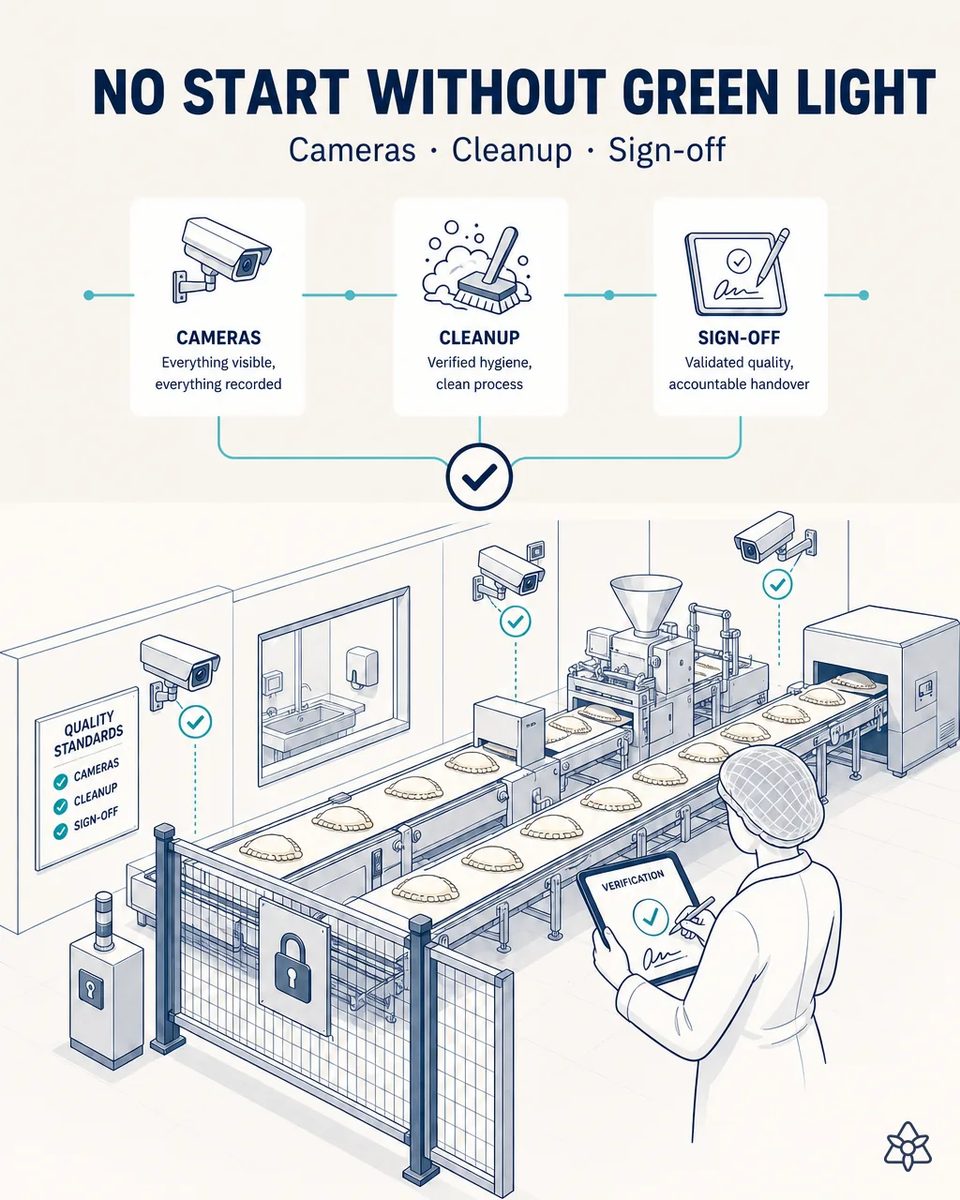
Switching formulas — say from one with dairy to one without — requires certified cleaning. Edge cameras at the critical points compare the current state against the 'clean' reference state and lock out start-up until everything checks out and quality signs off.
The checklist is well designed. The problem is how it gets signed.
Running several formulas and allergens on the same lines — in-house brand plus contract manufacturing — multiplies critical changeovers per shift compared to a single-formula plant. Today it depends on someone signing off 'clean' with no objective visual evidence, and leftover filling from the previous run can contaminate the first batch of the new formula.
- Going from a formula with dairy to one without requires certified cleaning of hopper, doser, conveyor and cutting tooling. Leftover filling from the previous run contaminates the first batch of the new formula.
- Running several formulas and allergens on the same lines multiplies critical changeovers per shift compared to a single-formula plant.
- Today everything depends on somebody signing “clean” with no objective visual evidence behind the box, and it gets signed with the line stopped and the shift clock running, which is the worst possible combination for a careful check.
- When an incident appears, the investigation runs into a ticked box and no proof. It is not bad faith: a signature is not a check, and the private-label client who audits knows it perfectly well when they ask to see the evidence for the last thirty changeovers.
Edge with JIDOKA AI — no start-up without conformity and sign-off.
Edge plus JIDOKA AI: fixed cameras with CNNs trained to recognize "clean" versus "leftover filling or dough from the previous run" at each critical point. The line won't start until every camera clears and quality signs off based on visual evidence.
The camera does not decide alone: it compares each critical point against its 'clean' reference state, and it is the quality lead who signs on that evidence. What changes is not who decides, but what they decide on. And along the way you are left, at no effort, with the photo the auditor will ask for six months later.
Today's formula change versus the validated change
| Aspect | Today | With iLEAN Edge |
|---|---|---|
| Cleaning sign-off | A ticked box | Critical points checked against reference |
| Leftover filling from the previous run | Found in the first batch | Blocks start-up |
| Cutting tooling and doser | Eyeballed | State compared image to image |
| First batch of the new formula | Under suspicion | Validated before the first disc |
| With many changeovers per shift | More accumulated exposure | The same check on every one |
| Evidence for the private-label client | Nonexistent | Photo and sign-off per changeover |
Blind sign-off with cross-contamination risk → sign-off based on visual evidence at every critical point.
Impact estimate — to be validated with your numbers.
The block below is an estimate to be validated against your plant's actual data. We put it forward so the committee has an order of magnitude; we refine it during the assessment.
- Protection of private-label contracts: the brief sets no payback range here, because the cost of losing a client over an allergen incident far exceeds the cost of the cleaning itself.
- The blind sign-off becomes a sign-off based on visual evidence, critical point by critical point.
- The risk of cross-contamination between formulas with and without dairy stops depending on the shift's haste.
- And for every formula change the plant ends up with visual proof to show the private-label client who audits before renewing the contract.
Protects private-label contracts — losing a client over an allergen incident costs far more than the cleaning itself. *Estimate to validate*.
And the fair question from the production manager
“What if the camera blocks the line for no reason with the shift clock running?” — that is the right objection, because the formula change sits on the critical path. Conformity is checked against that specific point's reference state and, in case of doubt, the system does not block silently: it escalates to the quality lead, who signs on the evidence. It is an anchored task — fixed scene, two known states — where the best models drop below 1.5% error [1]. It stops on a checkable discrepancy, not on model uncertainty.
[1] OpenAI paper "Why Language Models Hallucinate", 2025 — on the reliability of AI in anchored tasks.
What people ask about validating the allergen changeover
Which points get checked exactly?
Filling hopper and doser, forming conveyor, cutting tooling and the contact surfaces your cleaning plan specifies. The points are defined with quality during commissioning.
Does it spot leftover filling that is a similar color to the dough?
That is one of the states trained explicitly, and the most treacherous one. That is why the model compares against the reference image of that point when clean, not against a generic idea of cleanliness.
Doesn't it make the formula change longer?
The check takes seconds per critical point. What makes the change longer today is the margin added for lack of evidence, plus the rework when the first batch of the new formula comes out doubtful and somebody has to decide what to do with it.
Can it be skipped in an emergency?
An exception can be defined with the quality lead's signature, and it is logged as such with its time and its reason. What cannot happen is starting up with no trace of who decided to skip it.
Does it replace allergen testing?
No. Lab analyses remain the reference. What the camera adds is the visual check at the moment of the change, which today does not exist as evidence.
More cases from this series
- Photo of the production order at batch start-upHow an empanada plant gets the production order and filling sheet into the central system in zero…
- Photo of the delivery note, no typing while the cold chain waitsPhoto of the delivery note and the raw-material labels: full traceability without sacrificing cold-chain…
- The forming machine panel, read without touching itAn external camera reads the aging forming-and-sealing machine's panel without touching it, correlating…
- The line lead dictates while walkingThe line lead of an empanada plant dictates incidents while walking, through an earpiece, and gets…
- The modified-atmosphere packer, stitched to the ERPThe modified-atmosphere packer is stitched to the ERP: batch, date, and allergens flow automatically, no…
- The quality spreadsheet stops being retyped by handThe quality lab's spreadsheet flows straight into the ERP after validation, with no manual retyping and…
Tell us how many formula changes with a different allergen you run per shift.
We work on your plant's real data, not ours. Assessment with no commitment.
Request estimated ROI within 48h ‹ See all cases of empanada plants See food industry