Confirm with 2 taps before data reaches the ERP
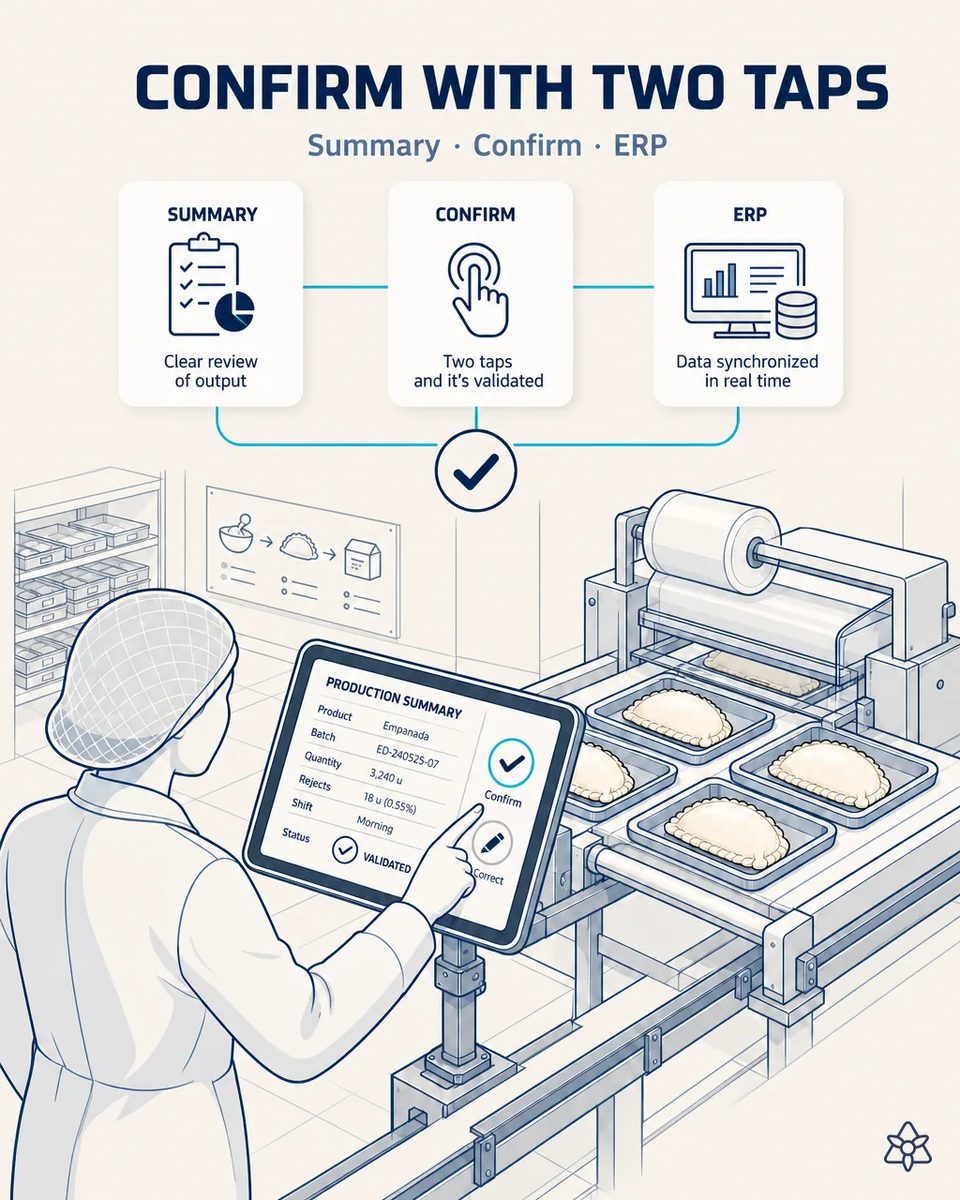
No data iLEAN captures — photo, voice, or parsed email — reaches the central system before a supervisor has seen it. An industrial tablet shows a two-second visual summary, and the supervisor confirms with two taps, in seconds, with no training required.
The brake is not technical: it is who writes into the master data.
The main cultural brake on digitizing a plant is the fear that AI will enter data on its own and contaminate the ERP's allergen and batch master data. But operators don't want to type more either. Without a fast validation gate, any automation reads as a risk, not a help.
- The main cultural brake on digitizing an empanada plant is the fear that AI will enter data on its own and contaminate the ERP's allergen, batch and expiry master data.
- But operators do not want to type more either: every minute in front of a terminal is a minute not spent on the line.
- Without a fast validation gate, any automation reads as a risk rather than a help — and the project never clears the committee.
- The result is the worst of both worlds: unvalidated data entering the ERP, or data simply not captured because nobody trusts it. In a plant where the master data defines which allergens get printed on the tray, that distrust is not irrational: it is the only defense the quality team has today.
Connect with early human verification — two taps at the line.
Connect early-human-verification mode: every capture lands on an industrial tablet as a two-second visual summary. The supervisor confirms (✓) or corrects (✏️) before the data crosses into the central system.
This is the piece that guarantees the master data does not get contaminated and that every data point has a named owner. Without it, the other eleven do not get signed off in committee: nobody approves an AI writing on its own into the system an allergen label depends on. So it is not sold as one more case, but as the entry condition for the whole matrix.
Today's data versus validated data
| Aspect | Today | With iLEAN |
|---|---|---|
| Who writes into the master data | Whoever types, hours later | Whoever validates, in seconds |
| Allergen and expiry master | Exposed to typing errors | Only confirmed data gets in |
| Effort for the supervisor | Walk back to the terminal | Two taps on the tablet |
| Data nobody dares capture | Stays outside | Captured and validated |
| Correcting an extraction | Does not exist | Stored with its author |
| Training required | ERP screens | None: confirm or correct |
Unvalidated data contaminating the ERP, or data left uncaptured out of distrust → data captured and validated within seconds, clean master data.
Impact estimate — to be validated with your numbers.
The block below is an estimate to be validated against your plant's actual data. We put it forward so the committee has an order of magnitude; we refine it during the assessment.
- No standalone payback: this is the enabling piece of the whole matrix. Without it, none of the other eleven cases gets signed off in this plant.
- The dominant value is not productivity, it is risk: the batch, allergen and expiry master data stops being exposed to automatic writing.
- Every data point carries the name of whoever saw it, which is what gets asked for when a retail chain demands the traceability of a tray.
- And the quality team's cultural resistance drops at once, because the AI proposes and the person disposes: that is the sentence that unblocks the committee.
Enabling piece for the whole iLEAN matrix — without it, the other pieces don't get signed off with confidence. *Strategic value, not directly monetizable*.
And the fair question from the production manager
“If a person signs in the end, what is the AI saving?” — the work is not in deciding, it is in gathering. Today somebody would have to walk to the terminal, find the batch and type the data in. With the verification gate it all arrives gathered into a two-second summary and is simply confirmed or corrected. The prior extraction is besides an anchored task, where the best models drop below 1.5% error [1]: the supervisor reviews, they do not rewrite.
[1] OpenAI paper "Why Language Models Hallucinate", 2025 — on the reliability of AI in anchored tasks.
What people ask about two-tap validation
How long does it really take a supervisor?
Seconds. The tablet shows a visual summary with the essentials — batch, formula, allergens, quantity produced, rejects — and it is resolved with one tap to confirm or one to correct, without leaving the packing area.
Can iLEAN write to the ERP without validation?
No, and it is not configurable: it is the architecture, not a deployment option. No data crosses into the central system without prior human confirmation, whether it came from a photo, a dictation or a parsed email.
What gets recorded about each validation?
Which summary was shown, who confirmed it, when, and what they corrected if they corrected anything. That is what serves later in a client audit or a labeling complaint, when you have to show who signed the data off.
What if the supervisor corrects the AI?
The correction is stored with its author. It works as an audit trail and as feedback so extraction improves on exactly that field, for instance a misread piece weight or an ambiguous filling percentage on the sheet.
Do we need one tablet per line?
Not necessarily. In small plants one tablet in the packing area covers the shift's validations; in multi-line plants you put one per line so nobody has to cross the floor and end up validating everything in a block at shift end.
More cases from this series
- Photo of the production order at batch start-upHow an empanada plant gets the production order and filling sheet into the central system in zero…
- Photo of the delivery note, no typing while the cold chain waitsPhoto of the delivery note and the raw-material labels: full traceability without sacrificing cold-chain…
- The forming machine panel, read without touching itAn external camera reads the aging forming-and-sealing machine's panel without touching it, correlating…
- The line lead dictates while walkingThe line lead of an empanada plant dictates incidents while walking, through an earpiece, and gets…
- The modified-atmosphere packer, stitched to the ERPThe modified-atmosphere packer is stitched to the ERP: batch, date, and allergens flow automatically, no…
- The quality spreadsheet stops being retyped by handThe quality lab's spreadsheet flows straight into the ERP after validation, with no manual retyping and…
Tell us who writes into your ERP's allergen master data today.
We work on your plant's real data, not ours. Assessment with no commitment.
Request estimated ROI within 48h ‹ See all cases of empanada plants See food industry