Cured-meat traceability from animal to case
Application example · Impact to validate
The capital pain of a cured meat plant is always the same: zero traceability incidents between the animal of origin and the cured product that ships out. The iLEAN system coordinates 4 verification rings that cross-check each other.
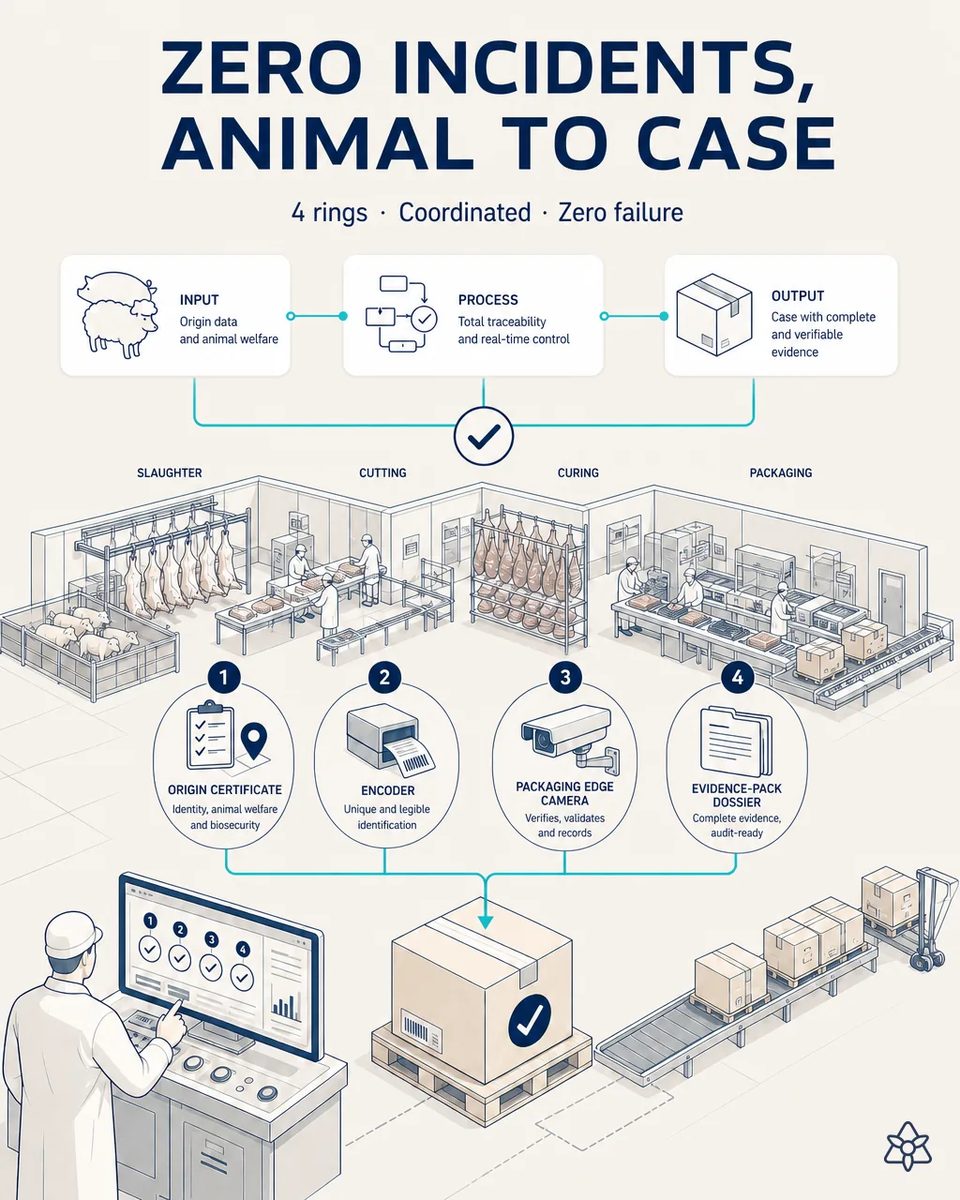
Follow the relationships from livestock origin to shipped case
A recall or health alert from a mistraced batch destroys distributor trust, triggers penalties, and can cost certifications.
- Preserve transformations through receiving, slaughter, cutting, curing-room entry, slicing and case aggregation. Continuity does not come from reusing one identifier everywhere. An operation may create child batches, consume several incoming groups or produce losses. Those relationships determine the real scope of an investigation and must remain visible alongside the documents that support them.
Preparing this use case at the plant
Ring 1 (origin: health certificate + delivery note) → Ring 2 (encoder connected to the ERP) → Ring 3 (Edge at packaging cross-checks the print against the active batch; JIDOKA AI stops the line on mismatch) → Ring 4 (evidence pack with quality sign-off). SMED AI speeds up batch changeovers so productivity isn't penalized.
The four rings coordinate origin documents, encoder configuration, package observation and signed evidence. Start with a bounded product route and verify its links in both directions. A mismatch between printed information and the active order prompts review. Organize reference changes so productivity improvements retain physical separation and correct identification of the batches involved in the transition.
Operational change to validate
| Stage | Starting point | Proposed workflow |
|---|---|---|
| Cured-meat traceability from animal to case | A recall or health alert from a mistraced batch destroys distributor trust, triggers penalties, and can cost certifications. | Ring 1 (origin: health certificate + delivery note) → Ring 2 (encoder connected to the ERP) → Ring 3 (Edge at packaging cross-checks the print against the active batch; JIDOKA AI stops the line on mismatch) → Ring 4 (evidence pack with quality sign-off). SMED AI speeds up batch changeovers so productivity isn't penalized. |
Example target, subject to plant validation: traceability incidents with partial-recall risk → zero. Discrepancy caught on the line, not at the customer or the audit.
Measure results before scaling
The block below is an estimate to be validated against your plant's actual data. We put it forward so the committee has an order of magnitude; we refine it during the assessment.
Protection against recalls (single impact > €100,000) and against the multi-year distributor and certifier relationship. Estimated payback of 6-12 months against the first avoided incident. Estimate to be validated with the quality lead and management.
Questions about cured-meat traceability from animal to case
How is animal-to-case traceability tested?
Choose a case and reconstruct its incoming origins; then start from a receipt and identify the related finished products. Review quantities, splits, aggregations and gaps. The exercise may reveal missing intermediate movements even when all four digital controls operate correctly at their individual locations. End-to-end evidence therefore needs both local checks and verified relationships between process stages.
Can the system promise that recalls will never occur?
Its objective is to reduce errors and identify affected units quickly, not guarantee zero risk. Economic assessment separates recurring operating costs from hypothetical avoided incidents. Quality and management review scenarios using their own plant volumes, response times and exposure before assigning a return to the complete system. A rare incident should not be treated as a guaranteed annual saving.
Book a session to see the 4-ring system applied to your plant.
We work on your plant's real data, not ours. Assessment with no commitment.
Request estimated ROI within 48h ‹ See all cases of cured meat processing See food industry