Livestock origin documents to ERP by photo
Application example · Impact to validate
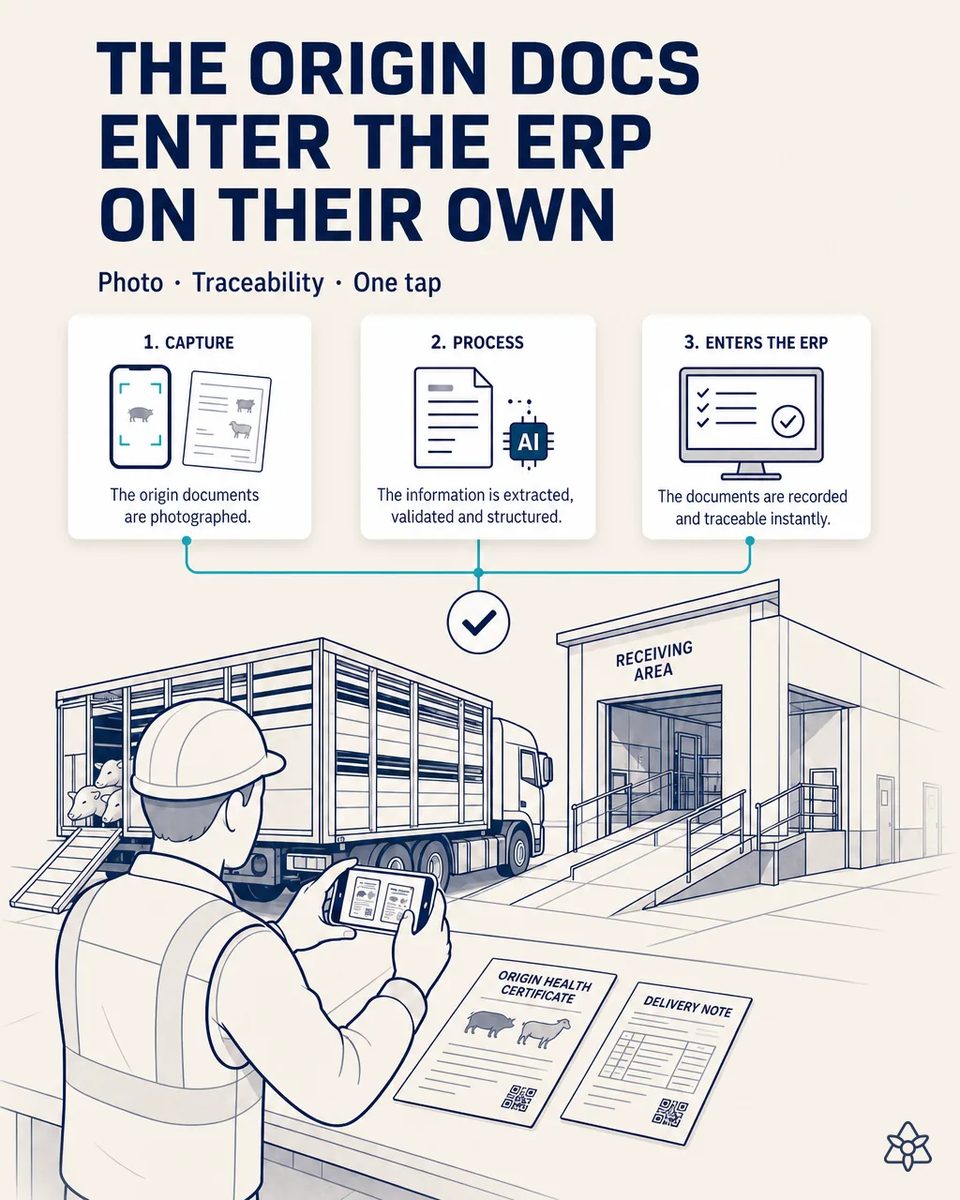
The truck arrives with the livestock. The receiving lead photographs the origin health certificate and delivery note with a phone instead of typing into the ERP while the truck waits.
Link receiving documents to the actual livestock origin
The truck waits while the certificate is typed line by line; rushing it means an origin field gets mis-entered and shows up weeks later as a traceability gap.
- Receiving reconciles the announced delivery with what arrives: origin, movement document, carrier and quantity. A delivery note and an origin certificate may describe the same shipment from different perspectives. Start by establishing that correspondence and retain both originals so the receiving supervisor can explain differences before the entry is finalized in the business system.
Preparing this use case at the plant
Connect photo mode. Recognizes the official health certificate and delivery note formats, extracts farm, head count, date and carrier, and enters the ERP after a validation tap.
Capture complete documents and show the extracted summary next to the expected delivery. Cropped pages, unreadable identifiers and conflicting quantities send the entry to review. Approval creates or updates the receipt, with the ERP response retained. The origin identifier follows the delivery when it is subsequently assigned to a slaughter batch rather than remaining only in a document folder.
Operational change to validate
| Stage | Starting point | Proposed workflow |
|---|---|---|
| Livestock origin documents to ERP by photo | The truck waits while the certificate is typed line by line; rushing it means an origin field gets mis-entered and shows up weeks later as a traceability gap. | Connect photo mode. Recognizes the official health certificate and delivery note formats, extracts farm, head count, date and carrier, and enters the ERP after a validation tap. |
Example target, subject to plant validation: 30-45 min of typing on receiving → 5 min. Hidden origin errors → zero. Broken animal-to-batch traceability → complete from truck unloading.
Measure results before scaling
The block below is an estimate to be validated against your plant's actual data. We put it forward so the committee has an order of magnitude; we refine it during the assessment.
The receiving/traceability module typically requires 2-3 active licenses; with Connect only the lead validates — typical 50-70% reduction. Estimated payback of 3-8 months. Estimate to be validated.
Questions about livestock origin documents to erp by photo
What if one truck arrives with several origin documents?
Separate the origins and relate each document to its quantity and receiving entry. A truck is a logistics unit; it should not become a single origin merely for convenience. Preserve those distinctions so a later investigation can establish which incoming groups contributed to the relevant processing batches and finished cured products.
Which portion of receiving time can be reduced?
This example targets administrative capture and reconciliation. Unloading, inspections and physical checks retain their own procedures. Time those components separately during the pilot and record document exceptions. That approach prevents savings attributed to digital capture from being confused with changes in staffing, shipment size or the conditions at the receiving area.
Request a capture trial on your own health certificate.
We work on your plant's real data, not ours. Assessment with no commitment.
Request estimated ROI within 48h ‹ See all cases of cured meat processing See food industry