AI livestock supplier alerts for cured meats
Application example · Impact to validate
The supplying farm messages on WhatsApp about a livestock delivery delay. It reaches the purchasing lead, who reads it hours later, once the slaughterhouse crew and official veterinarian are already scheduled. With iLEAN Connect, the system reads the notice at zero second and returns the concrete action.
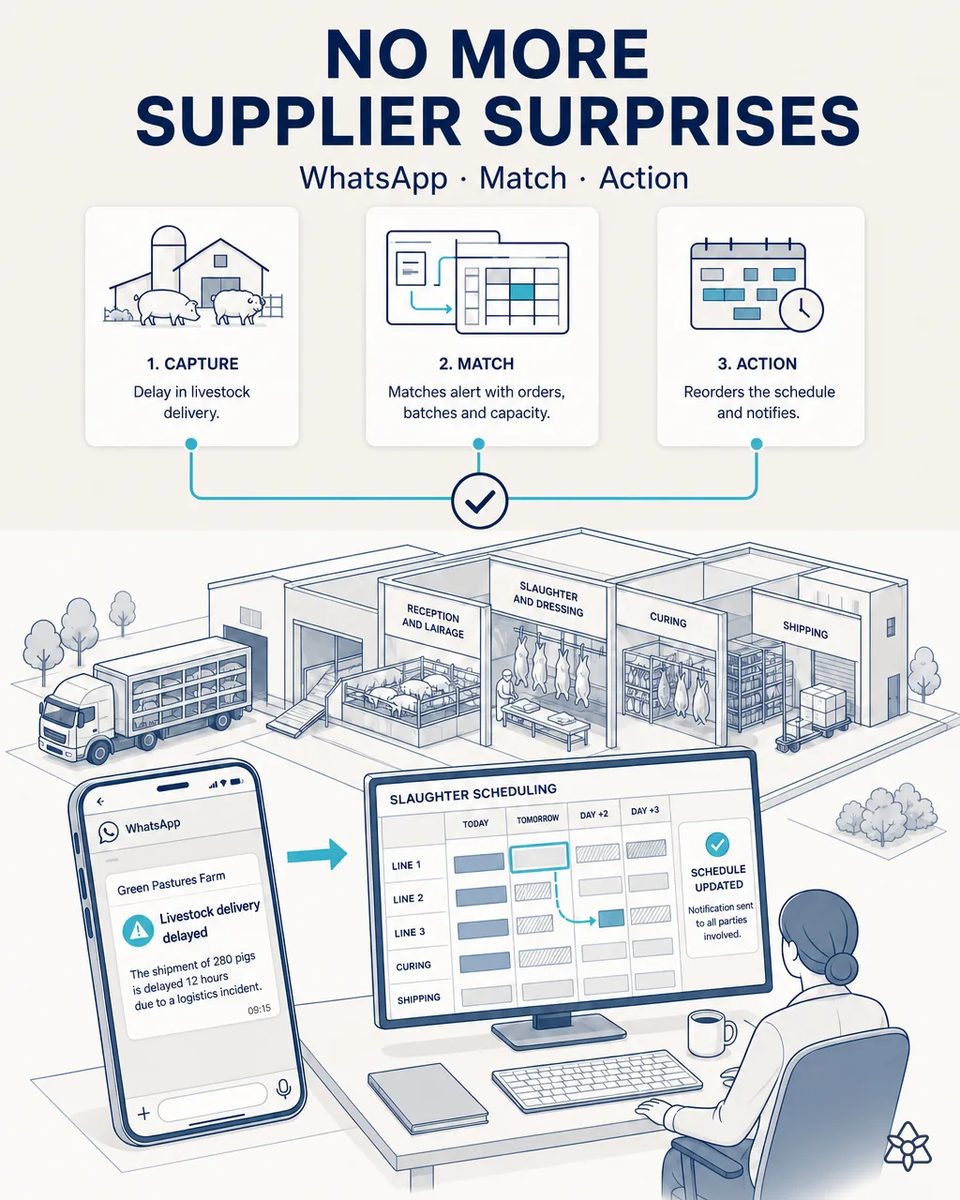
Turn a livestock delivery alert into a reviewed schedule proposal
Critical supplier notices arrive on personal channels to one person who can't always check in real time. By the time it's read, the team is scheduled in vain.
- A useful message identifies the farm, expected delivery, affected quantity and revised arrival. A short delay and a complete cancellation call for different responses. Suppliers may send several updates about the same truck; treating each message as a new delivery would multiply exceptions and confuse receiving. The integration therefore needs a stable link to the expected arrival.
Preparing this use case at the plant
Connect chaotic-sources mode — silent 24/7 mailbox/WhatsApp copy. An LLM extracts intent, supplier, quantity and new date, cross-references the active slaughter schedule, and returns the concrete action to the right role.
Connect authorized business channels to the delivery schedule. Missing details become a pending question rather than an assumed value. The planner receives the original message, affected slaughter batches and a proposal for review. Staffing notifications and schedule changes are confirmed before communication, taking account of available capacity and receiving constraints instead of automatically moving every activity.
Operational change to validate
| Stage | Starting point | Proposed workflow |
|---|---|---|
| AI livestock supplier alerts for cured meats | Critical supplier notices arrive on personal channels to one person who can't always check in real time. By the time it's read, the team is scheduled in vain. | Connect chaotic-sources mode — silent 24/7 mailbox/WhatsApp copy. An LLM extracts intent, supplier, quantity and new date, cross-references the active slaughter schedule, and returns the concrete action to the right role. |
Example target, subject to plant validation: 2-4h human latency → seconds. Rescheduling based on the real notice, not on what was read late.
Measure results before scaling
The block below is an estimate to be validated against your plant's actual data. We put it forward so the committee has an order of magnitude; we refine it during the assessment.
Estimated payback of 3-7 months depending on supply-incident frequency, from avoiding slaughterhouse and veterinary days scheduled in vain. Estimate to be validated.
Questions about ai livestock supplier alerts for cured meats
What happens when the supplier changes the arrival again?
The history preserves both messages and identifies the current version. Recalculate the proposal against the latest schedule so a decision is not executed using a superseded arrival time. The responsible person can inspect the difference and contact the supplier when a fresh message conflicts with an earlier confirmation.
How is the benefit of an earlier alert calculated?
Compare message receipt, operational review and decision timestamps. Count only waiting time or reorganization that the extra notice could actually avoid. Use the plant's staffing and service costs. Faster reading is valuable, but it does not automatically mean the whole slaughter program can be rescheduled when another resource remains unavailable.
Tell us how you currently manage your livestock supplier alerts.
We work on your plant's real data, not ours. Assessment with no commitment.
Request estimated ROI within 48h ‹ See all cases of cured meat processing See food industry