Zero food safety incidents
The capital pain of any condiment, sauce and canned-food plant with a wide recipe catalog is the same: zero food safety incidents. The iLEAN flagship system coordinates Connect, Edge and Agents into cross-checking verification rings, stopping the line before the pallet leaves the plant if anything doesn't match.
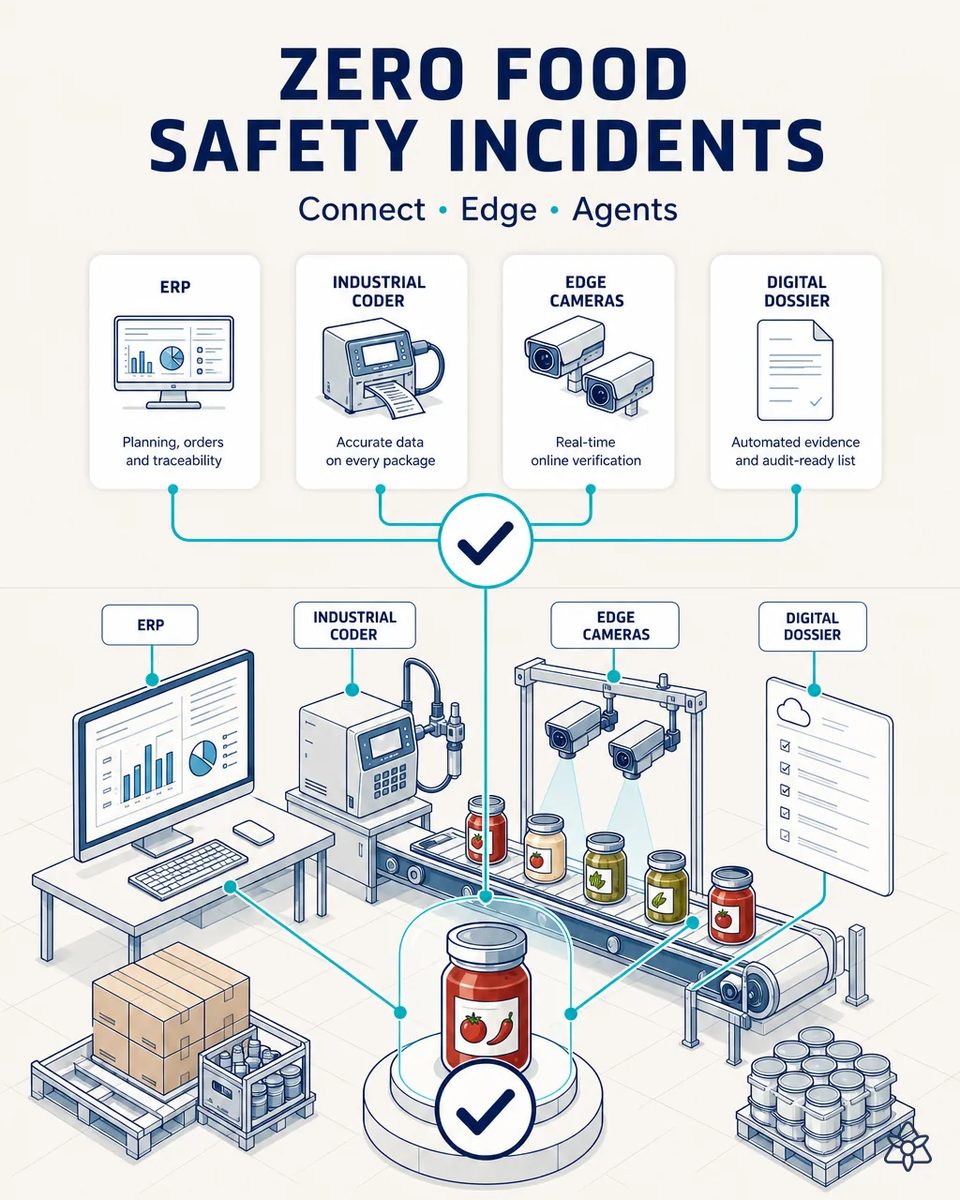
Two failures dominate the risk of this sub-sector.
an incident from insufficient sterilization or an undeclared allergen is the sub-sector's single biggest reputational and financial risk, with possible direct health impact on the consumer and a recall across hundreds of points of sale.
- Insufficient sterilization of a can or jar, and an undeclared allergen in a sauce or dressing: either one is the biggest reputational and financial risk a plant like this carries.
- Both can have a direct health impact on the consumer and lead to a recall across hundreds of points of sale.
- Neither is usually one failure. A cycle slightly short at the retort, a wrong code at the coder, a residue left at a changeover, a missed label: each one passes its own check.
- That is why controls in isolation fall short. What catches the incident is the moment two independent sources stop agreeing.
Cross-checking rings — the eleven cases above, coordinated.
the coordinated rings — the recipe and its allergens from the ERP, the batch printed by the coder (case 8), the retort's sterilization curve (case 2), the cleaning state validated by Edge before restart (case 10), and the batch scanned by the camera at packing (case 9) — cross-check one another, backed by the auditable dossier (case 11) and sped up by SMED AI so coordination doesn't cost productivity.
Each ring already exists in some form, and incidents still happen. The strength is the cross-check: the recipe's allergens, the code printed, the sterilization curve, the cleaning state and the container scanned at packing must all match, or the pallet stays. When they do not, the line stops and quality sees exactly which ring disagreed and why.
The verification rings, and what each one closes on sauce and canning lines
| Ring | Which cases it draws on | What it closes |
|---|---|---|
| 1 · Formula and allergens | ERP recipe + batch startup (1) + receiving (7) | Which formula, which allergens, which ingredient lots |
| 2 · Batch code | Coder (8) + line tablet (5) | That printed batch, date and allergens match the order |
| 3 · Sterilization | Retort panel (2) | That every load completed its thermal process |
| 4 · Changeover and packing | Allergen changeover (10) + fill defect (9) | A clean line at restart and the right container at packing |
| 5 · Audit evidence | Audit dossier (11) | The proof behind the other four, batch by batch |
| Speed | SMED AI between formats | Coordination without losing productivity |
latent risk of a sterilization or allergen-crossover incident → discrepancies caught on the line, never at the customer.
Impact estimate — to be validated with quality and general management.
The block below is an estimate to be validated against your plant's actual data. We put it forward so the committee has an order of magnitude; we refine it during the assessment.
- Estimated payback 6-12 months, counted against the first incident avoided.
- Protecting customer and retailer relationships carries multi-year value far above the cost of a single recall.
- Discrepancies are caught on the line, never at the customer: that is the whole gap between an internal hold and a public recall.
- And the latent risk of a sterilization or allergen-crossover incident turns into a list of discrepancies, each one with its cause.
estimated payback 6-12 months against the first incident avoided; protecting customer and retailer relationships carries multi-year value far above the cost of a single recall. *Estimate to validate with quality and general management.*
And the fair question from the production manager
"Do we need all twelve cases before this protects anything?" — no. The rings are built in layers and each case pays on its own; the coder linked to the ERP plus the line tablet already closes the commonest cause of a labeling recall. Under every layer, the extraction is an anchored task with the best models under 1.5% error [1], and the line stops on a verifiable discrepancy between sources, not on a model's doubt. Ring by ring, the plant sees the return before deciding on the next one.
[1] OpenAI paper "Why Language Models Hallucinate", 2025 — on the reliability of AI in anchored tasks.
What people ask about zero food safety incidents
Which ring is usually built first on sauce and canning lines?
The one with the fewest dependencies and the clearest risk in your plant: often the coder linked to the ERP, or the retort panel if canning dominates your mix. Each layer pays on its own, so the order is set by your risk, not by a roadmap.
Why cross-check instead of improving each control?
Because incidents in this sector are usually a chain of small deviations that each pass their own control. Only comparing independent sources exposes the chain. A slightly short cycle, a code from the previous batch and a residue film can each pass; together they are the incident.
Who decides to stop the line when the rings disagree?
JIDOKA AI holds the pallet on a verifiable mismatch and alerts quality, who decide with the evidence on screen. The hold is recorded with the mismatch that caused it, so the decision carries its evidence. Nothing is held because a model was uncertain; uncertainty goes to a person.
Doesn't holding pallets slow down shipping?
SMED AI works on format and allergen changeovers so that coordination does not cost productivity, and holds happen only on real discrepancies. A hold on a real discrepancy costs hours; the incident it prevents costs a recall.
Does it replace our HACCP plan?
No. The HACCP plan defines the critical control points; iLEAN checks they were met and that every system agrees with what happened on the line. Nor does it replace the ERP or the quality system; it makes them agree with each other.
More cases from this series
- The coder stitched to the ERPBatch, date and allergens travel from the ERP to the coder automatically via API. Zero typing, zero…
- Paperless batch startupThe operator photographs the batch order and formula at startup; the batch already exists in the central…
- The plant manager's headsetThe plant manager dictates incidents while walking the floor; iLEAN listens, structures and pushes back…
- Lab spreadsheet to ERP in secondsiLEAN detects the lab's quality spreadsheet, verifies it, and pushes it to the ERP automatically.…
- Two-tap line verificationNothing iLEAN captures enters the master ERP without a human confirming it first with two taps on an…
- The retort that finally talksAn external camera digitizes the retort's sterilization curve without touching the equipment or its…
Book an AI Discovery session to design your own verification rings.
We work on your plant's real data, not ours. Assessment with no commitment.
Request estimated ROI within 48h ‹ See all cases of condiments and sauces See food industry