From sampling to 100% unit inspection
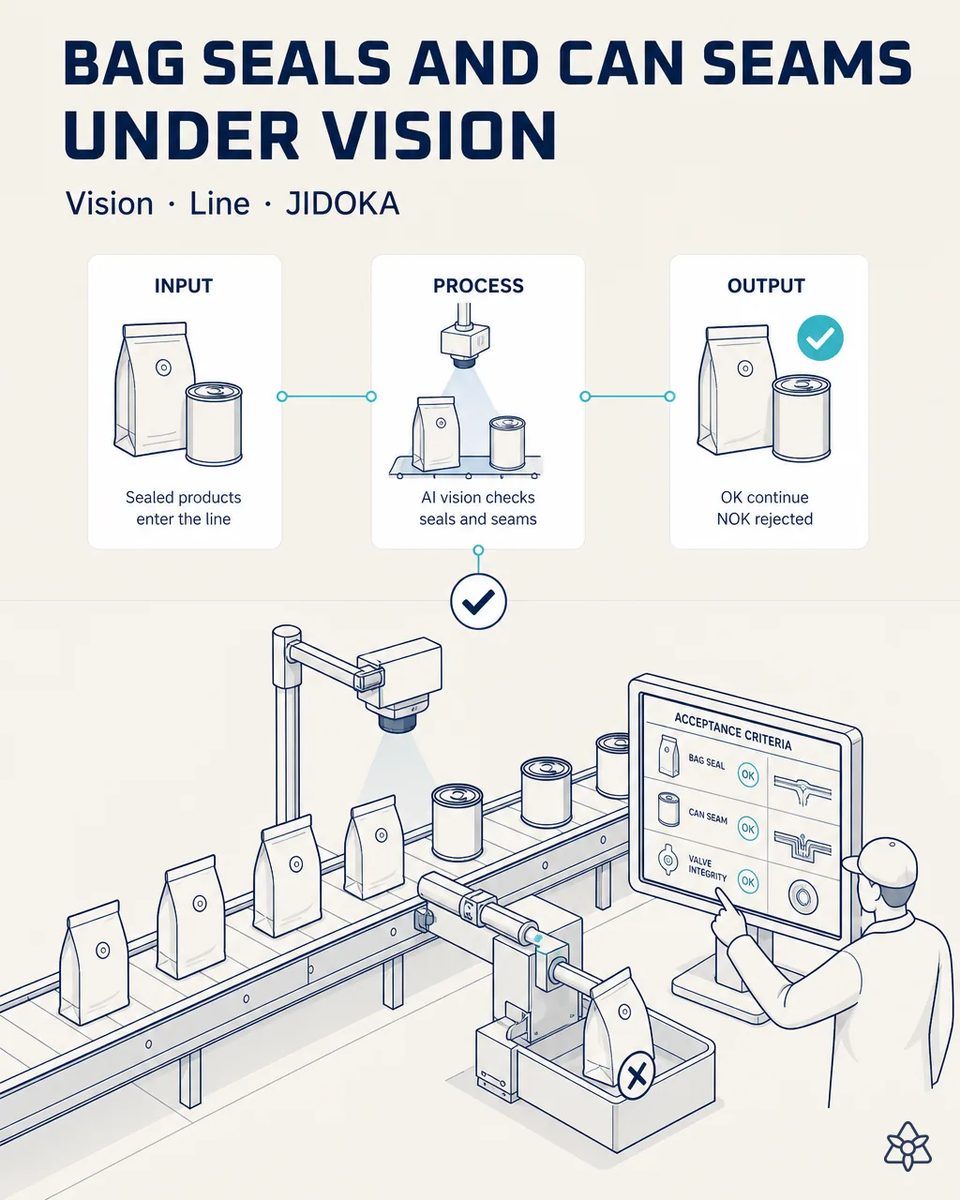
At real packaging line speed the human eye tires and lets through the defect that costs the most: the badly welded seal. In coffee, a bag with an imperfect weld or a misplaced degassing valve loses its aroma; in canned food, a double seam out of specification is a food safety risk. Edge iLEAN puts a camera over the line, infers in milliseconds per unit and rejects the defective one before it reaches the case.
The cost of the defect is asymmetric, and sampling leaves gaps exactly where it matters.
One hundred per cent visual inspection is impossible at real line speed, and this isn't a matter of operator willingness or training: it's a physical limit. That's why the industry standard is sampling, which by definition leaves gaps between samples. The cost of the defect, however, is completely asymmetric between products. A badly sealed coffee bag reaches the consumer as stale product: complaint, loss of brand trust, distributor return. A can with a double seam out of specification is a different category of problem: it's food safety, with regulatory consequences in the destination market. There's a third effect specific to multi-plant groups: each factory has its own acceptance criteria, learned from that plant's most experienced operator. The same format is accepted or rejected differently depending on where it's packed, and there's no way to audit that criterion because it isn't written down anywhere.
- Full visual control is impossible at real line speed, and it is not a matter of willingness or training: it is a physical limit. That is why sampling is the industry standard.
- A badly sealed coffee bag reaches the consumer as stale product: a claim, lost brand trust, a distributor return.
- A can with a double seam out of specification is a different category of problem: it is food safety, with regulatory consequences in the destination market.
- And every factory has its own acceptance criterion, learned from the most senior operator: the same format is accepted or rejected differently depending on where it is packed, and there is no way to audit that criterion because it is not written down.
Edge — machine vision on the line, local inference.
Edge — in-line machine vision. The flow:
The acceptance criterion stops being a local custom: it becomes explicit inside the model, identical across every plant packing that format, and auditable.
- An industrial camera mounted over the packaging line, downstream of the seal or seam.
- A neural network trained on good and bad examples of that line's specific pack format: valve bag, can, glass jar with cap, pasta pack.
- Local inference on an Edge GPU, in milliseconds per unit, with no images sent to the cloud — for latency, cost and bandwidth reasons.
- Automatic rejection of the defective unit before packing.
- Every rejection is logged with its image, feeding the audit evidence pack with no extra work.
The acceptance criteria stop being a local custom and become explicit inside the model: identical across every plant packing the same format, and auditable.
Sampling vs. 100% control
| Aspect | Sampling control | With iLEAN Edge |
|---|---|---|
| Coverage | A fraction of units | 100% |
| Badly sealed bag | Reaches the consumer | Rejected before packing |
| Out-of-spec double seam | Regulatory risk | Detected on the line |
| Acceptance criterion | Implicit, different per plant | Single and explicit |
| Auditing that criterion | Not written anywhere | It is in the model |
| Evidence of a rejection | None | Image on record |
sampling a fraction → 100% unit inspection. Implicit criteria differing by plant → single auditable criteria. Complaints from pack defects → sharply reduced.
Impact estimate — to validate against your numbers.
The block below is an estimate to be validated against your plant's actual data. We put it forward so the committee has an order of magnitude; we refine it during the assessment.
- Packing lines for valve bags, cans, glass jars with capsules and pasta packs.
- Indicative payback between 5 and 12 months, depending on the current defect rate and the unit value of the format.
- In canning it is also justified by risk reduction, not only by waste: the double seam is food safety.
- Start with the format that generates the most claims: that is where the case pays for itself first.
estimated payback of 5 to 12 months depending on the current defect rate and the unit value of the format. For canned goods it is also justified by risk reduction, not only by waste. *Estimate to validate*.
And the fair question from the production manager
“What if it rejects good units?” — the threshold is tuned during the training weeks with real production, and the starting point is deliberately conservative: better to send a few doubtful ones to review than to let a defective seal through. Everything it flags is kept with its image, so the criterion gets audited instead of argued.
[1] OpenAI paper "Why Language Models Hallucinate", 2025 — on the reliability of AI in anchored tasks.
What people ask about vision on seals
Why is inference local and not in the cloud?
Latency, cost and bandwidth. Sending an image of every unit to the cloud at packer cadence is not viable: the reject decision has to be made in milliseconds and at the rejector itself. The GPU sits at the line precisely for that.
How long does training take?
Weeks, not months, and it needs real packs: good ones and defective ones. That is the practical constraint — if a defect appears once a month, examples take time to accumulate. For the frequent ones, which are the ones that hurt, there is usually enough material within a few runs.
Does one model cover both cans and bags?
No: it is trained per specific pack, because what counts as a defect on a valve bag is not what counts on a double seam. What does carry over is the mounting and the groundwork, so the second line costs considerably less than the first.
Does it slow the line down?
No: inference happens in milliseconds on a local GPU, which is precisely why it is not in the cloud. The camera runs at the packer's cadence, not the other way around.
What does a multi-plant group gain over a single factory?
The common criterion. Today the same format is accepted or rejected differently depending on the plant, because the criterion belongs to the most senior operator at each site and is written nowhere. With the model trained once, every plant packing that format applies the same criterion — and it can be audited.
More cases from this series
- From two weeks reconstructing traceability to zeroEvery critical change generates its dossier: before/after photos, decisions and signatures, reorganised…
- Ten acquired factories, one operational languageA capture and normalisation layer over the systems that already exist makes M&A-acquired factories speak…
- Lot, date and allergens stop depending on someone typingLot, date and allergens travel from the active order to the coder via API. Zero typing on the machine…
- Goods-in stops blocking the dock manager for an hourPhotograph the docket and the sack labels: iLEAN extracts lots and origin certificates, the manager…
- What the shift lead knows stops evaporating every eight hoursThe shift lead dictates issues while walking between retort and filler; the AI structures them, links…
- The shift quality sheet stops being retyped by handiLEAN reads the quality sheet as it is saved, normalises it to the group model and, after sign-off,…
Start with the format that generates you the most claims.
We work on your plant's real data, not ours. Assessment with no commitment.
Request estimated ROI within 48h ‹ See all cases of coffee, culinary, snacks and foodservice See food