From two weeks reconstructing traceability to zero
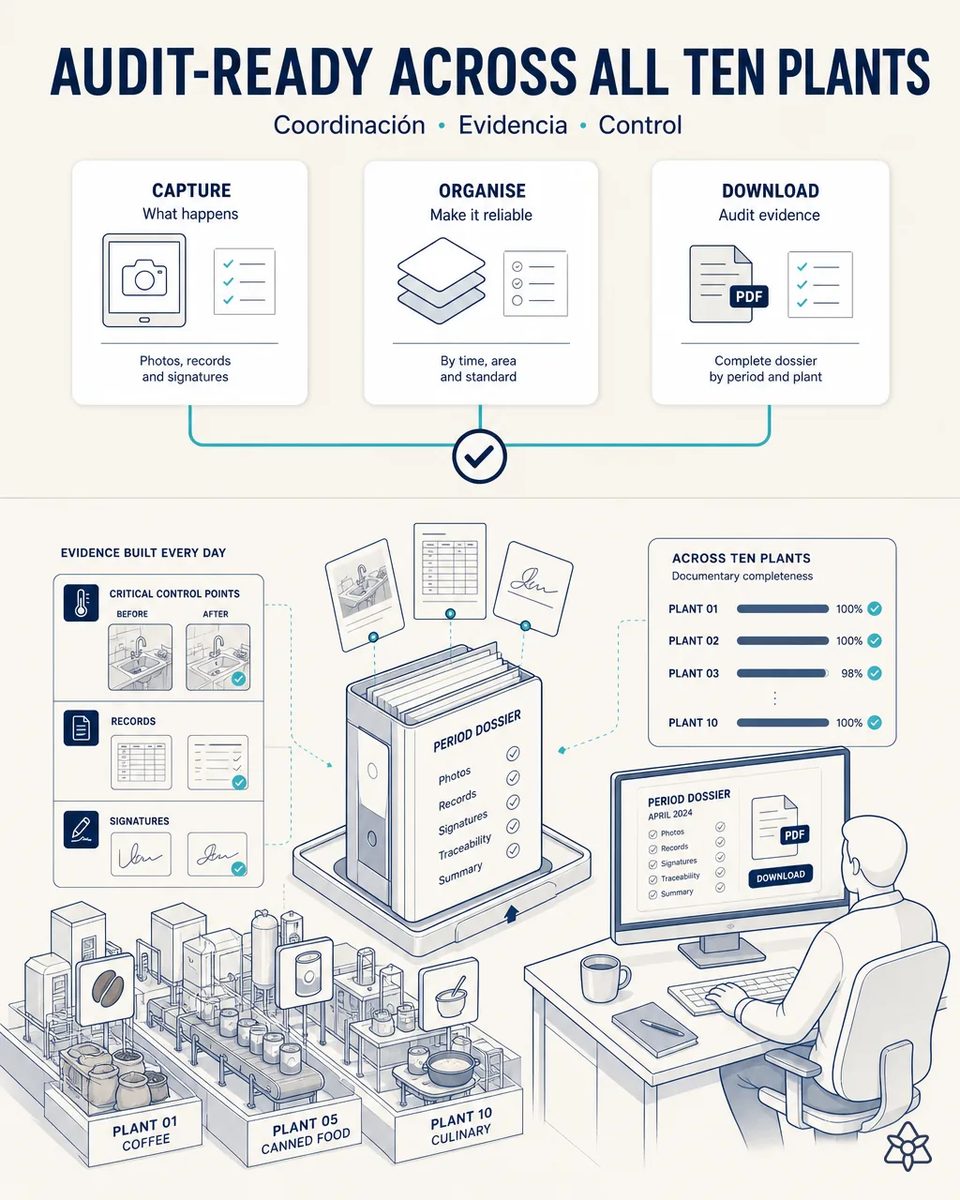
The day the auditor arrives — from the retailer standard, the gluten-free certifier, the green coffee sustainability scheme or the destination market authority — someone in the plant spends two weeks reconstructing traceability. With iLEAN Edge + Agents, every critical change automatically generates its evidence pack: before and after photos of each point, a record of decisions and time-stamped signatures, reorganised by certifying standard.
It is not that evidence is missing. It is that it is not gathered.
It's worth being precise, because the issue isn't missing evidence: the evidence exists. It's on a paper log, in a photo on someone's phone, in a lab spreadsheet, in an email. What's missing is having it gathered, ordered and tied to the lot and the specific change the auditor will ask about. Reconstructing it is manual work against the clock that competes directly with production, and it repeats every time a different certifier arrives, because each standard wants the same information organised its own way. When a non-conformity appears, it's almost never because the plant did something wrong: it's a documentary gap. In a group with ten plants across different countries this happens several times a year, differently at each site. Which leaves corporate management without an answer to a basic question: which of my plants is actually ready for an audit? You find out when the auditor arrives, which is too late.
- The evidence exists: on a paper log, in a photo on somebody's phone, in a lab spreadsheet, in an email.
- What is missing is for it to be ordered and tied to the batch and the specific change the auditor is going to ask about.
- Rebuilding it competes directly with production, and it repeats with every certifier because each standard asks for the same information organized its own way.
- A nonconformity is almost never because the plant did something wrong: it is a documentary gap. And corporate cannot answer a basic question — which plant is ready? — until the auditor arrives, which is too late.
Edge + Agents — evidence is captured where it happens and organizes itself.
Edge + Agents. The flow:
Every certifier asks for the same information organized its own way. It gets captured once and organized as many times as needed, with no duplicated work on the floor.
- Edge captures the visual evidence at the moment of each critical change: before and after photos of every point, time-stamped.
- Connect contributes what the other cases captured: logs, curves, lab sheets, goods-in records, human validations with their signatures.
- Agents organises that same data according to whichever standard is asking — each certifier its own way — without duplicating capture in the plant.
- It generates the evidence pack per period and per plant, downloadable by the auditor.
- It maintains a documentary completeness indicator per site, visible from head office in real time.
Rebuilt evidence vs. evidence already composed
| Aspect | Today | With iLEAN Agents |
|---|---|---|
| Preparation per audit | Two weeks | Zero |
| Where the evidence lives | Paper, phones, spreadsheets, email | Organized by standard |
| Several standards | One rebuild for each | One dossier per standard |
| Documentary gaps | Nonconformity | Eliminated |
| “Which plant is ready?” | You find out when the auditor arrives | Completeness indicator in real time |
| Bounding a claim | Over-contained | By batch and change, in minutes |
two weeks of reconstruction before every audit → zero. "We'll know if the plant is ready when the auditor comes" → a per-plant completeness indicator in real time. Non-conformity risk from documentary gaps → eliminated.
Impact estimate — to validate against your numbers.
The block below is an estimate to be validated against your plant's actual data. We put it forward so the committee has an order of magnitude; we refine it during the assessment.
- Groups with plants in several countries and several standards per plant: retailer, gluten-free, green coffee sustainability, destination-market authority.
- Indicative payback between 6 and 12 months, depending on audit frequency and number of standards.
- Continuous protection of the certifications that grant markets and customers — the underlying argument, above the recovered time.
- Plus the plant time spent preparing audits, which today competes with producing.
continuous protection of the certifications that unlock markets and customers, plus recovered plant time spent preparing audits. Estimated payback of 6 to 12 months depending on audit frequency and number of standards per plant. *Estimate to validate*.
And the fair question from the production manager
“Isn't this just another document manager?” — a document manager stores what somebody uploads. Here nobody uploads anything: evidence is generated where the work happens — the changeover cameras, the tablet signature, the photographed log — and Agents' job is to order it by the standard that asks for it, which is exactly the part that eats the two weeks today.
[1] OpenAI paper "Why Language Models Hallucinate", 2025 — on the reliability of AI in anchored tasks.
What people ask about the audit dossier
Does it work for several standards at once?
That is the case it is built for. A plant serving a retailer, holding gluten-free certification and working coffee under a sustainability scheme lives under three documentary regimes, and today every audit is a separate rebuild of the same facts. Capture is single; organization is one per standard.
Does Edge need to be deployed first?
For the richest evidence — allergen changeover photos, clean-line validation — yes, because that is what generates it. But the case works partially from earlier: tablet signatures, photographed logs, receiving and lab sheets already compose a dossier far better than today's. It grows as the other pieces get deployed.
What is the completeness indicator per plant?
A live percentage of how much of the evidence a standard requires is actually captured at that plant, visible from corporate. It is what turns “we will know if it is ready when the auditor comes” into a figure somebody looks at on a Tuesday morning.
How far back does it go?
As far back as capture has been running. It does not reconstruct history that was never recorded, and it is worth being clear: the first audit after deployment covers a period partly documented the old way. From the second onwards, the whole period is already composed.
Can the auditor be given direct access?
It can be done, and it is a decision to take deliberately rather than by default. What is normally done is generating the dossier for the requested period and sending it, which already turns days into minutes. Standing access is a commercial decision, not a technical one.
More cases from this series
- Ten acquired factories, one operational languageA capture and normalisation layer over the systems that already exist makes M&A-acquired factories speak…
- Lot, date and allergens stop depending on someone typingLot, date and allergens travel from the active order to the coder via API. Zero typing on the machine…
- Goods-in stops blocking the dock manager for an hourPhotograph the docket and the sack labels: iLEAN extracts lots and origin certificates, the manager…
- What the shift lead knows stops evaporating every eight hoursThe shift lead dictates issues while walking between retort and filler; the AI structures them, links…
- The shift quality sheet stops being retyped by handiLEAN reads the quality sheet as it is saved, normalises it to the group model and, after sign-off,…
- The alert that dies in an inbox now reaches production in secondsAlerts from your own restaurant channel reach production in seconds, cross-checked against live orders…
Have the dossier ready before anybody asks for it, in all ten plants.
We work on your plant's real data, not ours. Assessment with no commitment.
Request estimated ROI within 48h ‹ See all cases of coffee, culinary, snacks and foodservice See food