The alert that dies in an inbox now reaches production in seconds
When a group roasts its own coffee and also runs the coffee shops and restaurants that sell it, the whole chain sits inside the house — and yet the alert that matters still travels by messaging app. A store manager reports a stockout, a pallet with the wrong grind, or a promotion about to triple demand. The message reaches one person, who reads it when they can, and by then the plant has closed the week's schedule. With iLEAN Connect the message is read at second zero, and what reaches planning isn't an alert — it's an action.
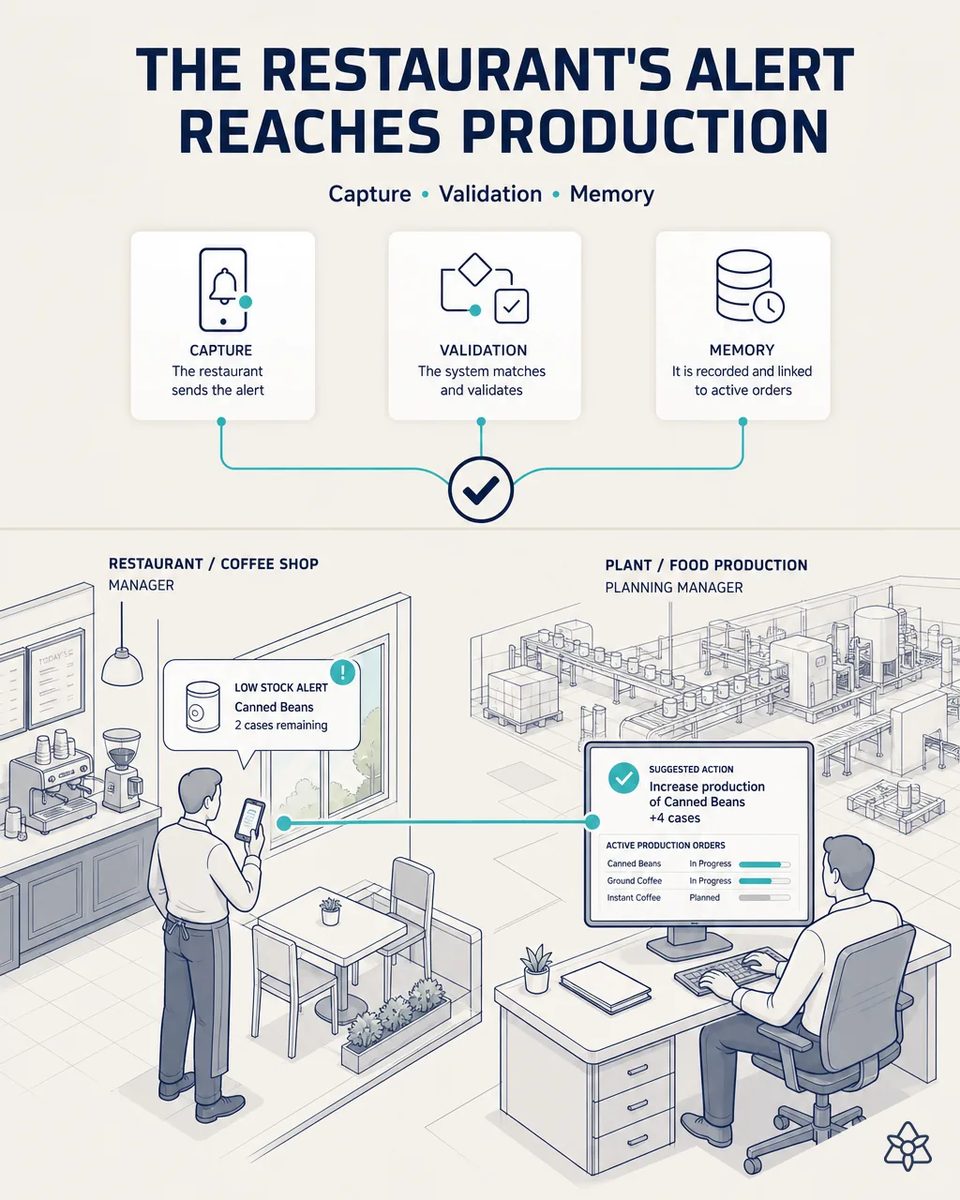
The expensive part is not the latency: it is that the signal is never in one place.
Critical alerts from your own channel arrive through informal routes: messaging, personal email, phone calls. Unstructured, in several languages and from several countries. Each reaches one specific person who processes it when their day allows, and the process leaves no trace: there's no way to know afterwards how many alerts there were, of what kind, or what was done about them. The costliest part isn't the latency, it's the lack of aggregation. If three outlets report the same thing in the same week, nobody sees that pattern because the three messages landed in three different inboxes. The signal existed and was complete; it simply wasn't in one place where someone could read it as a trend. And the economic consequence is doubled. A stockout in your own channel is paid in the restaurant's lost sale and again in the mis-planned production of the plant supplying it. In a vertically integrated group, the same error appears twice in the P&L.
- Alerts arrive through informal channels: messaging, personal email, a phone call. No format, in several languages and from several countries.
- Each one lands in a different inbox and gets processed when that person's day allows. It leaves no trace.
- If three outlets report the same thing in the same week, nobody sees the pattern: the signal existed and was complete, just scattered.
- And in an integrated group the same mistake is paid twice: in the restaurant's lost sale and in the mis-planned production of the plant supplying it.
Connect in chaotic-sources mode — nobody changes tools.
Connect in "chaotic sources" mode. The flow:
What reaches planning is not a notification: it is which order to move and to which center, already cross-referenced with active orders and real stock.
- A dedicated mailbox and a WhatsApp Business number sit on silent copy, around the clock. Nobody switches tools: the store manager keeps writing exactly as they do today.
- As soon as a message arrives, a language model extracts the intent — stockout, quality issue, demand forecast — and the entities — reference, format, outlet, quantity.
- It is cross-checked against live data: active production orders and real stock at the distribution centre.
- The relevant role receives a concrete action — which order to move and to which centre — not a notification.
- All alerts are aggregated and traceable, so the pattern is visible even when the messages come from different countries.
Scattered alerts vs. an aggregated flow
| Aspect | Today | With iLEAN Connect |
|---|---|---|
| Alert latency | Hours | Seconds |
| Where it ends up | A personal inbox | Aggregated and traceable |
| What planning receives | A message | A concrete action |
| Pattern across outlets | Invisible | Visible across countries |
| The manager's tool | Theirs | Theirs, unchanged |
| Replanning | On what somebody read this morning | On what is happening now |
hours of human latency → seconds. Alerts scattered across personal inboxes → an aggregated, traceable flow from channel to plant. Replanning based on what someone read this morning → based on what is happening now.
Impact estimate — to validate against your numbers.
The block below is an estimate to be validated against your plant's actual data. We put it forward so the committee has an order of magnitude; we refine it during the assessment.
- Vertically integrated groups that roast and also run their own cafés and restaurants.
- Indicative payback between 3 and 7 months, depending on how often critical alerts arrive and how many outlets are served.
- Through fewer stockouts in the owned channel and fewer disruptions from late replanning.
- The larger value, and the hardest to put in the spreadsheet: seeing the pattern that today sits in three separate inboxes.
reduced stockouts in the owned channel and fewer stoppages from late replanning; estimated payback of 3 to 7 months depending on alert frequency and number of outlets served. *Estimate to validate*.
And the fair question from the production manager
“Are you going to read my people's messages?” — what gets read is a dedicated inbox and a WhatsApp Business number set up for operational alerts. Nobody's personal messaging is touched and no private conversation is accessed. And what comes out is a proposed action for a role, not a report about a person.
[1] OpenAI paper "Why Language Models Hallucinate", 2025 — on the reliability of AI in anchored tasks.
What people ask about alerts from the owned channel
Does the outlet manager have to learn a new app?
No, and that is the condition for this to work. An outlet manager has a full counter and writes the alert however they can, on their phone, between two services. Anything that asks them to open another tool gets abandoned within weeks. They keep writing exactly as before, to a number they already know.
What if the message is in another language?
It is processed the same. In a group with outlets in several countries that is normal, and it is one of the reasons alerts do not aggregate today: nobody was going to normalize messages in three languages by hand. The model extracts intent and entities regardless of the language.
What happens with an ambiguous alert?
It still gets routed, flagged as ambiguous, rather than discarded. An ambiguous alert processed late is still better than a lost one, and the role receiving it decides. What the system does not do is act alone on a doubtful reading.
Can it move an order by itself?
No. It proposes the action — which order to move and to which center — and the planner decides. It is the same rule as the rest of the matrix: the AI supplies the cross-referenced data and the proposal, never the signature.
Is it only for stockouts?
That is the most frequent case, not the only one. Quality incidents spotted in the dining room and demand forecasts also come in — a promotion about to triple consumption of one reference, which is exactly the alert that today arrives once the week's schedule is closed.
More cases from this series
- From two weeks reconstructing traceability to zeroEvery critical change generates its dossier: before/after photos, decisions and signatures, reorganised…
- Ten acquired factories, one operational languageA capture and normalisation layer over the systems that already exist makes M&A-acquired factories speak…
- Lot, date and allergens stop depending on someone typingLot, date and allergens travel from the active order to the coder via API. Zero typing on the machine…
- Goods-in stops blocking the dock manager for an hourPhotograph the docket and the sack labels: iLEAN extracts lots and origin certificates, the manager…
- What the shift lead knows stops evaporating every eight hoursThe shift lead dictates issues while walking between retort and filler; the AI structures them, links…
- The shift quality sheet stops being retyped by handiLEAN reads the quality sheet as it is saved, normalises it to the group model and, after sign-off,…
Tell us how many critical alerts reach you by WhatsApp each week.
We work on your plant's real data, not ours. Assessment with no commitment.
Request estimated ROI within 48h ‹ See all cases of coffee, culinary, snacks and foodservice See food