Lot, date and allergens stop depending on someone typing
The coder printing lot and date on every coffee bag, every can and every pasta pack is the last physical step before the customer. It's relatively modern and it has an API, but it's isolated from the ERP: at every lot change someone types the code into its keypad by hand. One wrong digit means half a production run with the wrong lot. With iLEAN, lot, dates and allergens travel automatically from the active order, without replacing either system.
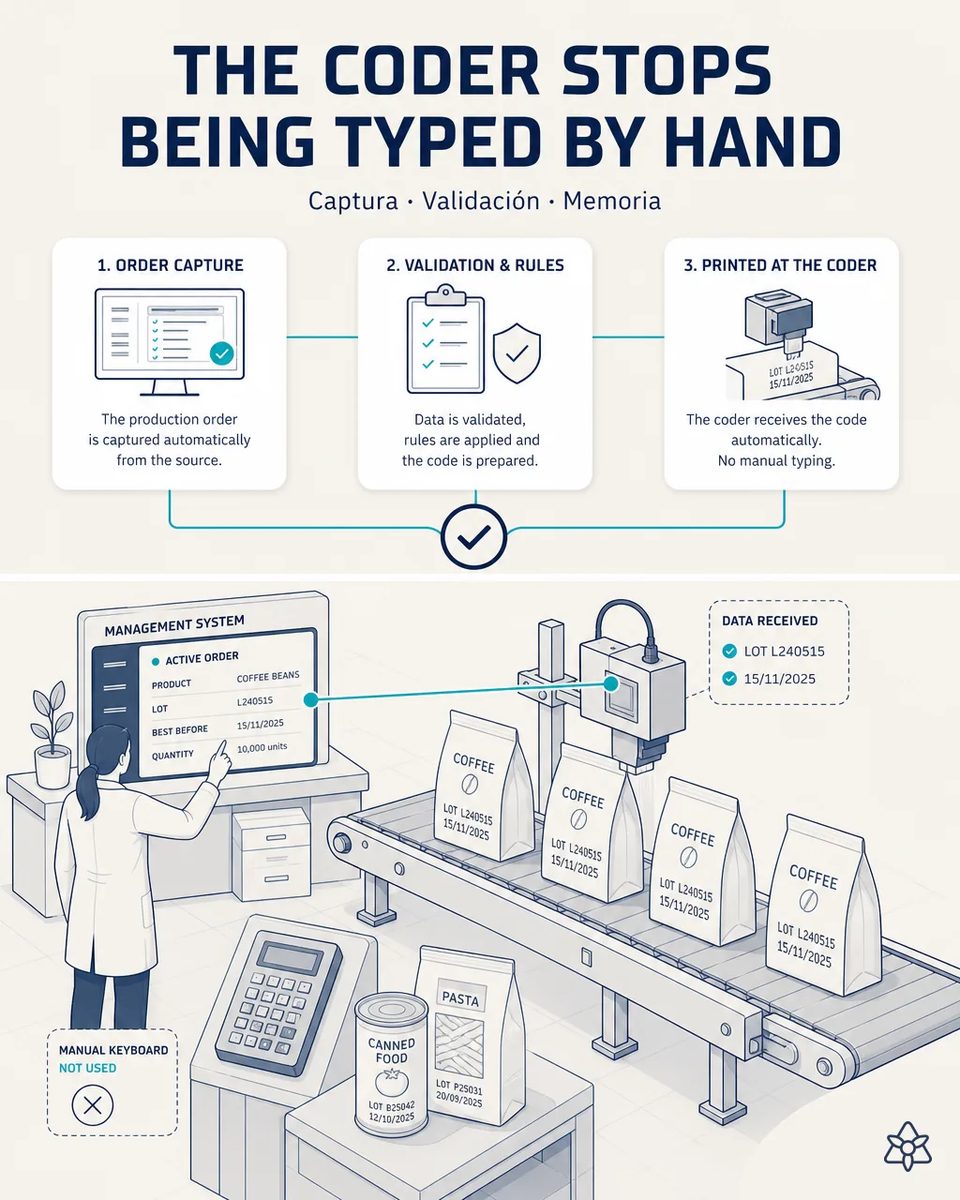
It is the last thing that happens before the door, and it still depends on typing.
Coding combines two features that make it dangerous: it's the last thing that happens before product leaves the plant, and it's one of the few steps still depending on manual typing. An error there isn't caught downstream, because there is no downstream — it goes out of the door. The allergen case is especially delicate in a group making culinary products with and without gluten and canned goods on different recipes. The printed list has to match exactly the recipe running at that moment, not the previous shift's or the next order's. There's no tolerance margin. And the integration has been pending for years at each plant, not through negligence but through prioritisation: there's always something more urgent than connecting a machine that "already works". Which is exactly why the fix has to be cheap and fast, not a multi-year project.
- An error there is not caught downstream because there is no downstream: it goes out of the door.
- One wrong digit means half a production run with the wrong batch code.
- Allergens are the delicate case: the printed list has to match the recipe being produced right now, not the previous shift's and not the next order's. There is no tolerance.
- The integration has been pending for years, not through negligence but through prioritization: there is always something more urgent than connecting a machine that “already works”.
Connect stitching two modern systems through the API, replacing neither.
Connect stitching two modern systems via API, replacing neither. The flow:
The pattern replicates plant by plant even when each has a different ERP: solved once and deployed N times, instead of N bespoke projects.
- The ERP marks the start of the production order.
- Connect automatically publishes to the coder the lot, the packing and best-before dates, and the allergen list of the active recipe.
- A lot change becomes a tap in the management system, not typing on a machine keypad.
- What was printed is recorded and available for cross-checking with in-line visual verification and for the audit evidence pack.
The pattern replicates plant by plant identically, even though each has a different ERP: solve once, deploy N times, instead of N bespoke projects.
Isolated coder vs. stitched coder
| Aspect | Today | With iLEAN Connect |
|---|---|---|
| Batch change | Typed into the machine panel | One tap in the management system |
| Where the data comes from | The memory of whoever types | The active order |
| Allergen list | Whatever the last shift left | The active recipe's |
| Typing errors | Several a month per plant | None of human origin |
| What was printed | Not recorded | Recorded and cross-checkable |
| Rollout across N plants | N bespoke projects | One replicable pattern |
several typing errors a month per plant, some carrying recall risk → zero human-origin coding errors. One bespoke integration per plant → one replicable pattern.
Impact estimate — to validate against your numbers.
The block below is an estimate to be validated against your plant's actual data. We put it forward so the committee has an order of magnitude; we refine it during the assessment.
- Relatively modern coders, with an API, but isolated from the ERP in every plant.
- Indicative payback between 3 and 6 months: among the fastest in the matrix.
- And a sharp reduction in recall risk from mislabeling, which is the argument that carries weight when allergens are involved.
- To be checked against the real history of coding errors of the last few years.
fast payback, estimated at 3 to 6 months, and a drastic reduction in recall risk from mislabelling. *Estimate to validate* against the coding error history.
And the fair question from the production manager
“What if the integration leaves the coder down?” — it is stitched through the API the machine already exposes, without touching its control, and it is tested first on one line during a batch change that was already planned. If something does not fit, it shows on that line and not across the plant. The coder still accepts manual typing exactly as before.
[1] OpenAI paper "Why Language Models Hallucinate", 2025 — on the reliability of AI in anchored tasks.
What people ask about stitching the coder
Does the coder have to be replaced?
No. These machines are usually the most modern thing on the line and almost always expose an API: what is missing is not technical capability, it is the integration project that never reaches the top of the list. Connect uses that API and the machine stays where it is.
Why are allergens such a critical matter?
Because in a group producing gluten-free and conventional culinary plus canned goods with different recipes, the printed list has to match the recipe being produced at that moment. A one-order lag is enough for mislabeling, and there is no tolerance and no downstream control that catches it.
Can it get out of sync with the order?
The trigger is the order start in the ERP, so publication is tied to the same event that defines what is being produced. And what was printed is recorded, so it can be cross-checked against inline visual verification: if it ever did not match, it shows, instead of being discovered in the market.
Does it work with any ERP?
Yes, and that is the point of the pattern. Each acquired plant brings its own and none gets replaced; what replicates is the way of stitching, not the specific integration. That is why the second plant costs a fraction of the first.
Can we start with one line?
That is the recommended way. You stitch one line, check across a couple of batch changes that what is printed matches the order, and replicate. The integration is the same for every line sharing a coder.
More cases from this series
- From two weeks reconstructing traceability to zeroEvery critical change generates its dossier: before/after photos, decisions and signatures, reorganised…
- Ten acquired factories, one operational languageA capture and normalisation layer over the systems that already exist makes M&A-acquired factories speak…
- Goods-in stops blocking the dock manager for an hourPhotograph the docket and the sack labels: iLEAN extracts lots and origin certificates, the manager…
- What the shift lead knows stops evaporating every eight hoursThe shift lead dictates issues while walking between retort and filler; the AI structures them, links…
- The shift quality sheet stops being retyped by handiLEAN reads the quality sheet as it is saved, normalises it to the group model and, after sign-off,…
- The alert that dies in an inbox now reaches production in secondsAlerts from your own restaurant channel reach production in seconds, cross-checked against live orders…
Tell us how many coding errors you have had this year.
We work on your plant's real data, not ours. Assessment with no commitment.
Request estimated ROI within 48h ‹ See all cases of coffee, culinary, snacks and foodservice See food