Goods-in stops blocking the dock manager for an hour
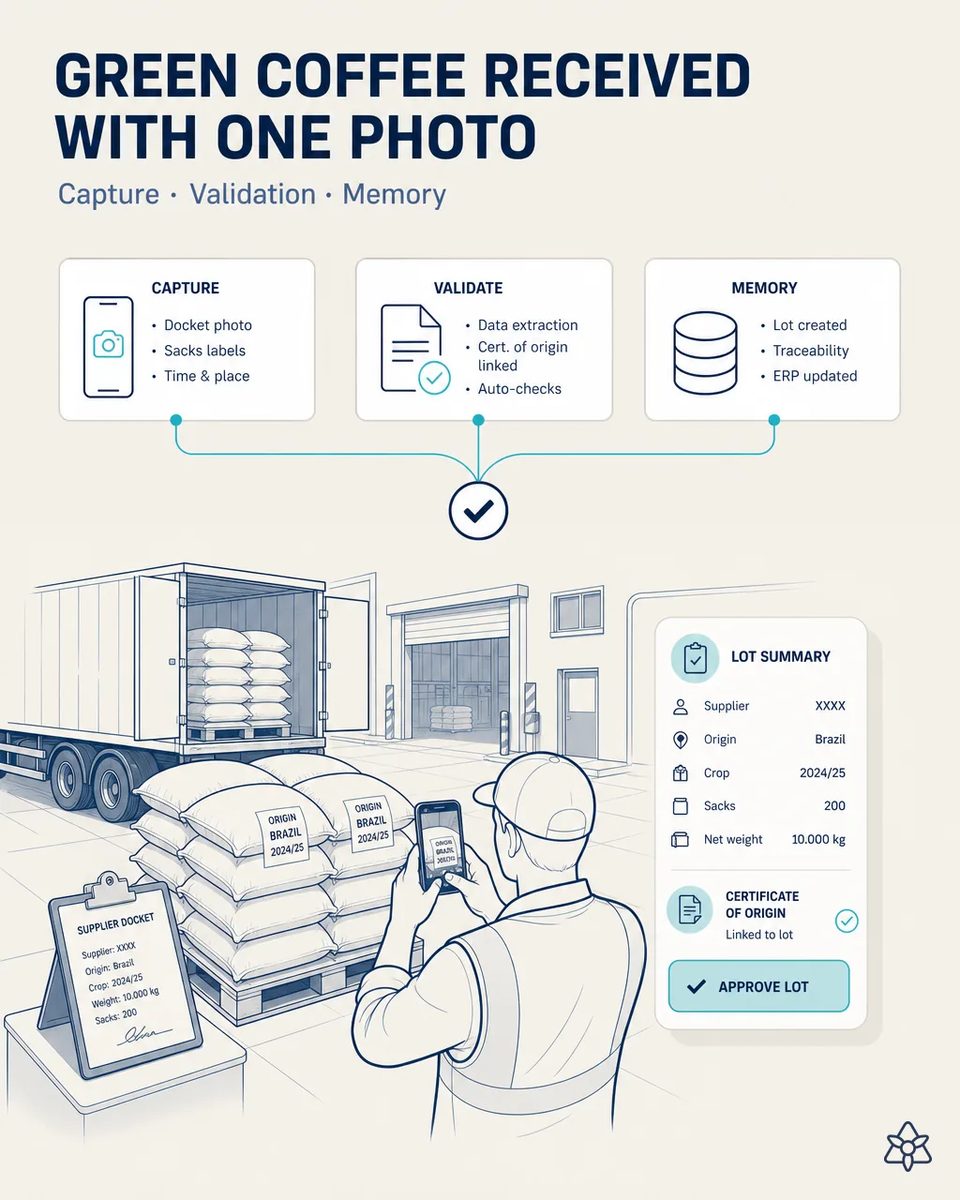
The green coffee container arrives, or the fresh produce truck, or the flour pallet. Goods-in is where all traceability is born and it's exactly where time pressure is highest: you have to sign and also type line by line into the ERP. With iLEAN Connect, one photo of the docket and one of the labels is enough: the system extracts lots, quantities and expiry dates, ties the origin certificate to the physical lot, the manager approves with one tap and it all enters the ERP.
Two incompatible tasks at the same moment.
The goods-in manager has a docket with dozens of lines in front of him and the sacks or pallets with their lot and origin labels. And two incompatible tasks at the same moment: release the haulier and record the intake correctly. Either the truck waits and charges demurrage, or it gets typed in a hurry. Both options cost money, one visibly and one not. When it's typed in a hurry, lots are traced wrongly. And it doesn't show that day: it resurfaces weeks later, in an alert or a complaint nobody can trace backwards, because the link between the physical lot and the record was broken on the dock. Green coffee adds a documentary layer. If the lot falls under a sustainability scheme or organic certification, the certificate has to stay tied to the physical lot. Today that's usually a PDF in an email someone files by hand, and proving that link a year later is an exercise in documentary archaeology.
- Releasing the carrier and recording the intake correctly, at once.
- Either the truck waits charging demurrage, or it gets keyed in fast. Both cost money, one visibly and one not.
- When it gets keyed in fast, batches end up badly traced — and that does not show that day: it comes back weeks later, when nobody can reconstruct it.
- Green coffee adds a documentary layer: if the lot is under a sustainability scheme or organic certification, the certificate has to stay tied to the physical lot. Today it is a PDF in an email.
Connect in photo-the-analog mode with a push to the ERP.
Connect in "photo of the analogue" mode with ERP push. The flow:
Proving a year later that this certificate belongs to that lot should not be an exercise in documentary archaeology. Tied at the dock, it comes out in the same dossier as everything else.
- Photo of the supplier's docket. AI vision recognises each supplier's format without asking any of them to change it, and extracts the full tabular structure.
- Photo of the sack, big bag or pallet labels: reading GS1-128, QR, barcode or plain text by OCR.
- The origin or sustainability certificate is automatically linked to the physical lot received.
- The manager reviews the on-screen summary and approves with one tap.
- Connect pushes to the ERP via API: lot, quantity, expiry, supplier and associated documentation.
Keyed receiving vs. captured receiving
| Aspect | Current receiving | With iLEAN Connect |
|---|---|---|
| Lead blocked | Close to an hour | Minutes |
| Delivery note | Keyed line by line | Photo and one tap |
| Sack and pallet labels | By eye | GS1-128, QR, barcode or OCR |
| Batch errors | Show up weeks later | Show up in the validation |
| Origin certificate | Loose PDF in an email | Tied to the physical lot |
| Receiving module licenses | 2-3 active | 1, the validator's |
unloading blocking the manager for the best part of an hour → minutes. Lot errors surfacing weeks later → caught at validation. Certificate loose in an email → tied to the lot from goods-in.
Impact estimate — to validate against your numbers.
The block below is an estimate to be validated against your plant's actual data. We put it forward so the committee has an order of magnitude; we refine it during the assessment.
- Continuous intake of green coffee, fresh vegetables and flour, with delivery notes of dozens of lines.
- CFO angle: the receiving and warehouse module typically needs 2-3 active licenses per plant; with Connect only the lead validates.
- Typical reduction of 50 to 70% in receiving and warehouse licenses, plus the mass-capture modules that stop being necessary.
- Indicative payback of 3 to 8 months per plant, adding licenses and avoided carrier demurrage.
— *CFO angle, direct licence saving*: the goods-in and warehouse module typically requires 2-3 active licences per plant (goods-in manager, support, supervisor); with Connect only the manager approves, without logging into the ERP. Typical reduction of 50-70% in goods-in/warehouse module licences, plus elimination of bulk-capture module costs and invoiced demurrage. Estimated payback 3-8 months per plant. *Estimate to validate*.
And the fair question from the production manager
“What if it extracts a quantity wrong and stock enters wrong?” — extracting a table from a delivery note is an anchored task over a structured document, where the best models drop below 1.5% error [1]. And today's keying error under time pressure is considerably more frequent, with the aggravating factor that it appears weeks later. Here the summary is validated with the truck still at the dock.
[1] OpenAI paper "Why Language Models Hallucinate", 2025 — on the reliability of AI in anchored tasks.
What people ask about digitizing receiving
Do suppliers have to use a standard delivery note?
No, and that is what makes the case viable. Each supplier sends theirs however they want and standardizing formats is an endless project you do not even control. Vision recognizes the tabular structure of the document rather than relying on fixed templates, so it lives with different formats from day one.
What about the origin or sustainability certificate?
It is captured the same way and stays tied to the lot, which is the part lost today. In green coffee under a sustainability scheme or organic certification that document gets requested, and hunting for it in an email a year later is exactly the work that turns an audit into somebody's week.
Why does inbound traceability matter so much?
Because it is the first link: if the green lot entered badly linked, no later traceability works. When an alert or a claim arrives you cannot bound which production went out with that material, and far more has to be contained than is really affected.
Does it replace the RF terminal?
At the receiving point, largely yes, and part of the saving is there: the mass-capture modules and the dedicated terminals that existed only for this step stop being needed. In the rest of the warehouse nothing is touched.
What if the note does not match the order?
The discrepancy is flagged for review instead of entering as it is. The lead sees it highlighted and decides: accept, correct or reject the line. It is exactly the case where today it gets keyed fast and the problem appears weeks later.
More cases from this series
- From two weeks reconstructing traceability to zeroEvery critical change generates its dossier: before/after photos, decisions and signatures, reorganised…
- Ten acquired factories, one operational languageA capture and normalisation layer over the systems that already exist makes M&A-acquired factories speak…
- Lot, date and allergens stop depending on someone typingLot, date and allergens travel from the active order to the coder via API. Zero typing on the machine…
- What the shift lead knows stops evaporating every eight hoursThe shift lead dictates issues while walking between retort and filler; the AI structures them, links…
- The shift quality sheet stops being retyped by handiLEAN reads the quality sheet as it is saved, normalises it to the group model and, after sign-off,…
- The alert that dies in an inbox now reaches production in secondsAlerts from your own restaurant channel reach production in seconds, cross-checked against live orders…
Tell us how long a delivery blocks your dock lead today.
We work on your plant's real data, not ours. Assessment with no commitment.
Request estimated ROI within 48h ‹ See all cases of coffee, culinary, snacks and foodservice See food