The shift quality sheet stops being retyped by hand
In every plant, the quality manager fills in a spreadsheet each shift: cupping, sensory profile and moisture for coffee; pH, Brix, vacuum and drained weight for canned goods; moisture and calibre for culinary products. It's the live data of the operation, and it lives in a shared folder the ERP never sees. iLEAN Connect observes the folder, reads the sheet as it is saved, normalises it to the group's common model and, after sign-off, inserts it into the ERP through its API.
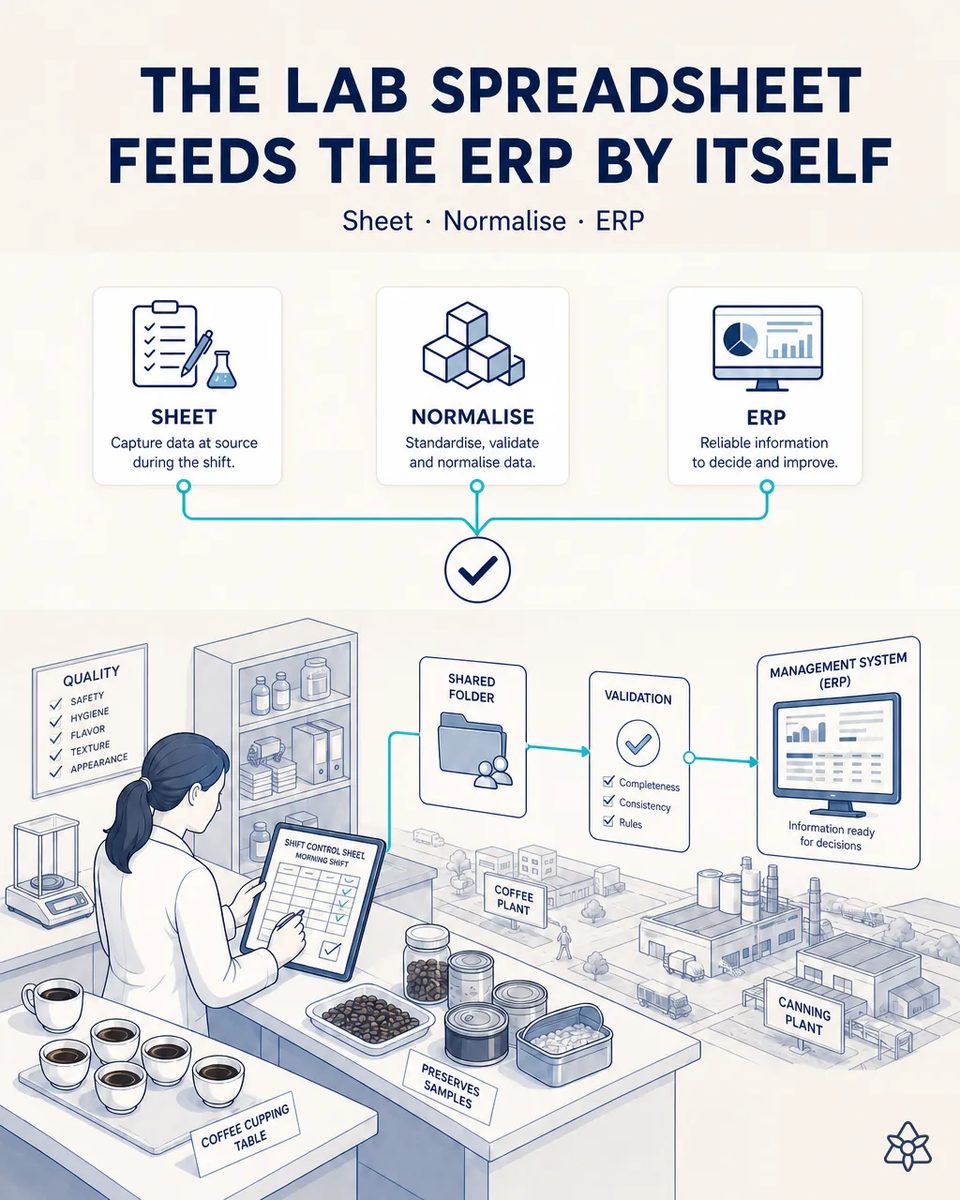
Two parallel worlds, and decisions get made according to who is making them.
Two parallel worlds coexist in every plant. The real spreadsheet, holding the shift's data, current and reliable. And the official ERP, with data transcribed days or weeks later, carrying the copy errors you'd expect from repetitive work. Decisions get made looking at one or the other depending on who makes them, producing arguments that aren't about the operation but about which number is the right one. Someone spends half a day a month per plant on that transcription. That's a qualified person's time spent copying cells, and it introduces latency exactly where it's least affordable: quality parameters are what let you react to a deviation while there's still time. In a multi-plant group there's a worse consequence than lost time. Each lab has its own sheet, with its own columns and sometimes its own units. Quality parameters can't be aggregated across plants even when they measure exactly the same thing, so management can't compare quality between two factories in the same group.
- The real spreadsheet, where the shift's data lives, current and reliable.
- The official ERP, with figures keyed in days or weeks later and the copying errors you would expect from repetitive work.
- Half a day a month per plant of a qualified person copying cells — and latency exactly where it hurts: quality parameters are what let you react while you still can.
- Every lab has its own sheet, with its own columns and sometimes its own units: management cannot compare the quality of two factories in the same group.
Connect in listen-inward mode — it watches the folder, not the people.
Connect in "listen inward" mode. The flow:
The decisive step is normalization: the plant does not change its sheet, the translation into the group's common model happens on iLEAN's side.
- iLEAN observes the shared folder — the folder, not the people — and detects when the file has been saved.
- It reads the delta and parses it with a grounded language model, tolerant of each plant having its own sheet layout.
- It normalises to the group's common model. This is the decisive step: the plant doesn't change its sheet, normalisation happens on the iLEAN side.
- The manager validates on screen (early human verification).
- The data is inserted into the ERP through its API, and becomes aggregable with the other plants'.
An isolated sheet vs. an integrated sheet
| Aspect | Today | With iLEAN Connect |
|---|---|---|
| Spreadsheet → ERP lag | Days or weeks | Second zero |
| Keying | Half a day a month per plant | None |
| Copying errors | Those of repetitive work | There is no copying |
| Sheet format | One per lab | Theirs, normalized |
| Comparing quality across plants | Not possible | Aggregable from the first shift |
| ERP licenses on the module | 4-5 per plant | 1, the validator's |
weeks of lag → second zero. Half a day a month per plant transcribing → zero. Quality parameters not comparable across plants → aggregable from the first shift.
Impact estimate — to validate against your numbers.
The block below is an estimate to be validated against your plant's actual data. We put it forward so the committee has an order of magnitude; we refine it during the assessment.
- One quality sheet per shift and per plant: cupping and moisture in coffee, pH, Brix, vacuum and drained weight in canning, moisture and sizing in culinary.
- CFO angle: the ERP is licensed per active user. If 4-5 lab people log in only to enter results, with Connect one person logs in.
- Typical reduction of 50 to 80% in quality and lab module licenses, recurring and multiplied by the number of plants.
- Indicative payback of 4 to 9 months per plant, plus the annual saving. To be checked against the real ERP invoice.
— *CFO angle, direct licence saving*: ERP is licensed per active user. If each plant has 4-5 lab people who log in purely to enter quality results, that's 4-5 licences per plant; with Connect only the manager who validates logs in → 1 licence. Typical reduction of 50-80% in quality and lab module licences, recurring and multiplied by the number of plants. Estimated payback 4-9 months per plant plus the annual saving. *Estimate to validate* against the real ERP invoice.
And the fair question from the production manager
“What if I change a column on the sheet?” — nothing breaks, and that is the reason for parsing with a language model instead of a fixed cell mapping. A rigid parser breaks the first time somebody inserts a row; here the structure is interpreted. If a change leaves something ambiguous, it is flagged in the validation rather than entering wrong.
[1] OpenAI paper "Why Language Models Hallucinate", 2025 — on the reliability of AI in anchored tasks.
What people ask about integrating the lab sheet
Do all plants' sheets have to be unified?
No, and that is what makes the case viable. Unifying lab sheets across acquired plants is a political project as much as a technical one: each has been tuned for years to its process and its people. Every plant keeps its own and the normalization to the group model happens in iLEAN.
Are the lab people being monitored?
What is watched is the shared folder, not the people: the system detects that a file has been saved and reads the delta. There is no tracking of who works how much and no individual indicators, and it is worth saying before anyone asks, because it is the first reaction in a lab.
Are ERP licenses really saved?
It is the argument that convinces a finance director fastest, and it is worth checking against the real invoice before promising it. If four or five people per plant log into the ERP only to enter quality results, with on-screen validation only the lead logs in. That saving is recurring and multiplies by the number of plants.
What about the history already in the sheets?
It can be loaded backwards if the old sheets are available, and it is usually done with the last few months. It is not essential to start, but having some normalized history is what makes the comparison across plants mean something from the beginning.
What if the lab uses a LIMS rather than Excel?
Then the case is easier, not harder: it gets stitched through the API the way the coder or the ERP are, without going through the folder. The case is framed on Excel because that is what is in most plants of this size.
More cases from this series
- From two weeks reconstructing traceability to zeroEvery critical change generates its dossier: before/after photos, decisions and signatures, reorganised…
- Ten acquired factories, one operational languageA capture and normalisation layer over the systems that already exist makes M&A-acquired factories speak…
- Lot, date and allergens stop depending on someone typingLot, date and allergens travel from the active order to the coder via API. Zero typing on the machine…
- Goods-in stops blocking the dock manager for an hourPhotograph the docket and the sack labels: iLEAN extracts lots and origin certificates, the manager…
- What the shift lead knows stops evaporating every eight hoursThe shift lead dictates issues while walking between retort and filler; the AI structures them, links…
- The alert that dies in an inbox now reaches production in secondsAlerts from your own restaurant channel reach production in seconds, cross-checked against live orders…
Tell us how many ERP licenses you pay for just to enter quality results.
We work on your plant's real data, not ours. Assessment with no commitment.
Request estimated ROI within 48h ‹ See all cases of coffee, culinary, snacks and foodservice See food