The "line is clean" signature stops going in blind
A culinary line running conventional product on one shift and gluten-free on the next requires a certified clean-down in between, and it's one of the highest-risk moments in the plant. Today start-up depends on a person signing with no objective visual evidence behind it. With iLEAN Edge, fixed cameras at every critical point compare the current state against the reference state, and JIDOKA AI blocks start-up until all report OK and the quality manager signs on evidence.
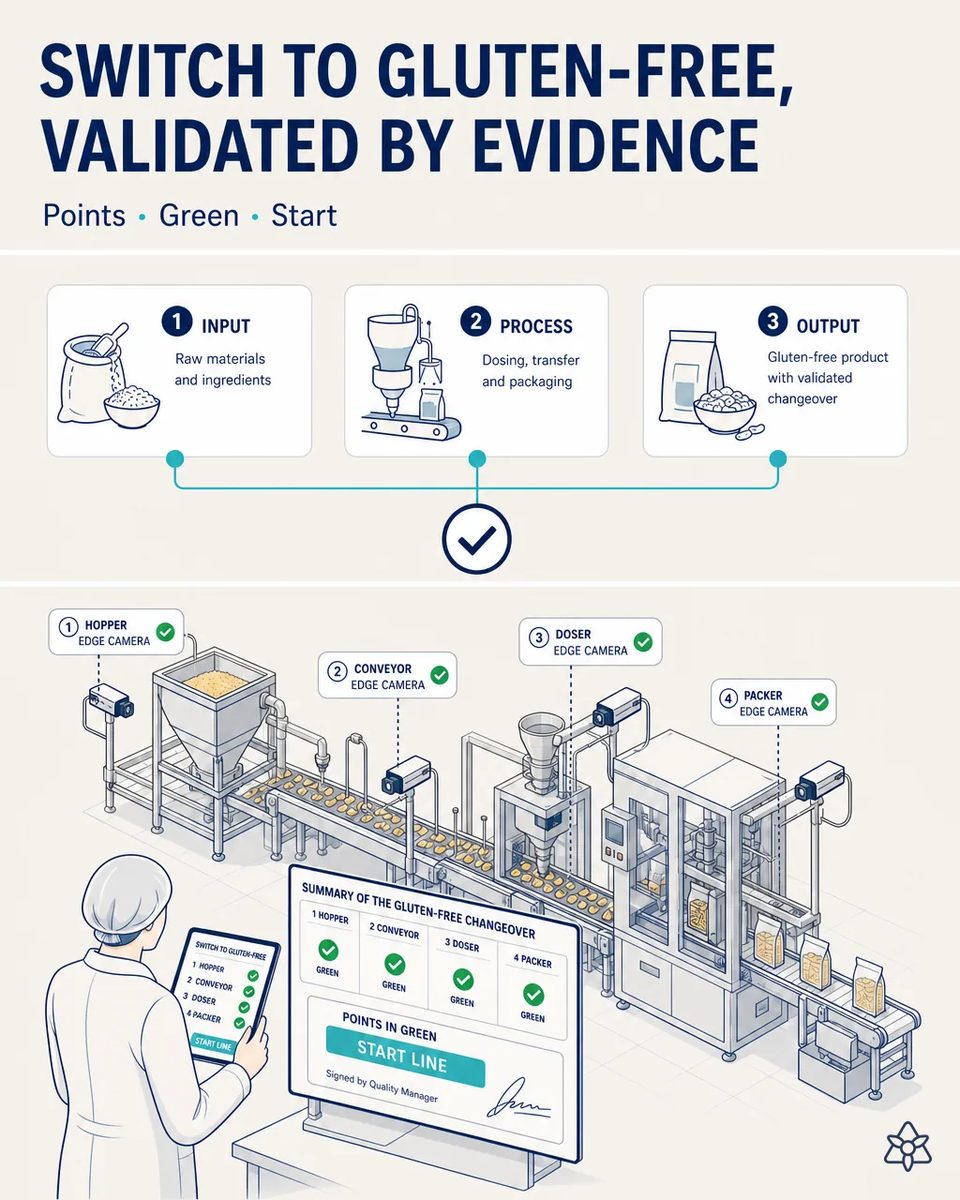
All the responsibility rests on a signature with no structured evidence behind it.
Gluten-free certification is what unlocks a market segment with margin, and it's lost with a single cross-contamination incident. A trace of wheat flour at one point on the line contaminates the first gluten-free lot: lot recall and risk to the certification itself. All of that responsibility rests today on a human signature with no structured evidence behind it. Not because anyone does their job badly, but because there's no practical way to document the state of the line point by point in the time available between two production runs. And there's a productivity cost that often goes unnoticed: the allergen clean-down is one of the longest line stoppages, and when the sign-off is delayed because the manager is in another room, the line stays down waiting on a person.
- Gluten-free certification is what grants access to a segment with margin, and it is lost with a single cross-contamination incident.
- A residue of wheat flour at one point of the line contaminates the first gluten-free batch: batch recall and risk to the certification.
- Not because anybody does their job badly, but because there is no practical way to document the state of the line point by point in the time available between two runs.
- And there is a productivity cost that goes unnoticed: allergen cleaning is one of the longest stops, and when the signature is delayed because the lead is in another room, the line stays down waiting for a person.
Edge + JIDOKA AI + SMED AI — the line does not start until every point reads OK.
Edge + JIDOKA AI + SMED AI. The flow:
The decision still belongs to the quality lead. What changes is that they now sign on point-by-point visual evidence, filed with the before and after images.
- Fixed Edge cameras at the line's critical points: hopper, conveyor, doser, table, packer.
- Each camera compares the current state against the "clean and ready for gluten-free" reference state, with models trained to tell clean from residue at that specific point, not in the abstract.
- JIDOKA AI blocks line start-up until every point reports OK and the quality manager signs.
- The signature now rests on point-by-point visual evidence, archived with the before and after images.
- SMED AI shortens the changeover without relaxing the criteria, and validation happens as soon as the points are green.
The same pattern — reference state, comparison, block, sign-off — reapplies to recipe changes in canning and origin changes in roasting.
Blind signature vs. signature on evidence
| Aspect | Today | With Edge and JIDOKA AI |
|---|---|---|
| State of the line | Checked by eye, against the clock | Compared with the reference state |
| Points verified | The ones there is time for | Hopper, transport, doser, table, packer |
| Startup | When somebody signs | Blocked until everything reads OK |
| Backing for the signature | None | Before and after images of each point |
| Line waiting for the lead | Routine | Validation as soon as they are green |
| Changeover time | The longest stop | Reduced without relaxing criteria |
blind sign-off with contamination risk → sign-off backed by point-by-point visual evidence. Line down waiting for the manager → validation as soon as cameras are green. Changeover time → reduced without relaxing criteria.
Impact estimate — to validate against your numbers.
The block below is an estimate to be validated against your plant's actual data. We put it forward so the committee has an order of magnitude; we refine it during the assessment.
- Culinary lines that alternate conventional and gluten-free on consecutive shifts.
- The return is in protecting the certification that grants the segment and in avoiding the recall of the first batch.
- Plus the reduction in changeover time, one of the longest stops in the plant.
- The payback depends on the weight of the segment in the mix and the frequency of changeovers: that is the first figure to put on the table.
the return lies in protecting the certification that unlocks the segment and in avoiding the recall of the first lot, plus the reduced changeover time. Payback depends on the segment's share of the mix and on changeover frequency. *Estimate to validate*.
And the fair question from the production manager
“Won't blocking startup cost me more than it saves?” — it is the fair objection, and it is why this case travels with SMED AI: the goal is a changeover that is faster and verified, not one that is safer but slower. And the line already waits today, just for a person to turn up; with the cameras green, validation happens as soon as the state allows.
[1] OpenAI paper "Why Language Models Hallucinate", 2025 — on the reliability of AI in anchored tasks.
What people ask about validating the allergen changeover
Does it replace the cleaning protocol?
No: it verifies that it was carried out. The protocol, the products and the times stay yours and stay whatever the certification requires. What changes is that the final check stops depending on a glance against the clock and gets documented point by point.
What if a camera fails?
The rule is defined before deployment. The usual setup is that a failure raises an alert and allows a supervisor override with a record, rather than halting the plant. What is not allowed is an override with no trace: if somebody starts up without a green light, that is exactly the fact worth having recorded.
How many points need covering?
The critical ones on that line: hopper, transport, doser, table and packer are usually the five. They are defined with quality at the start, because they are the same ones looked at by eye today — the change is that now the look leaves a record.
Can it really tell clean from residue?
It is trained for that specific point, not in the abstract, and that is what makes it possible: recognizing “this hopper is clean” is a bounded task; “detect any dirt anywhere” would not be. That is why the model is trained point by point with images of that same line.
Does it work for changeovers other than gluten-free?
The same pattern — reference state, comparison, block, signature — reapplies to the recipe changeover in canning and the origin changeover in roasting. Gluten-free carries the most regulatory pressure, which is why it is usually where people start.
More cases from this series
- From two weeks reconstructing traceability to zeroEvery critical change generates its dossier: before/after photos, decisions and signatures, reorganised…
- Ten acquired factories, one operational languageA capture and normalisation layer over the systems that already exist makes M&A-acquired factories speak…
- Lot, date and allergens stop depending on someone typingLot, date and allergens travel from the active order to the coder via API. Zero typing on the machine…
- Goods-in stops blocking the dock manager for an hourPhotograph the docket and the sack labels: iLEAN extracts lots and origin certificates, the manager…
- What the shift lead knows stops evaporating every eight hoursThe shift lead dictates issues while walking between retort and filler; the AI structures them, links…
- The shift quality sheet stops being retyped by handiLEAN reads the quality sheet as it is saved, normalises it to the group model and, after sign-off,…
Verify every allergen changeover without slowing the line down.
We work on your plant's real data, not ours. Assessment with no commitment.
Request estimated ROI within 48h ‹ See all cases of coffee, culinary, snacks and foodservice See food