The human gate that keeps your ERP master data clean
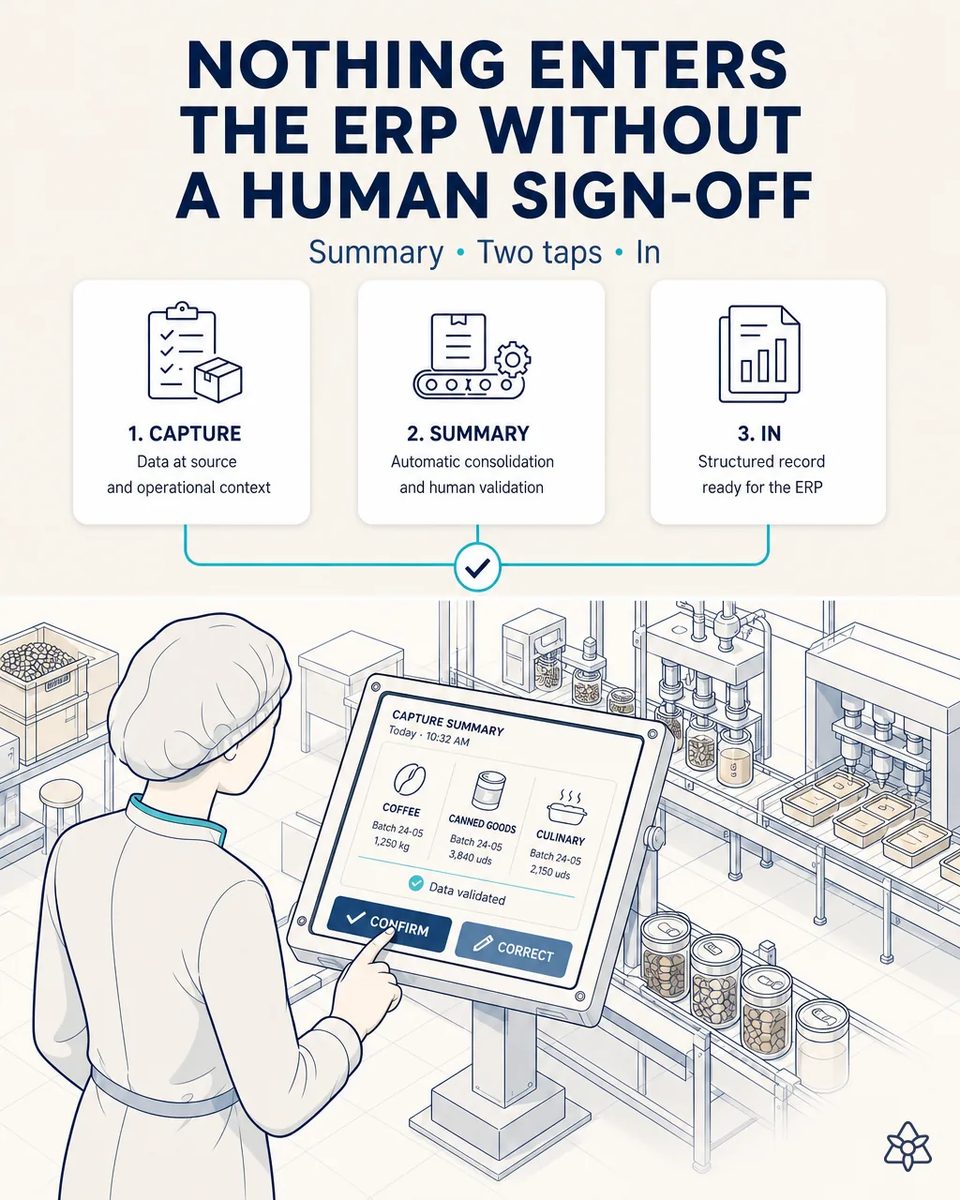
This is what separates iLEAN from an autonomous AI agent: nothing the system captures enters the ERP without a human having seen it first. An industrial tablet at the line shows a two-second visual summary of what was just captured — by photo, by voice, by parser or by email — and the operator confirms with two taps or corrects before the data crosses. No prior training and no habit change.
Two constraints that look incompatible, and both are legitimate.
The blocker to digitalisation in a plant, and especially in a recently acquired one, is almost never technical. It's about trust, and it's always phrased the same way: the AI will enter data on its own and then someone will have to clean up the ERP master by hand. It's a legitimate objection, based on real experience with previous integrations, and it isn't answered with promises — it's answered with architecture. At the same time there's the opposite constraint. The operator doesn't want to type, and rightly so: their job is to keep the line producing. Any solution that adds tasks is abandoned within three weeks, however good it looks on paper. That isn't resistance to change, it's the physics of a shift. The two constraints look incompatible: either data enters without control, or it enters slowly and at the operator's expense. Early human verification exists precisely to resolve both at once.
- “The AI is going to enter data on its own and then somebody will have to clean the ERP master by hand.” A legitimate objection, based on real previous integrations, and not answered with promises.
- The operator does not want to type, and rightly so: their job is to keep the line producing.
- Anything that adds tasks gets abandoned in three weeks, however good it looks on paper. That is not resistance to change, it is shift physics.
- Either data enters unchecked, or it enters slowly at the operator's expense. Early human verification exists to solve both at once.
Connect in early-human-verification mode — two taps, not a form.
Connect in "early human verification" mode. The flow:
The design distinction is subtle and it decides adoption: the interface is built for validating, not for entering data.
- Any capture from the other cases — photographed log, curve read from the panel, dictated issue, channel alert, lab sheet — goes first to the industrial tablet at the line or the supervisor's station.
- It is presented as a visual summary designed to be read in two seconds, not as a form.
- The operator confirms (the data crosses to the central system) or corrects before it crosses. Two taps.
- A record is kept of who validated what and when — a record that later feeds the audit evidence pack with no extra work.
The design distinction is subtle and decides adoption: the interface is built for validating, not for data entry.
Data with no gate vs. signed data
| Aspect | Without the human gate | With early verification |
|---|---|---|
| Entry into the ERP | Automatic, or non-existent | Only after confirmation |
| ERP master | Gets dirty, or never fed | Clean |
| Operator's work | Filling in a form | Two taps on a summary |
| Reading time | Minutes | Two seconds |
| Who validated what | Not recorded | Recorded with a timestamp |
| Adoption at three months | Where it gets abandoned | Still alive |
unvalidated data contaminating the ERP, or data simply not captured out of mistrust → data captured and signed off with seconds of latency, and clean master data. Traceability of who validated what → automatic.
Impact estimate — to validate against your numbers.
The block below is an estimate to be validated against your plant's actual data. We put it forward so the committee has an order of magnitude; we refine it during the assessment.
- Applies to every capture in the matrix: photographed log, panel curve, dictated incident, channel alert, lab spreadsheet.
- Enabling piece: it does not monetize on its own and it makes no sense to ask it for its own payback.
- Without it, the other pieces get neither signed off in committee nor accepted on the floor.
- Its return is adoption and avoided risk, not direct savings.
an enabling piece; it doesn't monetise in isolation. Without early human verification, the other pieces are neither signed off in committee nor accepted on the floor. *Strategic and adoption value.*
And the fair question from the production manager
“Isn't this putting a person back to entering data?” — it is the opposite, and the difference is what is being asked of them. A form makes you produce information from scratch; here what is in front of you is a summary already composed and the task is to say whether it is right. Reading it takes two seconds and in most cases the gesture is to confirm. What is preserved is the judgment of the person on the line.
[1] OpenAI paper "Why Language Models Hallucinate", 2025 — on the reliability of AI in anchored tasks.
What people ask about early human verification
Why not let the data through if the model is nearly always right?
Because “nearly always” is not the criterion a committee decides on. The cost of one bad record in the ERP master is not proportional to the error: it contaminates reports, decisions and audits for months. The gate costs two seconds per capture and removes that whole category of problem.
Who validates: the operator or the supervisor?
It depends on the data. Line data is validated by whoever is on the line, because they are the ones who can see that a weight does not add up. Lab or receiving data is validated by the relevant lead. The rule is that it is validated by whoever has the judgment to catch the error, not by whoever has the title.
What if nobody validates and captures pile up?
They stay pending and visible, and do not enter. Piling up is itself an indicator: it means the capture is badly fitted into that role's flow and needs revisiting. That is preferable to letting them in and having the problem surface in a report three months later.
Does it count as a record for an audit?
Yes, and it is a side effect that tends to surprise. Who validated what and when is recorded, which feeds the audit dossier with no extra work. Part of what gets rebuilt by hand before an audit today comes from here.
Does it need training?
No, and if it did it would be badly designed. The screen shows a visual summary and two buttons. All the design effort goes into it being understood in two seconds with nobody explaining anything, because on the floor there is no second chance for that.
More cases from this series
- From two weeks reconstructing traceability to zeroEvery critical change generates its dossier: before/after photos, decisions and signatures, reorganised…
- Ten acquired factories, one operational languageA capture and normalisation layer over the systems that already exist makes M&A-acquired factories speak…
- Lot, date and allergens stop depending on someone typingLot, date and allergens travel from the active order to the coder via API. Zero typing on the machine…
- Goods-in stops blocking the dock manager for an hourPhotograph the docket and the sack labels: iLEAN extracts lots and origin certificates, the manager…
- What the shift lead knows stops evaporating every eight hoursThe shift lead dictates issues while walking between retort and filler; the AI structures them, links…
- The shift quality sheet stops being retyped by handiLEAN reads the quality sheet as it is saved, normalises it to the group model and, after sign-off,…
Tell us which previous integration left your ERP master dirty.
We work on your plant's real data, not ours. Assessment with no commitment.
Request estimated ROI within 48h ‹ See all cases of coffee, culinary, snacks and foodservice See food