ZERO ALLERGEN RECALLS
The capital pain of any bouillon and soup factory running several brands and formats on the same lines is the same: zero recalls from undeclared allergens, batch or labeling errors. A recall doesn't just cost the recovery operation across hundreds of points of sale — it damages the trust built with the distributor and the consumer, right when the plant is expanding capacity.
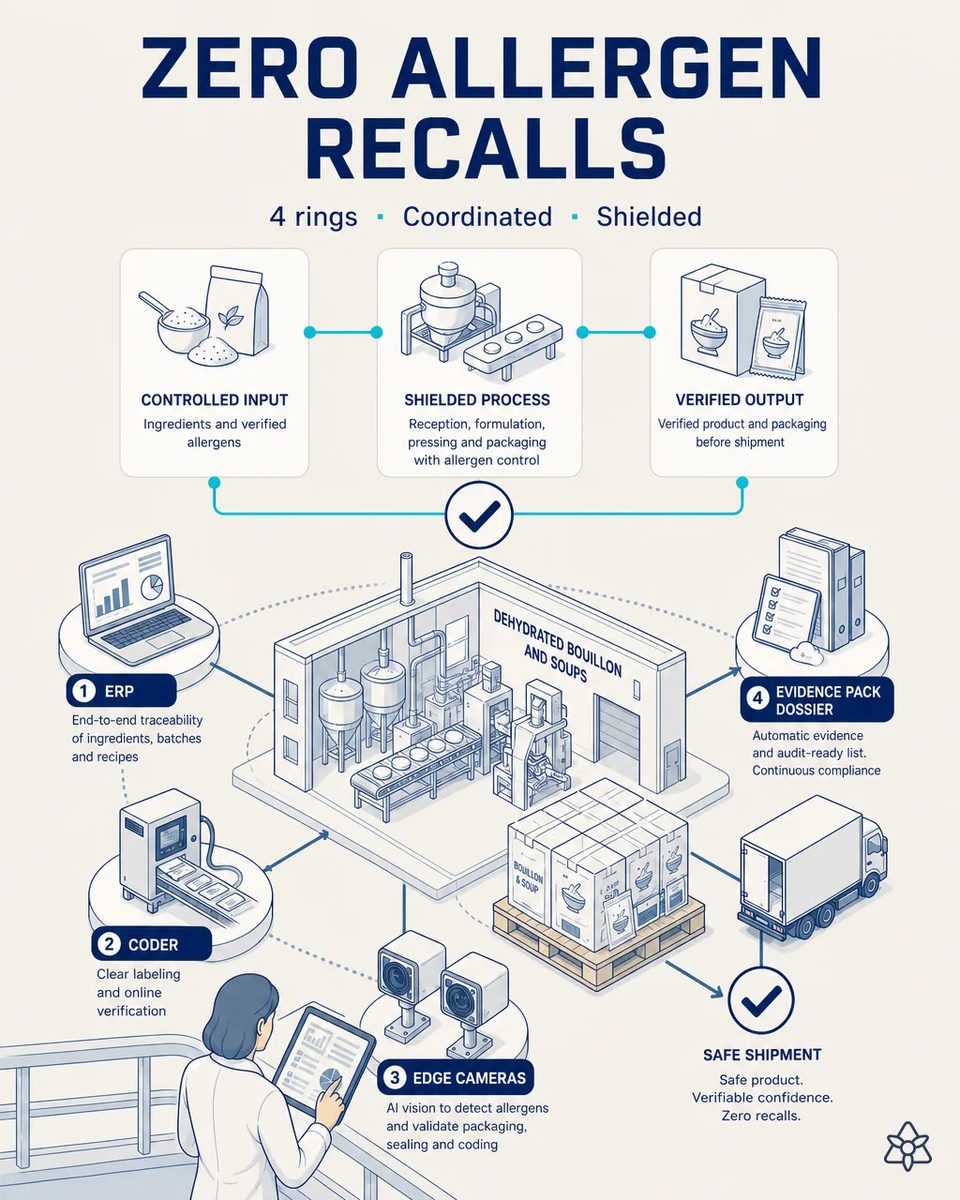
A recall is almost never one failure: it is four small ones lining up.
The capital pain of any bouillon and soup factory running several brands and formats on the same lines is the same: zero recalls from undeclared allergens, batch or labeling errors. A recall doesn't just cost the recovery operation across hundreds of points of sale — it damages the trust built with the distributor and the consumer, right when the plant is expanding capacity.
- A recipe changed at the last minute, a changeover signed in a hurry, a batch typed into the coder by hand and a pallet released on schedule. Four ordinary Tuesdays in a row.
- Each link passes its own control, which is precisely why the combination survives all the way to the point of sale. Nothing looked wrong at any single step.
- The cost is not only recovering product across hundreds of points of sale: it is the trust of the distributor and of the consumer who read the label and believed it.
- And it lands hardest exactly when the plant is expanding capacity, adding lines and taking on new brands, which is when the coexistence of recipes is at its most complex.
Four rings that cross-check — everything above, orchestrated.
The flagship coordinates four rings that cross-check each other: the ERP defines recipe and allergens, the coder prints what the ERP publishes, Edge cameras validate cleaning and batch after every changeover, and the evidence-pack dossier cross-checks the previous three. SMED AI speeds up brand changeovers without sacrificing safety; if anything doesn't match, JIDOKA AI stops the line before the pallet leaves the plant.
No single ring solves it. Each one already exists in some form in your plant and pallets still ship wrong. What gives the chain away is four independent sources that stop agreeing with each other, plus something that stops the line when they do.
The four rings and what each one shuts down
| Ring | Which cases it draws on | What it closes |
|---|---|---|
| 1 · Recipe | Recipe startup (1) + receiving (7) | Which formula, which allergens and which raw-material lots |
| 2 · Print | Coder (8) + line tablet (5) | That what is printed is what the order published |
| 3 · Line | Pressing and sealing (9) + changeover validation (10) | The state of the equipment and the piece that actually left it |
| 4 · Evidence | Audit dossier (11) + dryer panel (2) | The proof behind the other three, pallet by pallet |
| Cross-check | JIDOKA AI across the four | Holds the line when two sources disagree |
| Brand changeovers | SMED AI between runs | Speeds up the change without spending safety |
Yearly incidents with partial-recall risk → zero. Discrepancy detection on the line, not at the point of sale.
Impact estimate — to be validated with the board, not with production.
The block below is an estimate to be validated against your plant's actual data. We put it forward so the committee has an order of magnitude; we refine it during the assessment.
- Estimated payback 6-12 months, counted against the first recall avoided.
- A single recall runs over €100,000 in recovery alone, before you count what the distributor does about it afterwards and what it costs to get back on the shelf.
- Discrepancies are caught on the line, not at the point of sale, which is the whole distance between an internal incident and a public recall.
- And the brand equity of every label you pack, your own or somebody else's, stops depending on whether a particular shift went well.
Protection against recalls (single impact > €100K) and protection of the distributor relationship and the equity of the brands involved. Estimated payback of 6 to 12 months against the first recall avoided. Estimate to be validated.
And the fair question from the production manager
"Do we have to deploy all twelve before any of this works?" — no, and treating it that way is how a plant never starts. The rings are built in layers and each case pays on its own; ring 2 alone, coder plus line tablet, removes the most common cause of a labeling recall. On the extraction every layer rests on, an anchored task, the best models stay under 1.5% error [1], with human confirmation behind it at the line tablet. The plants that get furthest are the ones that ship one ring, measure it, and then decide on the next.
[1] OpenAI paper "Why Language Models Hallucinate", 2025 — on the reliability of AI in anchored tasks.
What people ask about the full anti-recall system
Which ring should we build first?
Usually ring 2, because the coder and the line tablet together close the failure that produces most labeling recalls, and they are the two fastest pieces to deploy. Ring 1 follows naturally from them.
Why is the cross-check worth more than four good controls?
It catches the combination, which is what no single control can do. A changeover signed in good faith and a hand-typed batch are each acceptable on their own; together they are the pallet that gets recalled six weeks later.
What happens when two rings disagree?
The line holds and the discrepancy is shown with both sources side by side, so a person can resolve it in minutes rather than investigate it for a day. The stop is triggered by a factual mismatch between two systems, never by the model being unsure about something.
Doesn't stopping the line cost more than it saves?
The stops are rare and short, and they happen at a changeover rather than mid-run. Against sorting product back from hundreds of points of sale, it is not a close calculation.
Does it replace the ERP or the quality system?
No. Ring 1 depends on the ERP being the source of truth for recipe and allergens, and nothing changes that. What iLEAN adds is the check that reality on the line matches what those systems say.
More cases from this series
- PAPERLESS RECIPE STARTUPThe operator photographs the order and recipe sheet; the batch and its exact recipe exist instantly.…
- THE CODER STOPS BEING HAND-TYPEDBatch, date and allergens travel from the ERP to the coder automatically. Payback 3-6 months.
- THE DELIVERY NOTE NO LONGER BLOCKS THE TRUCKPhoto the delivery note and batch labels; one-tap validation pushes straight to the ERP. Payback 3-8…
- THE VINTAGE DRYER STARTS TALKINGA camera reads the dryer panel without touching the machine: moisture and temperature digitized per…
- THE LINE SUPERVISOR DICTATES ON THE GOEarpiece + voice AI: the line supervisor logs issues while walking, no keyboard needed.
- NOTHING ENTERS WITHOUT A HUMAN SIGN-OFFEvery iLEAN capture passes through a 2-tap validation tablet before entering the central system.
Tell us what an undeclared allergen would cost you across your distribution.
We work on your plant's real data, not ours. Assessment with no commitment.
Request estimated ROI within 48h ‹ See all cases of bouillon and dehydrated soups See food industry