Fill level, cap and label under 100% control
On a filling line running hundreds or thousands of bottles a minute, full visual control by a person is physically impossible. What exists is a sample, and a sample lets whole runs through: a setting that drifts can produce half an hour of defective product before anyone notices on the next round.
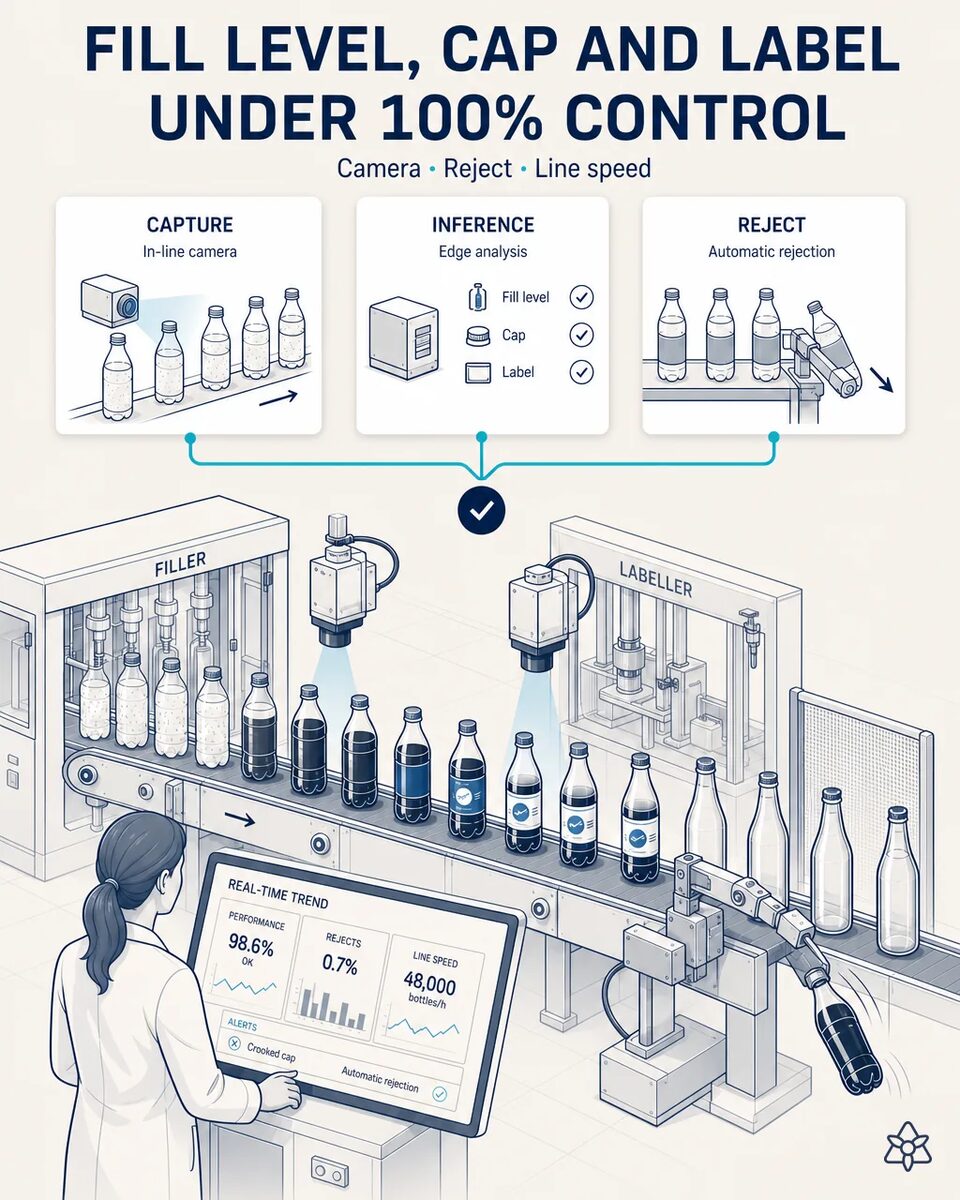
Sampling lets whole runs through.
Low fill level, which is a consumer complaint and a net content issue. Crooked or under-torqued caps, which means lost carbonation and leaks on the pallet. And labels off-center, creased or simply from the wrong flavor, which is what a retail account rejects at its own goods-in bay and sends back whole. A defective bottle costs cents. A pallet rejected at the customer's bay costs the product, the return freight, the service penalty and an uncomfortable conversation with a major account. That is the figure to weigh the investment against, not the value of the unit.
- At hundreds or thousands of bottles a minute, one hundred percent human visual control is physically impossible. What exists is a sample.
- A setting that drifts can produce half an hour of defective product before anyone notices on the next round.
- Low fill level: consumer complaint and net content problem. Crooked or badly tightened cap: loss of carbonation and leakage in the pallet.
- Off-center, creased or plain wrong-flavor label: what the retail customer rejects at their own dock and returns in full.
- A defective bottle costs cents. A pallet rejected at the customer's dock costs the product, the return freight, the service penalty and an uncomfortable conversation.
Edge — vision that infers at the line, in milliseconds per unit.
Edge: vision inferring at the edge, in milliseconds. iLEAN Edge places cameras at the outfeed of the filler-capper and the labeller, with a local compute unit. The model is trained on this plant's actual containers and labels, not on a generic catalog. Inference happens at the edge with no image sent to the cloud: no latency, no traffic cost and no dependency on the connection. And it flags the trend, not just the unit. The defective bottle is rejected before it reaches packing, but the greater value is in the signal: if the share of low fills climbs steadily, the problem is not the bottles, it is the filler. The line supervisor gets that trend within seconds rather than at the end of the shift.
What changes is not only coverage: it is timing. Catching the drift in the first few dozen bottles instead of on the next round turns half an hour of lost product into a two-minute adjustment.
Today's sampling versus Edge control
| Aspect | Sampling control | With iLEAN Edge |
|---|---|---|
| Coverage | 1-2 % of units | 100 % |
| A drifting setting | Half an hour of defective product | Seen in the first few dozen |
| Where the failure is caught | At the customer's dock | Before packing |
| Cost of the rejection | The pallet, the freight and the penalty | The bottle |
| Wrong-flavor label | Found with pallets already built | Rejected on the line |
| Where the image is processed | — | On site: no latency, no traffic |
Estimated impact — to validate with your own numbers.
The block below is an estimate to be validated against your plant's actual data. We put it forward so the committee has an order of magnitude; we refine it during the assessment.
- Estimated payback 5-12 months, depending on your current reject rate.
- The real weight sits in retail customer returns: that is where the cost stops bearing any relation to the price of the bottle.
- From 1-2 % sampling to 100 % control of units, at real cadence.
- And a drifting setting stops costing half an hour of production.
The return depends on the current reject rate and above all on how much retail returns weigh today. Estimated payback between five and twelve months. Estimate to be validated against your reject and return figures for the last financial year.
And the fair question from the production manager
«What if it rejects good bottles?» — the false positive is the real risk of any vision system, which is why the model is trained on good and bad units of your specific formats and with that station's lighting, not on a generic model. Borderline units are escalated for a person to decide, and every decision feeds back into training.
[1] OpenAI paper "Why Language Models Hallucinate", 2025 — on the reliability of AI in anchored tasks.
What people ask about vision on the filling line
Does it keep up with the filler's cadence?
Yes: inference is local and resolves in milliseconds per unit. It does not depend on the plant network or the cloud, which is what Edge means.
Where do the cameras go?
At the filler-capper exit and at the labeler exit. They are different defect families and are trained separately.
Does it catch the wrong-flavor label?
Yes, and it is the most expensive defect: it is the one the retail customer rejects at their dock and returns in full, not unit by unit.
How many bottles are needed to train it?
Fewer than feared, because the defect catalog of a filling line is known and repetitive. What is needed is that they be real units from your formats.
Does it replace net content control?
It does not replace it, it backs it up. The legal control follows its procedure; what changes is that low fill stops slipping between samples.
More cases from this series
- The audit file builds itselfEvery changeover and batch generates its record as it happens: photos, parameters, signatures. Agents…
- Zero variance across plant, distribution centers and routeFour coordinated rings trace product and returnable containers from the plant dock to the route return,…
- The returnable bottle washer starts to talkAn external camera digitises caustic, temperature and contact time from an old returnable bottle washer,…
- Batch and expiry travel from ERP to coder with no typingBatch, packing date and expiry travel from the active order to the coder with no manual typing. Zero…
- Alerts from the depots and haulers become actioniLEAN reads alerts from distribution centers and haulers, cross-checks them against live orders and…
- The dock supervisor speaks and iLEAN listensThe dock supervisor dictates incidents while walking the bays; iLEAN structures them, stores them and…
Tell us how many pallets a retail customer returned to you last year.
We work on your plant's real data, not ours. Assessment with no commitment.
Request estimated ROI within 48h ‹ See all cases of beverage bottling See food