Nothing reaches the ERP without two human taps
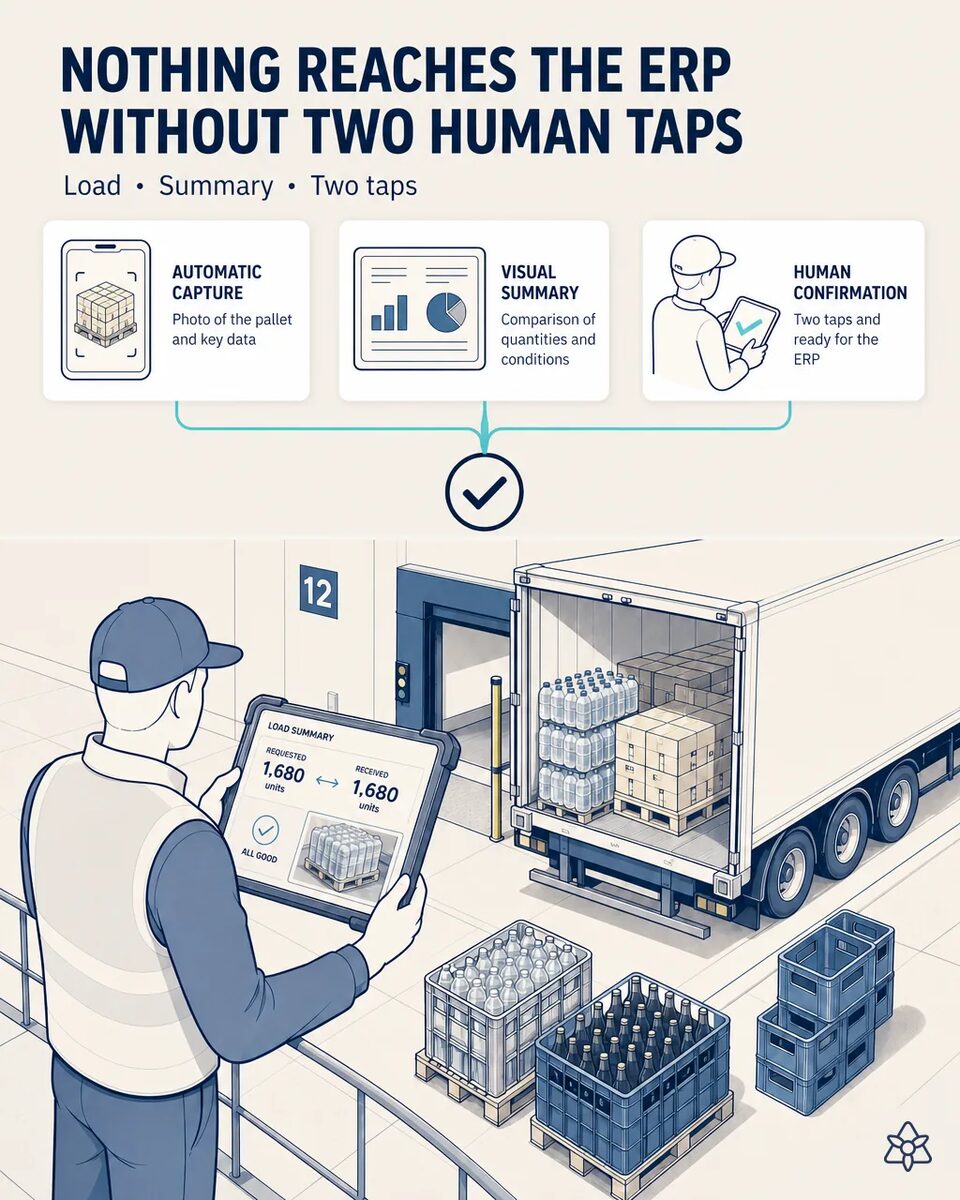
Nothing iLEAN captures reaches the central system without a human having seen it first. That is not an implementation detail: it is the difference between a system somebody can sign off and an autonomous agent that writes data on its own and eventually contaminates the master everyone relies on.
The balance point is not in capturing: it is in validating.
The real reason the dock is not automated is not feasibility: it is that if the AI miscounts and that number enters inventory, the site manager ends up paying for the variance. But the dock supervisor is not going to type in every load either. The balance point is not capture: it is validation.
- The real reason the dock is not automated is not that it cannot be: it is that if the AI miscounts and that number reaches inventory, the depot manager ends up paying for the variance.
- But the dock supervisor is not going to type every load either: at bay cadence, any manual capture happens late, happens badly or does not happen.
- Hence the dilemma that blocks the case: either unvalidated data contaminating the master everyone consults, or data never captured out of distrust.
- And it is an expensive master to fix: product and returnable container inventory is consulted across the whole network.
Connect with early human verification — a two-second summary.
A tablet on the bay and a two-second summary. Connect in early human verification mode puts an industrial tablet on the loading bay and at the route settlement point. Everything iLEAN captures by any route — the photo of the load sheet, the vision count of the pallet, the supervisor's dictation, the depot alert — appears there as a visual summary designed to be validated in two seconds. Discrepancies are shown, not silently resolved. If iLEAN counted thirty-eight cases and the sheet says forty, the tablet displays both figures and the photo behind them. The supervisor confirms with one tap or corrects with another. Only then does the data cross into the ERP. Latency of seconds, no training required and no change of habit for anyone.
The interface is designed for validating, not for entering data. Asking a dock supervisor to fill in a form with a truck waiting is asking them not to do it.
The three ways of resolving it, compared
| Aspect | Autonomous AI | The supervisor types |
|---|---|---|
| Inventory protected | No | Yes |
| Actually done at cadence | — | No: late, badly or never |
| Supervisor's time | Zero | Minutes per load |
| Who answers for the variance | Nobody, so it is not approved | The depot |
| Signature per movement | No | Yes |
| Approvable by the board | No | Yes, but unused |
An enabling piece — no payback of its own, and stated as such.
The block below is an estimate to be validated against your plant's actual data. We put it forward so the committee has an order of magnitude; we refine it during the assessment.
- This case has no payback of its own: its value is that without it none of the other pieces gets approved.
- With it, inventory stays clean and every movement has a human signature behind it.
- That is what both an audit and the manager answering for their depot's variance require.
- And it removes both unvalidated data reaching the ERP and data never captured out of distrust.
Its value is not a direct saving but the fact that without it none of the other pieces get signed off. With it, inventory stays clean and every movement carries a human signature, which is what an audit and plain common sense both demand from whoever answers for the variance. Strategic value, not monetisable in isolation.
And the fair question from the production manager
«If a person signs in the end, what is the AI saving?» — the work is not in deciding, it is in counting and assembling. Today somebody would have to count product cases and empty containers by format and type it in. With the verification gate it all arrives counted in a two-second summary and they only confirm or correct. Every correction is stored, and the system learns where its counting fails.
[1] OpenAI paper "Why Language Models Hallucinate", 2025 — on the reliability of AI in anchored tasks.
What people ask about dock validation
How long does it take the supervisor?
The summary is meant to be read in two seconds and resolved in two taps. If it cost minutes it would be filled in after the truck left, which is the failure this case closes.
Can the AI write to inventory without a signature?
No, and it is not configurable: it is the architecture. Data crosses into the ERP only after human confirmation.
Does it work for route settlement too?
Yes, and that is where it is needed most: route settlement is where returnable container variance appears, and today it is where the least evidence is left.
What gets recorded?
What summary was shown, who confirmed it, when, and what they corrected if anything. That serves later as evidence and as feedback for the counting.
Does the dock crew need training?
Practically none, and that is deliberate: they are not asked to enter data, they are asked to confirm or correct a specific number.
More cases from this series
- The audit file builds itselfEvery changeover and batch generates its record as it happens: photos, parameters, signatures. Agents…
- Zero variance across plant, distribution centers and routeFour coordinated rings trace product and returnable containers from the plant dock to the route return,…
- The returnable bottle washer starts to talkAn external camera digitises caustic, temperature and contact time from an old returnable bottle washer,…
- Batch and expiry travel from ERP to coder with no typingBatch, packing date and expiry travel from the active order to the coder with no manual typing. Zero…
- Alerts from the depots and haulers become actioniLEAN reads alerts from distribution centers and haulers, cross-checks them against live orders and…
- The dock supervisor speaks and iLEAN listensThe dock supervisor dictates incidents while walking the bays; iLEAN structures them, stores them and…
Tell us what objection stopped the last data project on your dock.
We work on your plant's real data, not ours. Assessment with no commitment.
Request estimated ROI within 48h ‹ See all cases of beverage bottling See food