Delivery note and pallet labels in one photo, dock to ERP
The receiving supervisor faces a delivery note with fifteen lines, a stack of pallets each with its batch label and, for concentrate, a certificate of analysis that has to be filed. And a truck waiting at the bay while the demurrage clock runs.
What is repetitive and high-volume is what fails silently.
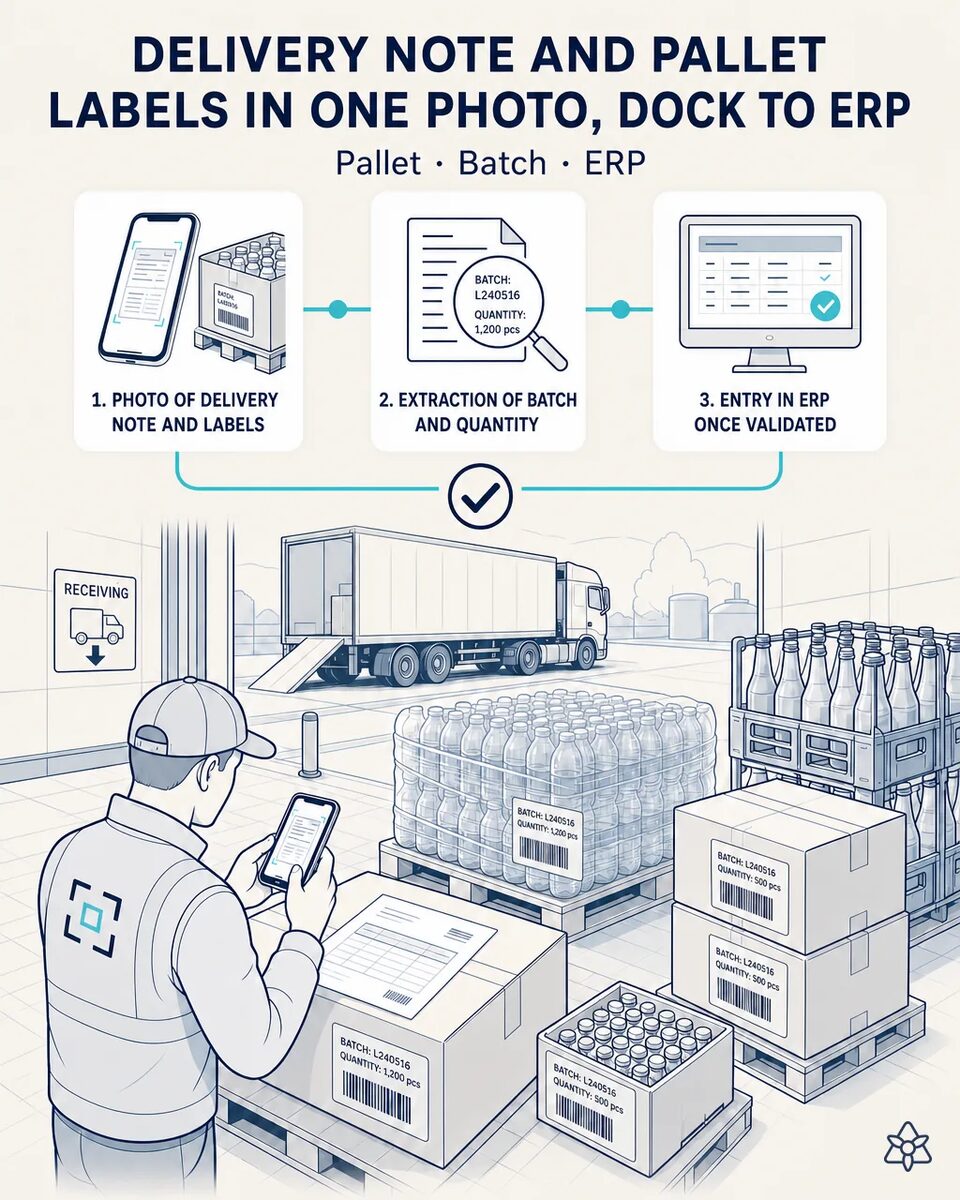
Packaging goods-in is repetitive and high volume, which makes it the most predictable source of silent error in the plant. Key it in quickly and preform and cap batches end up wrongly associated. That does not show today: it resurfaces weeks later, when a container defect has to be traced or the licensor asks which concentrate lot went into which production run. Connect in analogue-photo mode recognises each supplier's delivery note layout without asking anyone to change theirs, and extracts the full tabular structure. For pallet labels it reads GS1-128, QR codes, barcodes or plain text by optical recognition. The certificate of analysis is filed and linked to the batch automatically.
- Packaging receiving is repetitive and high-volume, and that makes it the most predictable source of silent error in the plant.
- If it is typed in a hurry, preform and cap lots end up badly linked. And that is not noticed today.
- It reappears weeks later, when a container defect has to be traced or when the licensor asks which concentrate lot went into which production run.
- Meanwhile the demurrage clock is running, pushing in exactly the opposite direction from doing it properly.
Connect in photo mode — without asking the supplier to change its delivery note.
One validation tap and it is in the ERP. The summary appears on the tablet, the supervisor confirms, and the data goes straight into the ERP via API: batch, quantity, expiry and supplier. Unloading stops tying up the receiving supervisor for the best part of an hour, and packaging traceability is complete straight from the photo. CFO angle: fewer licences at every goods-in point. The ERP goods-in and warehouse module typically requires two or three active licences per receiving point: receiving supervisor, support and line manager. With Connect only the supervisor validates, and does so without entering the ERP. The typical reduction is fifty to seventy percent of that module's licences, multiplied by every receiving point in the network.
The concentrate certificate of analysis stops being a filed PDF: its values end up tied to the lot and, transitively, to every production run that used it. That is what the licensor asks for when they ask.
Today's receiving versus captured receiving
| Aspect | Today | With iLEAN Connect |
|---|---|---|
| Truck held at the dock | As long as the typing takes | A couple of minutes |
| Carrier demurrage | Recurring | Eliminated |
| Preform and cap lots | Badly linked when rushed | Tied at unloading |
| Concentrate certificate of analysis | Filed | Tied to the lot and its production runs |
| Delivery note format | One per supplier | Recognized without asking for changes |
| Receiving module licenses | Several | One, the supervisor who validates |
Estimated impact — to validate with your own numbers.
The block below is an estimate to be validated against your plant's actual data. We put it forward so the committee has an order of magnitude; we refine it during the assessment.
- 💰 CFO angle: 50-70 % reduction in receiving module licenses, recurring every year.
- Estimated payback 3-8 months.
- Carrier demurrage eliminated, truck after truck.
- Avoided cost of a packaging traceability error, which today surfaces weeks late.
On top of the recurring license saving comes the elimination of hauler demurrage and the avoided cost of a packaging traceability failure. Estimated payback between three and eight months. Estimate to be validated against your goods-in volume and your ERP pricing.
And the fair question from the production manager
«Does it read a dirty or creased pallet label?» — most carry standard symbology, which is direct reading; optical recognition only comes in when the label is printed without it. In that case it is an anchored task and the best models drop below 1.5% error [1]. And above all there is the cross-check: if label and delivery note disagree, the discrepancy is highlighted rather than resolved silently.
[1] OpenAI paper "Why Language Models Hallucinate", 2025 — on the reliability of AI in anchored tasks.
What people ask about digitizing packaging receiving
Does it work with each supplier's delivery note?
Yes. Every supplier has its own format and the model recognizes the table structure without needing a template per supplier and without asking anyone to change theirs.
Is the concentrate certificate of analysis read?
Yes, and it is the part that adds most: its values end up tied to the lot, so proving to the licensor which concentrate went into which run stops being a search.
What if the truck brings more pallets than the note says?
The discrepancy is highlighted on screen before the supervisor validates. Today nobody does that cross-check with a truck waiting.
Do we need a barcode scanner?
Not necessarily: a photo from the phone or industrial tablet is enough. If the plant already has scanners that work well, they integrate just the same.
Can we start with receiving alone?
Yes, and it is usually a good starting point: the result is visible from the first truck and it does not depend on the other pieces being deployed.
More cases from this series
- The audit file builds itselfEvery changeover and batch generates its record as it happens: photos, parameters, signatures. Agents…
- Zero variance across plant, distribution centers and routeFour coordinated rings trace product and returnable containers from the plant dock to the route return,…
- The returnable bottle washer starts to talkAn external camera digitises caustic, temperature and contact time from an old returnable bottle washer,…
- Batch and expiry travel from ERP to coder with no typingBatch, packing date and expiry travel from the active order to the coder with no manual typing. Zero…
- Alerts from the depots and haulers become actioniLEAN reads alerts from distribution centers and haulers, cross-checks them against live orders and…
- The dock supervisor speaks and iLEAN listensThe dock supervisor dictates incidents while walking the bays; iLEAN structures them, stores them and…
Tell us how long it takes today to book in a preform or cap truck.
We work on your plant's real data, not ours. Assessment with no commitment.
Request estimated ROI within 48h ‹ See all cases of beverage bottling See food