None of those defects spoils the product; all of them spoil the brand
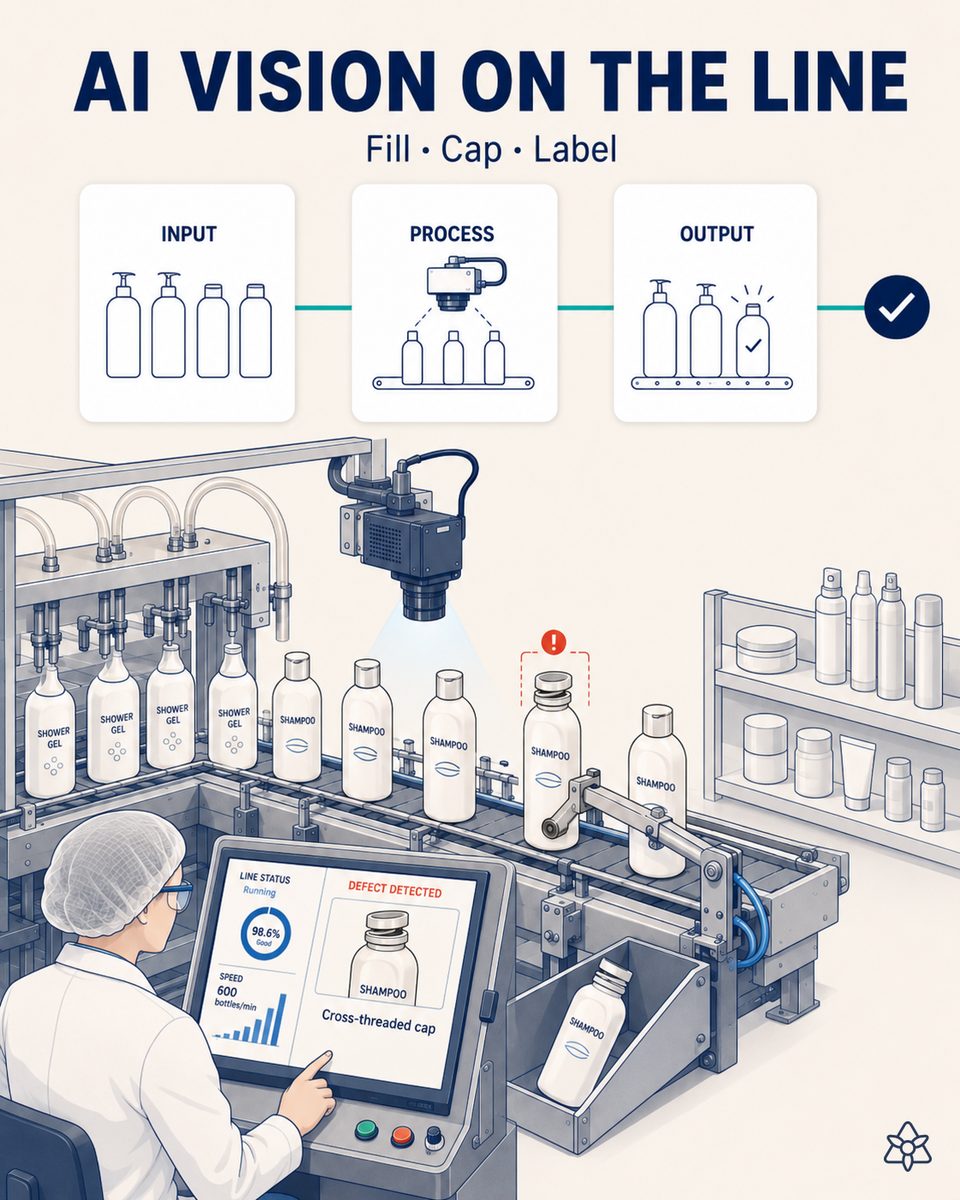
At one hundred to three hundred units per minute the human eye cannot keep up. Control today is sampling, and hundreds of units pass between samples. The defects that get through are always the same: fill level out of range, cross-threaded cap, missing pump, crooked label, unseated aerosol cap, illegible code. An Edge camera catches them at line speed and ejects before cartoning.
None of those defects spoils the product. Every one of them spoils the brand.
In-line quality control today is an operator looking at what they can, plus a final statistical sampling check. It is a reasonable method for catching systematic problems and a very poor one for catching sporadic ones. What makes this critical in personal care is that almost none of those defects affects the product, but every one affects brand perception — which is exactly what the brand owner is buying from their manufacturer. Any that reaches the customer becomes a return, a non-conformity and a mark on the supplier scorecard.
- At one hundred to three hundred units a minute the eye cannot keep up. It is a physical limit, not a training gap, which is why sampling became the standard.
- Hundreds of units pass between samples, and the sporadic defect is precisely the one that slips through that gap.
- The list barely changes: fill level out of range, cross-threaded cap, missing pump, crooked label, unseated aerosol cap, illegible code.
- What the brand owner is buying is brand perception, so each of those comes back as a return, a non-conformity and a mark on the supplier scorecard.
Edge — a camera on the line, inference in milliseconds, ejection before the carton.
an Edge camera over the line with local inference in milliseconds — no network or cloud dependency — and a neural network trained on good and bad images of that specific item and format. On detection it ejects the unit before it enters the carton. Every ejection is logged with its image: the operator sees on screen what is being ejected and why, and corrects the machine setting there and then. A systematic deviation usually precedes a breakdown, so vision doubles as a maintenance early warning.
A systematic deviation almost always precedes a breakdown, so the same camera that ejects units is the cheapest early warning the maintenance team is ever going to get.
Sampling vs. 100% inspection
| Aspect | Sampling control | With iLEAN Edge |
|---|---|---|
| Coverage | A fraction of units | Every unit |
| Where the defect is caught | Final inspection, or the customer | The unit in progress |
| Reaction time | The next sample | Milliseconds |
| Evidence of a rejection | None | Image on record |
| Machine drift | Noticed when it breaks | Visible as a trend |
| Acceptance criterion | The most senior operator's | Explicit inside the model |
from intermittent sampling to one hundred per cent inspection · from a defect found at final inspection to a defect ejected in the unit in progress · from a brand owner complaint to an internal incident resolved within the shift.
Impact estimate — to validate against your numbers.
The block below is an estimate to be validated against your plant's actual data. We put it forward so the committee has an order of magnitude; we refine it during the assessment.
- Filling and packing lines running one hundred to three hundred units a minute.
- Indicative payback between 5 and 10 months per line.
- At least 30% fewer defective units reaching the customer, plus less repacking rework.
- Start with the format that generates the most complaints: that is where the case pays for itself first.
estimated payback of 5 to 10 months per line. At least 30% fewer defective units reaching the customer and less repacking rework, plus early detection of machine drift. *Estimate to validate.*
And the fair question from the production manager
“What if it ejects good units?” — the threshold is tuned during the training weeks against real production, and it starts deliberately conservative: better a few doubtful units sent to review than one defective unit shipped to a brand owner. Every ejection is stored with its image, so the criterion gets audited instead of argued about in a meeting.
[1] OpenAI paper "Why Language Models Hallucinate", 2025 — on the reliability of AI in anchored tasks.
What people ask about vision on the packing line
Why local inference and not the cloud?
Latency, bandwidth and cost. At three hundred units a minute the reject decision has to happen in milliseconds and at the rejector itself; a round trip to a data center is not physically compatible with that. The GPU sits at the line for exactly this reason.
How long does training take?
Weeks rather than months, and it needs real units: good ones and bad ones of that specific item and format. For frequent defects there is usually enough material within a few runs; for a once-a-quarter defect the examples take longer to accumulate, and that is worth saying up front.
Does one model cover every brand on the line?
It is trained per format, because a crooked label on a 250 ml bottle is not the same object as an unseated cap on an aerosol. What carries over is the mounting, the lighting and the groundwork, so the second format on the same line costs a fraction of the first.
Does it slow the line down?
No. Inference happens locally in milliseconds and the camera runs at the line's cadence, not the other way round. If anything it removes the stops caused by finding a tray of defective units at final inspection.
What does the operator actually see?
What was ejected and why, with the image, on a screen at the line. That is the part that changes behavior: the operator corrects the capper or the labeler there and then, instead of learning at the end of the shift that the reject count was high.
More cases from this series
- A dozen customers auditing and not one week lostEvery batch dossier builds itself while production runs, indexed by standard and separated by brand. The…
- The failure that ruins the year is not scrapFour coordinated verification rings — intake, changeover, start-up and output — against the error that…
- The batch record exists at second zero, not eight hours laterThree photos at start-up and the batch record exists at second zero, with the real lot of every raw…
- In contract manufacturing, the customer decides the changeiLEAN reads the brand owner's email, extracts the artwork or component change and cross-checks it…
- The most expensive error in this sector starts at an industrial keyboardBatch, expiry and period-after-opening flow from the ERP to the coder using each brand's template. Zero…
- The truck does not wait and the lot is properly tracedPhoto the delivery note and the lot labels: iLEAN extracts, links the certificate of analysis and posts…
Tell us which defect gets past your fastest line today.
We work on your plant's real data, not ours. Assessment with no commitment.
Request estimated ROI within 48h ‹ See all cases of personal care See cosmetics