The batch record exists at second zero, not eight hours later
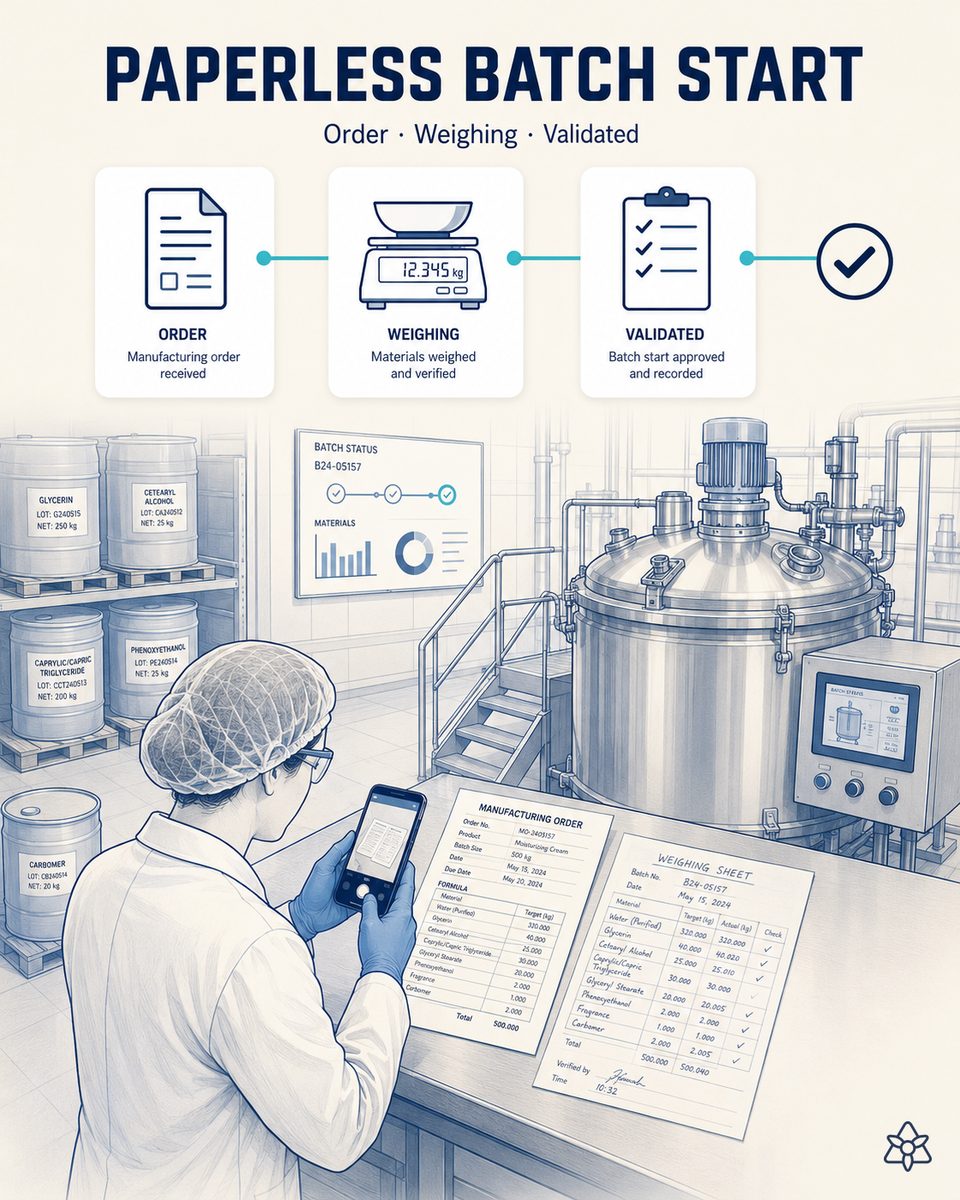
In a plant making personal care products for third-party brands, a bulk batch starts with three pieces of paper: the manufacturing order, the handwritten weighing sheet and the signed process parameter sheet. Those three documents are the batch record an auditor will ask for two years later. Today they sit in an office folder until someone digitises them. With iLEAN Connect, the operator takes three photos at start-up and it all lands structured in the central system immediately.
The paper is not the problem. The gap between the reserved lot and the drum actually opened is.
The weighing sheet is handwritten for a reason nobody disputes: the operator records the real lot of the drum they actually opened. And that lot is almost never the one the ERP reserved, because they took whatever was in the warehouse. That gap between reserved lot and consumed lot is precisely what breaks traceability the day a brand asks about one specific ingredient. Meanwhile the paperwork waits. Between closing the batch and someone scanning or keying it in, four to eight hours pass, sometimes a full shift. For all that time the central system has no idea what has been made, and planning works from a stale picture. When the audit arrives — your own or the brand owner's — reconstruction is manual: find the folder, sort the paper, decipher a scribbled margin note and hope no signature is missing.
- The ERP reserves one lot and the warehouse hands over another. Nobody is at fault — they hand over what is at the front — but the trace that gets stored is the reserved one.
- Four to eight hours, sometimes a whole shift, between closing the batch and somebody keying it in. Planning works from yesterday's picture.
- The evidence is a sheet in an office folder, with a margin note only its author can read and a signature that may or may not be there.
- And two years later a brand asks about one specific ingredient lot, and the answer has to be rebuilt by hand out of that folder.
Connect in photo mode — the operator keeps filling in exactly the same sheet.
Connect in photo mode. The operator photographs the manufacturing order, the weighing sheet and the parameter sheet with a phone or an industrial tablet. An anchored model recognises the document structure and extracts structured fields: item, brand, batch number, every raw material with its lot and actual weight, margin deviations and the signature. It all goes into iLEAN's central memory with the original photo as backing evidence. Flow: photo → anchored extraction → normalisation against the item specification → central memory → web query by item, brand or date. Zero habit change: the operator keeps filling in the same sheet.
The habit change is zero, and that is not a detail: it is why the case is still alive in month six, which is where the ones that ask a bulk operator to learn an app die.
The batch record on paper vs. the batch record captured
| Aspect | On paper today | With iLEAN Connect |
|---|---|---|
| When the batch exists in the system | 4-8 h later | Second zero |
| Lot of each raw material | The one the ERP reserved | The drum actually opened |
| Finding a two-year-old batch | Hunting through folders | A query by item or brand |
| An illegible or missing field | Surfaces weeks later | Flagged at validation |
| Evidence for the audit | The original sheet, if it survived | Photo plus structured fields |
| Production technician's keying time | Daily work | Recovered |
from 4-8 h of lag (sometimes a full shift) to second zero · from an unknown consumed lot until closing to the real lot logged as the drum is opened · from reconstructing the batch record by hunting for paper to querying it by item or brand.
Impact estimate — to validate against your numbers.
The block below is an estimate to be validated against your plant's actual data. We put it forward so the committee has an order of magnitude; we refine it during the assessment.
- Plants making bulk for third-party brands, with a handwritten weighing sheet per batch.
- Indicative payback between 4 and 9 months, depending on bulk batches per day.
- Plus the production technician's transcription time, recovered from the first week.
- And the risk of a lost or illegible sheet, which today only gets priced the day it happens.
estimated payback of 4 to 9 months depending on bulk batches per day, counting the transcription time the production technician gets back and the eliminated risk of lost or illegible paper. *Estimate to validate.*
And the fair question from the production manager
“What if it misreads a weight and a wrong figure gets in?” — reading fields off a form with a known structure is an anchored task, where the best models drop below 1.5% error [1]. But the real answer is the other one: the extracted summary goes to the tablet and somebody confirms or corrects it before it crosses into the system. Nothing enters on its own.
[1] OpenAI paper "Why Language Models Hallucinate", 2025 — on the reliability of AI in anchored tasks.
What people ask about digitizing the batch record
Does the weighing sheet have to change?
No, and that is the condition. The sheet has been tuned over years to how that plant weighs, and every attempt to replace it with a form on a screen ends with the operator writing on paper anyway and keying it in later. Vision reads the structure of the document, so the sheet stays as it is.
What if the operator writes a lot that is not the one the ERP reserved?
That is the case, not an edge case. Connect stores what was written — the drum actually opened — and flags the discrepancy against the reservation so stock and traceability can be corrected while the batch is still open. Today that gap only surfaces when a brand asks.
Does it work with several different sheet formats?
Yes. Plants making for a dozen accounts usually carry one sheet per customer or per family, inherited from whoever set the item up. Each one is anchored separately and the output lands in a single batch model, which is what makes bulk from different accounts comparable.
Is there network coverage in the bulk room?
It is not needed at the moment of the photo. The device queues the image and uploads it when there is a network, which is one reason to do this by photo rather than with a connected app: the operator's work never waits for the wifi.
Does the vessel's process curve come in through here?
No: that comes off the panel and is covered by another case in this matrix, with a camera on the vessel screen. The two are cross-referenced afterwards by batch, which is when the analysis becomes useful — a weighing sheet alone does not explain an out-of-spec viscosity.
More cases from this series
- A dozen customers auditing and not one week lostEvery batch dossier builds itself while production runs, indexed by standard and separated by brand. The…
- The failure that ruins the year is not scrapFour coordinated verification rings — intake, changeover, start-up and output — against the error that…
- In contract manufacturing, the customer decides the changeiLEAN reads the brand owner's email, extracts the artwork or component change and cross-checks it…
- The most expensive error in this sector starts at an industrial keyboardBatch, expiry and period-after-opening flow from the ERP to the coder using each brand's template. Zero…
- The truck does not wait and the lot is properly tracedPhoto the delivery note and the lot labels: iLEAN extracts, links the certificate of analysis and posts…
- The person who knows the plant best records the leastThe supervisor dictates while walking: iLEAN listens, structures by line and item, and answers back…
Tell us how many hours pass today between closing a batch and keying it in.
We work on your plant's real data, not ours. Assessment with no commitment.
Request estimated ROI within 48h ‹ See all cases of personal care See cosmetics