The truck does not wait and the lot is properly traced
The truck arrives with raw materials and components. The receiving supervisor has a delivery note with fifteen or twenty lines, a certificate of analysis for each regulated raw material, and pallets of bottles, caps and printed material with their lot labels. They have to sign and then book it into the ERP line by line. Either the haulier waits on demurrage, or it gets rushed and the lots end up wrongly assigned.
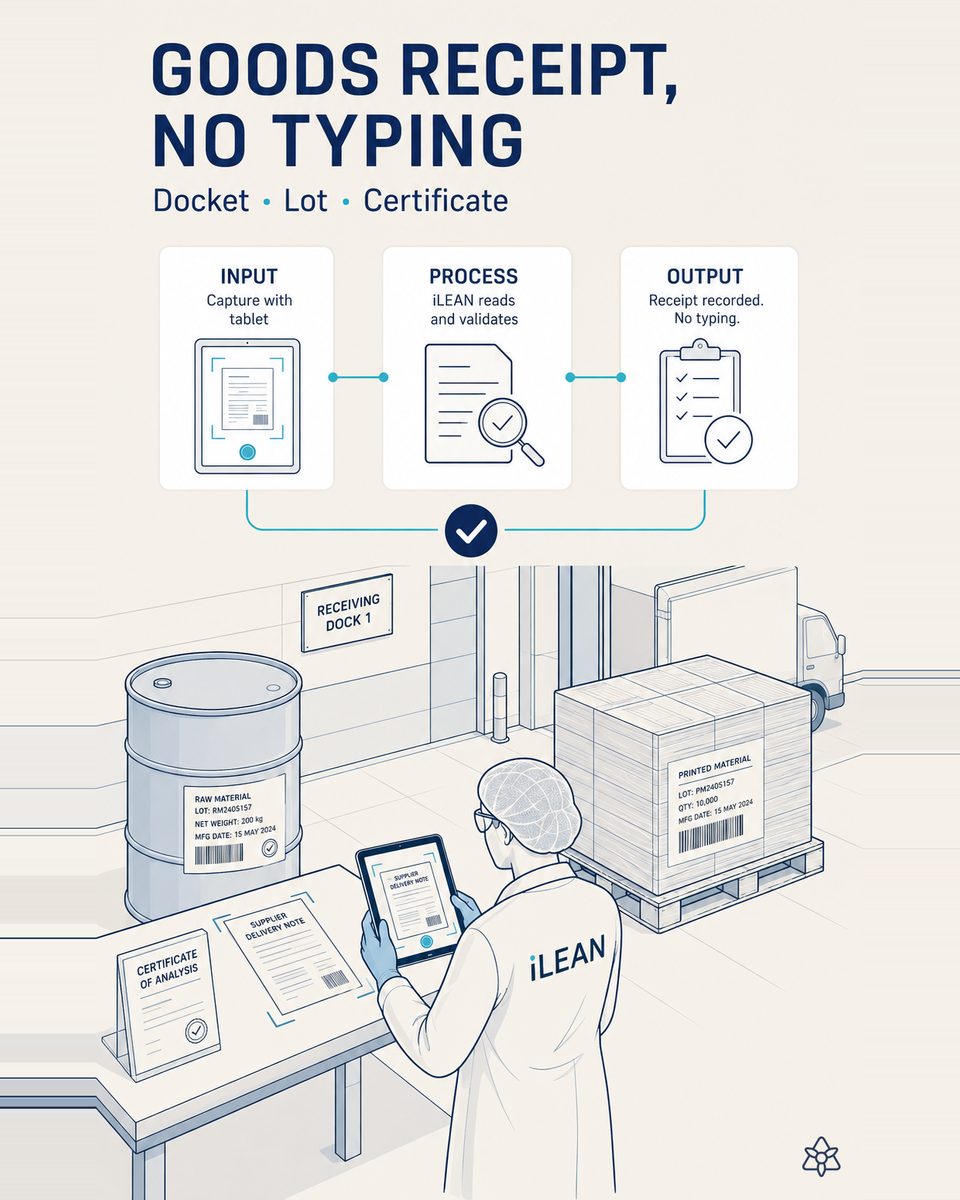
A receiving error is not paid for at receiving. It is paid for weeks later.
A receiving error is not paid for at receiving: it is paid for weeks later, the day a brand asks which surfactant lot their product came from and the trace does not add up. In contract manufacturing there is an aggravating factor: much of the material received is printed material owned by the customer — cartons, labels, screen-printed bottles. Its traceability matters as much as the chemical raw material's, because it is exactly what distinguishes one brand's product from another's. And the certificates of analysis, which are the evidence the audit will ask for, depend today on somebody filing the PDF in the right folder and mentally associating it with the right lot.
- Fifteen or twenty lines on the delivery note, a certificate of analysis per regulated raw material, and pallets of components with their own lot labels.
- Either the haulier waits on demurrage or it gets rushed, and rushing is exactly how lots end up assigned to the wrong line.
- Much of what arrives is the customer's printed material — cartons, labels, screen-printed bottles — and its traceability matters as much as the surfactant's, because it is what distinguishes one brand from another.
- The certificates depend on somebody filing a PDF in the right folder and mentally tying it to the right lot. That is the evidence the audit will ask for.
Connect in document-photo mode — photograph, check, one tap, posted.
Connect in document photo mode. Photograph the delivery note and the labels; iLEAN reads GS1-128, QR, barcode and plain text; extracts supplier, item, quantity, lot and expiry per line; attaches the certificate of analysis and safety data sheet to the matching lot; checks against the ERP purchase order and highlights discrepancies. The receiving supervisor validates with one tap and Connect posts to the ERP via API with the document already linked.
The certificate stops being a PDF in a folder and becomes an attribute of the lot, which is how it gets found the day somebody asks for it.
Booking in by hand vs. booking in by photo
| Aspect | Today | With iLEAN Connect |
|---|---|---|
| Time to book in a truck | 30-45 min | Minutes |
| Lot and expiry per line | Typed in | Read from label and code |
| Certificate of analysis | Filed by hand | Linked to its lot automatically |
| The customer's printed material | Traced loosely | Traced like a raw material |
| Discrepancy against the purchase order | Surfaces later | Highlighted before posting |
| Haulier demurrage | A recurring cost | Eliminated |
from 30-45 min of manual booking per truck to minutes · from certificates filed by hand to certificates automatically linked to their lot · from reconstructible traceability to queryable traceability · from haulier demurrage to zero.
Impact estimate — to validate against your numbers.
The block below is an estimate to be validated against your plant's actual data. We put it forward so the committee has an order of magnitude; we refine it during the assessment.
- Receiving areas taking raw material and customer-owned printed material across the same dock.
- CFO angle: receiving and warehouse licenses typically from four to one, a recurring −50% to −70% line.
- Indicative payback between 4 and 8 months, plus the demurrage that stops being paid.
- And lot-to-plant traceability by photo, which is precisely the evidence second-party audits ask for.
CFO angle — direct saving on receiving and warehouse module licences, typically from 4 to 1 (−50% to −70%), plus elimination of demurrage costs and full lot-to-plant traceability by photo, which is precisely the evidence second-party audits ask for. Estimated payback of 4 to 8 months. *Estimate to validate.*
And the fair question from the production manager
“What if the delivery note is a bad photocopy?” — it happens constantly, which is why the reading combines GS1-128, QR and barcode with plain text: where the print is poor, the code usually is not. Whatever cannot be read at all is flagged in the validation instead of invented, and the receiving supervisor completes it there and then, with the pallet still in front of them.
[1] OpenAI paper "Why Language Models Hallucinate", 2025 — on the reliability of AI in anchored tasks.
What people ask about goods receipt without typing
Does the supplier have to send anything in a particular format?
No. Suppliers of raw material, bottles and printed material each have their own delivery note and none of them will change it for you. The reading is anchored per supplier, which is workable because the same twenty or thirty suppliers cover almost everything crossing the dock.
What if the delivery does not match the purchase order?
That is the moment worth catching it. The discrepancy is highlighted before posting — quantity short, an unexpected lot, an expiry too close — and the receiving supervisor decides whether to accept, accept partially or reject. Today that comparison happens after the truck has left.
Is customer-owned printed material handled differently?
It is handled with the same rigor as chemical raw material, and that is the change. Cartons and labels belonging to a brand are what physically distinguish one account's product from another's, so they carry lot and location like any critical material.
Where does the certificate of analysis come from?
From the PDF that arrives with the delivery, photographed or picked up from the mailbox, tied to the lot it belongs to. From then on it is retrieved by lot rather than by remembering which folder and which month it was filed under.
Does the ERP have to change?
No: it posts through the API the ERP already exposes, with the document already linked. The receiving flow, the account codes and the approvals stay exactly as they are — what disappears is the typing between the pallet and the screen.
More cases from this series
- A dozen customers auditing and not one week lostEvery batch dossier builds itself while production runs, indexed by standard and separated by brand. The…
- The failure that ruins the year is not scrapFour coordinated verification rings — intake, changeover, start-up and output — against the error that…
- The batch record exists at second zero, not eight hours laterThree photos at start-up and the batch record exists at second zero, with the real lot of every raw…
- In contract manufacturing, the customer decides the changeiLEAN reads the brand owner's email, extracts the artwork or component change and cross-checks it…
- The most expensive error in this sector starts at an industrial keyboardBatch, expiry and period-after-opening flow from the ERP to the coder using each brand's template. Zero…
- The person who knows the plant best records the leastThe supervisor dictates while walking: iLEAN listens, structures by line and item, and answers back…
Tell us how long it takes today to book in a full truck.
We work on your plant's real data, not ours. Assessment with no commitment.
Request estimated ROI within 48h ‹ See all cases of personal care See cosmetics