The failure that ruins the year is not scrap
The pain that defines a personal care contract manufacturer is one brand's product going out with something belonging to another: a crossed component, a leftover label, a wrongly printed batch code, bulk released against the wrong specification. The manufacturer pays for the recall, the critical non-conformity lands on the customer's scorecard and the account goes under review.
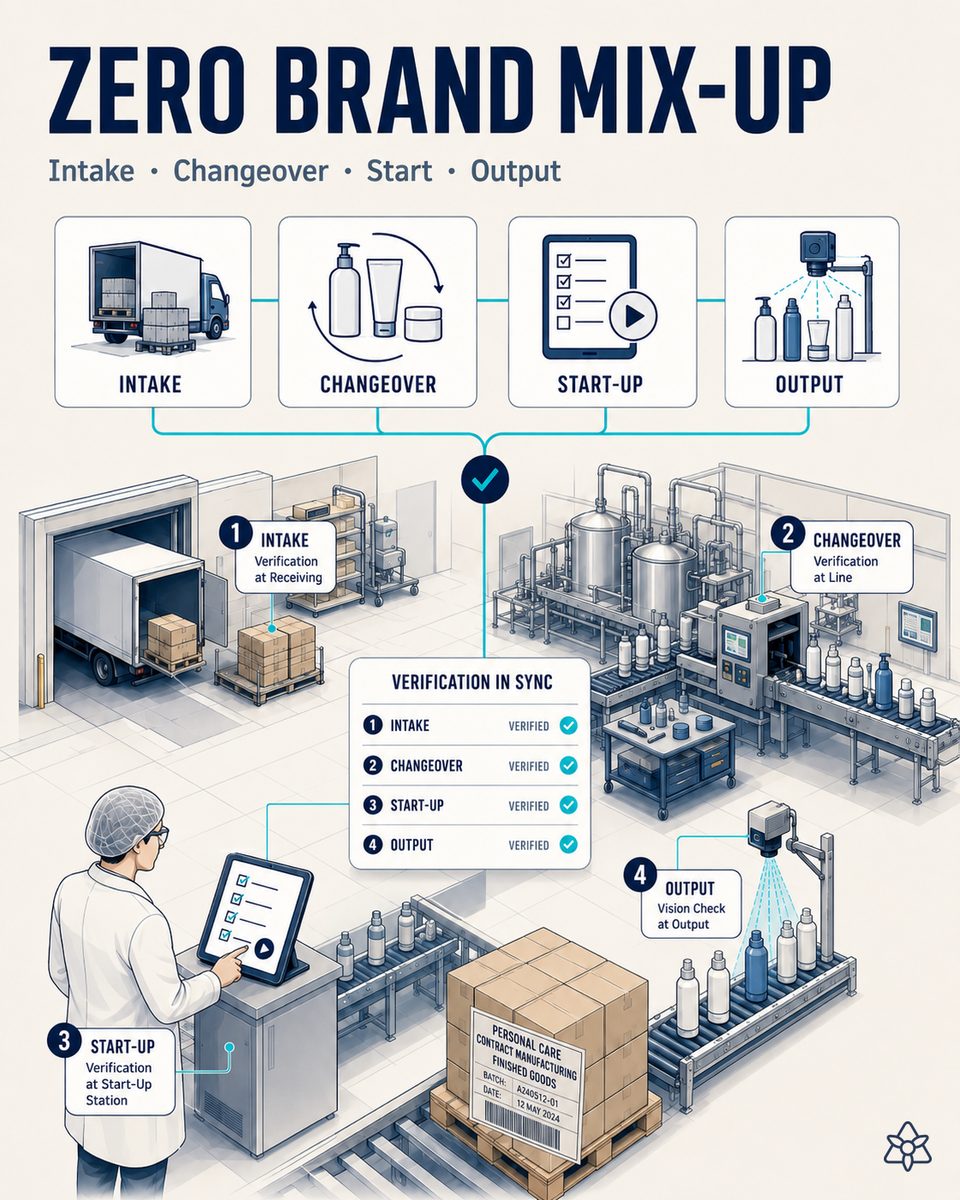
One human barrier, at the worst moment of the day.
It happens because a dozen brands share the same hall, warehouse and people. The bottles look alike, the caps are interchangeable, the printed material is stacked in the same aisle and the lines change item several times a day. No operator wants to get it wrong. But today the last barrier against mix-up is their attention at the end of a long changeover, with the line stopped and everyone in a hurry. A single, human barrier, at the worst possible moment. And it is a doubly expensive pain: the manufacturer answers financially to its customer and loses the relationship as well.
- A dozen brands share hall, warehouse and people. The bottles look alike, the caps are interchangeable and the printed material is stacked in the same aisle.
- The lines change item several times a day, so the risky moment is not rare: it comes round three times a shift.
- No operator wants to get it wrong. But the last barrier is their attention at the end of a long changeover, with the line stopped and everyone in a hurry.
- And the bill is double: the manufacturer answers financially to its customer and loses the relationship as well.
Not a new piece: the eleven previous cases acting at once as four independent rings.
not a new piece, but the eleven previous cases acting at once as four independent verification rings:
The point is not that each ring is perfect. It is that four independent barriers fail together far less often than one tired person at the end of a changeover.
- Intake ring (Connect, case 7): every component and raw material enters with its lot and certificate read off the label, not typed. Whatever is not identified is not available to reserve.
- Changeover ring (Edge + SMED AI, case 10): the line does not start until the cameras confirm nothing from the previous item remains and quality signs. The physical mix-up is blocked before it can exist.
- Start-up ring (Connect, cases 5 and 8): the item-component-lot triad is validated on the tablet with two taps and the coding message flows from the ERP to the coder with no typing, using that brand's template.
- Output ring (Edge + JIDOKA AI, case 9): vision inspects 100% of units and, faced with a systematic anomaly, stops the line rather than keep producing defective product.
Above all four, Agents correlates the vessel curve (case 2), the lab results (case 6), what the supervisor dictated during the shift (case 4) and what the brand flagged by email (case 3); and in parallel assembles the evidence pack (case 11) proving all four rings were active on that specific batch.
One barrier vs. four rings
| Ring | Today | With the four rings active |
|---|---|---|
| Intake | Lots typed in at receiving | Lot and certificate read off the label |
| Changeover | A signature with no evidence | Start-up locked until every point is green |
| Start-up | The component confirmed from memory | The triad validated on the tablet |
| Coding | Typed to each brand's template | Published from the released order |
| Output | Sampling at final inspection | Vision on one hundred per cent of units |
| Proving it afterwards | Rebuilt from paper | Evidence generated at the time |
from a single human barrier to four independent, verifiable rings · from proving the absence of mix-up by reconstructing paper to proving it with evidence generated at the time · from a recall discovered in the market to an anomaly intercepted on the line.
Impact estimate — to validate against your numbers.
The block below is an estimate to be validated against your plant's actual data. We put it forward so the committee has an order of magnitude; we refine it during the assessment.
- Personal care contract manufacturers where a recall would put the main account under review.
- The direct cost of a single consumer goods recall — reverse logistics, destruction, replacement, contractual penalties — comfortably exceeds deploying all twelve cases.
- Counting only the operational savings of the previous eleven, payback for the set lands between 6 and 12 months.
- The avoided-risk part is the largest and the hardest to put in a spreadsheet: that is a committee conversation, not a cell.
this is the highest-return case and the hardest to quantify up front, because its value is the avoided cost of a rare, catastrophic event. Conservative reference: the direct cost of a single consumer goods recall — reverse logistics, destruction, replacement, contractual penalties — comfortably exceeds the full deployment of all twelve cases. Counting only the operational savings of the previous eleven, payback for the set is estimated at 6-12 months. *Estimate to validate.*
And the fair question from the production manager
“Do all four rings have to be deployed for this to be worth anything?” — no, and trying would be a bad idea. Each ring works and pays for itself on its own; what the four together give is that a mix-up has to get past four independent checks instead of one tired person. The usual order starts with intake and start-up, which are the cheapest and feed everything else, and continues wherever the pain is most expensive.
[1] OpenAI paper "Why Language Models Hallucinate", 2025 — on the reliability of AI in anchored tasks.
What people ask about the four verification rings
Where do you start?
With the start-up ring, almost always. It is the cheapest, it sits exactly where the error originates and it needs little more than a tablet at the line. The changeover ring comes next, because it is the one that stops the physical mix-up and it also gives changeover time back.
Is one ring enough?
It reduces the risk in the way that ring covers, and it is worth having. But the reason this case exists as a whole is that the four failure paths are different: what gets past receiving is not what gets past a changeover. A single ring leaves the other three doors exactly as they are today.
What does this give us in front of the brand owner?
Something to show. Today the answer to “how do you guarantee my product is not made with another brand's component” is a procedure and a promise. With the rings active it is four verifiable checks plus the evidence that all four were live on that specific batch, which is a different conversation at renewal.
Does it stop the plant when something does not match?
It stops the line at the changeover ring and at the output ring, and that is deliberate — JIDOKA AI. Everywhere else it proposes and a person decides. A system that halted a plant on its own judgment would be switched off within a month, and rightly.
How long does the whole thing take to deploy?
Ring by ring, over months rather than weeks. Each one goes live on one line, gets validated and gets replicated. Trying to deploy four rings across every line at once is the standard way to end up with four half-finished projects and no barrier at all.
More cases from this series
- A dozen customers auditing and not one week lostEvery batch dossier builds itself while production runs, indexed by standard and separated by brand. The…
- The batch record exists at second zero, not eight hours laterThree photos at start-up and the batch record exists at second zero, with the real lot of every raw…
- In contract manufacturing, the customer decides the changeiLEAN reads the brand owner's email, extracts the artwork or component change and cross-checks it…
- The most expensive error in this sector starts at an industrial keyboardBatch, expiry and period-after-opening flow from the ERP to the coder using each brand's template. Zero…
- The truck does not wait and the lot is properly tracedPhoto the delivery note and the lot labels: iLEAN extracts, links the certificate of analysis and posts…
- The person who knows the plant best records the leastThe supervisor dictates while walking: iLEAN listens, structures by line and item, and answers back…
Tell us how many barriers stand today between a wrong component and the pallet leaving.
We work on your plant's real data, not ours. Assessment with no commitment.
Request estimated ROI within 48h ‹ See all cases of personal care See cosmetics