The person who knows the plant best records the least
The shift supervisor spends eight hours walking between filling and packing lines with both hands busy. They know most about what is happening on the floor and record the least, because they cannot type. Everything they notice dies at the end of the shift. With Connect in voice mode they talk to the AI while walking: it listens, structures, stores and answers back in seconds.
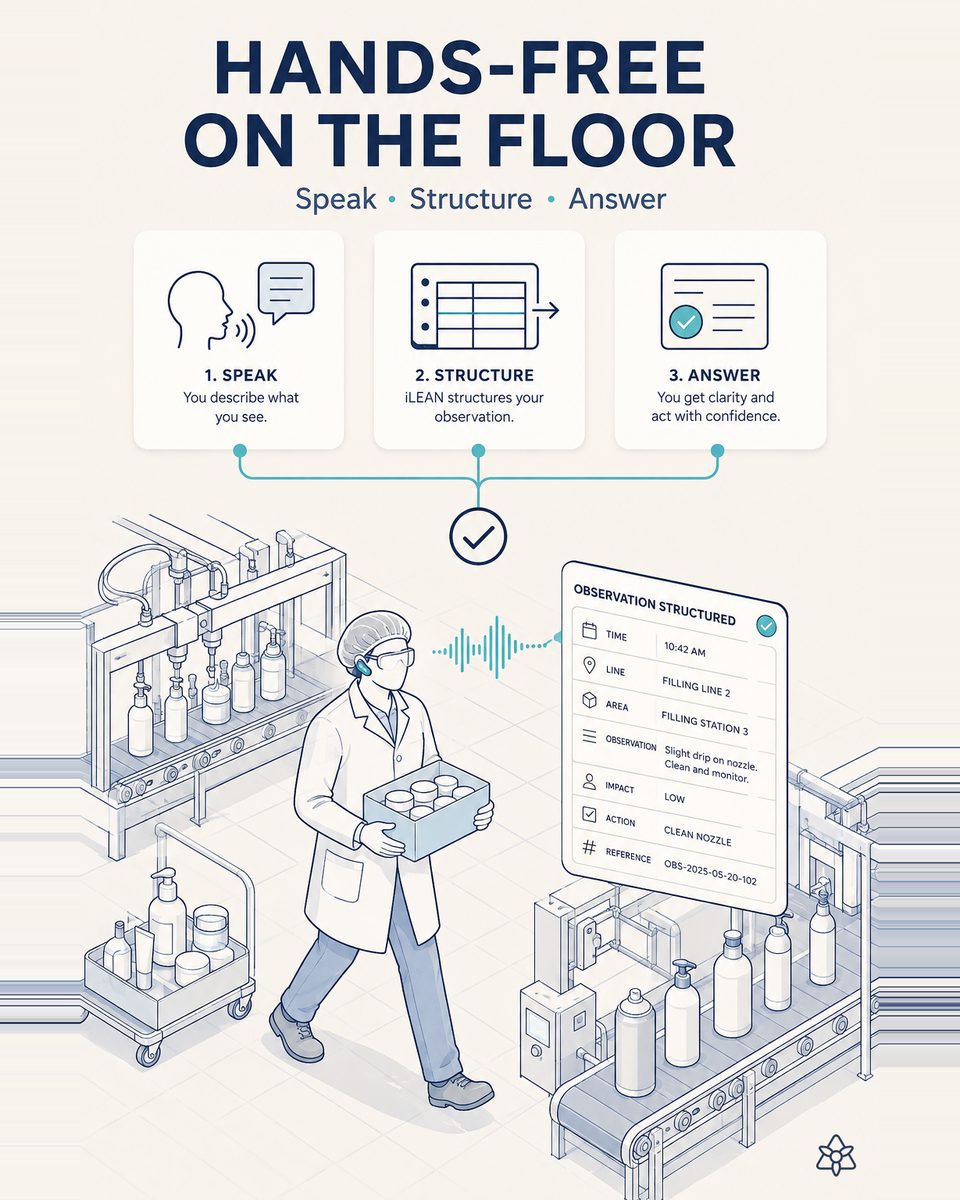
The person who knows most about what happened today is the one who records the least.
In a multi-brand plant, shift knowledge is the most perishable asset there is. The handover happens verbally in five minutes; whatever was not said does not exist. That line four has had three stoppages from a blocked pump, that the new cap lot runs tighter, that an operator flagged an odd smell in the bulk: these are early signals that, once logged, prevent a breakdown or a non-conformity. Unlogged, they are anecdotes. And when the brand complains about a defect three weeks later, nobody can reconstruct what was observed on the line that day.
- Both hands are busy for eight hours. Anything that requires stopping to type does not get written, and that is not a discipline problem.
- The handover is five verbal minutes: whatever is not said in them does not exist tomorrow.
- The early signals are what get lost: three stoppages on the same pump, a cap lot running tighter than usual, an odd smell flagged in the bulk.
- And when the brand complains three weeks later, nobody can reconstruct what was actually observed on that line that day.
Connect in voice mode — an industrial earpiece and a supervisor who never breaks stride.
industrial bluetooth earpiece plus Connect in voice mode. The supervisor dictates without breaking stride; iLEAN structures the observation by line, item, brand and incident type, and stores it in central memory. It answers back through the same earpiece: confirming the log, flagging that maintenance has an open work order on that machine, or answering order-progress questions. The AI assists, it does not replace: humans in command.
It answers back through the same earpiece: it confirms the record, warns that maintenance already has a work order open on that machine, or reads out how the order is running.
Shift knowledge today vs. shift knowledge on record
| Aspect | Today | With iLEAN Connect |
|---|---|---|
| What the supervisor observes | Said out loud, then gone | Recorded in seconds |
| Where it ends up | The next shift's memory | Indexed by line, item and brand |
| Repeat incidents | Rediscovered every time | With a history behind them |
| The handover | Five minutes of talking | Already written before it starts |
| A complaint three weeks later | Nothing to look at | What was seen on the line that day |
| Time spent reporting | 30-60 min per shift | Recovered |
from shift knowledge that evaporates to memory queryable by line, item and brand · from a five-minute verbal handover to a handover with the history already written · from repeating incidents to incidents with a history.
Impact estimate — to validate against your numbers.
The block below is an estimate to be validated against your plant's actual data. We put it forward so the committee has an order of magnitude; we refine it during the assessment.
- Multi-brand plants where the shift supervisor covers filling and packing on foot.
- Indicative payback between 4 and 9 months.
- Between thirty and sixty minutes per shift recovered from reporting and chasing information.
- Plus the repeat incidents that stop repeating once they have a history.
estimated payback of 4 to 9 months. Thirty to sixty minutes per shift recovered from reporting and chasing information, plus fewer repeat incidents caused by nothing being logged. *Estimate to validate.*
And the fair question from the production manager
“Is this surveillance of my people?” — no, and the distinction is deliberate: the supervisor decides when to speak and what to record, exactly as with the notebook in their pocket. It is not an open microphone and it does not log conversations. What comes out are incidents tied to a line and an item, not behavior reports about a person.
[1] OpenAI paper "Why Language Models Hallucinate", 2025 — on the reliability of AI in anchored tasks.
What people ask about the hands-free supervisor
Does it work with the noise of a filling line?
Yes: it is an industrial earpiece with noise cancellation, the same class of device used on a picking floor. Where a packer really is unbearable the supervisor steps a couple of meters away, which is what they already do to speak to anybody.
Our crews mix two languages on the floor. Does that break it?
No. Multi-brand plants often run mixed crews and the floor has its own dialect. What matters is that your plant's terms are loaded in — item names, line names, the nicknames the machines actually have — and that is part of the setup, not an afterthought.
Does it replace the shift report?
It fills it in. The supervisor stops writing it at the end of the shift and finds it already assembled from what was dictated during it. That version is both more complete and more accurate, because each piece was recorded when it happened.
Can it answer questions, or only record?
Answering is half the value. Through the same earpiece it says how the order is running, whether that raw material lot has an open non-conformity, whether maintenance has already been called for that machine. Without the answers it would just be a dictaphone.
Who gets to see what is dictated?
The roles that can act on it: production, quality, maintenance. It is not a private notebook and it is not a public feed. The rule is that an incident reaches whoever can do something about it, which is exactly what does not happen with a note in a pocket.
More cases from this series
- A dozen customers auditing and not one week lostEvery batch dossier builds itself while production runs, indexed by standard and separated by brand. The…
- The failure that ruins the year is not scrapFour coordinated verification rings — intake, changeover, start-up and output — against the error that…
- The batch record exists at second zero, not eight hours laterThree photos at start-up and the batch record exists at second zero, with the real lot of every raw…
- In contract manufacturing, the customer decides the changeiLEAN reads the brand owner's email, extracts the artwork or component change and cross-checks it…
- The most expensive error in this sector starts at an industrial keyboardBatch, expiry and period-after-opening flow from the ERP to the coder using each brand's template. Zero…
- The truck does not wait and the lot is properly tracedPhoto the delivery note and the lot labels: iLEAN extracts, links the certificate of analysis and posts…
Tell us how much of what your best supervisor knows is written down anywhere.
We work on your plant's real data, not ours. Assessment with no commitment.
Request estimated ROI within 48h ‹ See all cases of personal care See cosmetics