The most expensive error in this sector starts at an industrial keyboard
The coder on each line is a modern machine that already has an API, a protocol and message management software. But it sits isolated from the real flow, because integrating it properly never makes the priority list. The result: at every changeover somebody types batch, expiry, period-after-opening and sometimes the barcode by hand, standing up, with the line stopped and everyone in a hurry.
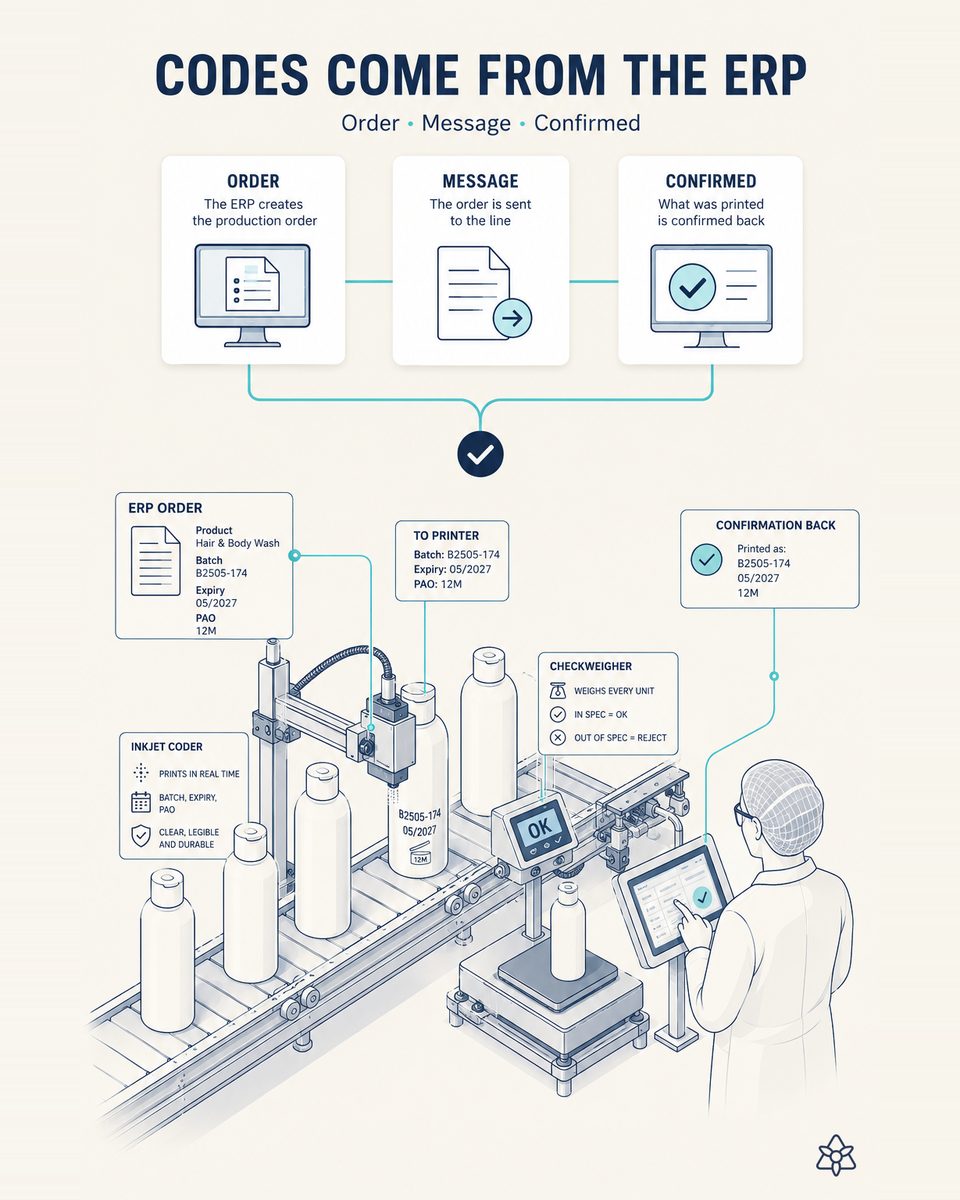
The most expensive error in this sector is typed standing up, with the line stopped.
In contract manufacturing every customer has their own coding format: some want the date in US style, some want the batch with a plant prefix, some want the period-after-opening on the carton and not on the bottle. Multiplied by a dozen accounts and several changeovers a day per line, the error surface is enormous. And the failure is not caught until final inspection or until it reaches the customer, with the batch already made. The same goes for the checkweigher: its weight limits are set by hand and its rejects are counted on a paper log that never reaches the ERP, so the order's real yield is known late and approximately.
- Every customer has their own coding format: a US-style date here, a plant prefix on the batch there, the period-after-opening on the carton and not on the bottle.
- Multiply that by a dozen accounts and several changeovers a day per line, and the error surface stops being manageable by care alone.
- It is not caught until final inspection, or at the customer, with the batch already made and palletized.
- The checkweigher has the same disease: limits set by hand and rejects counted on a paper log that never reaches the ERP, so real yield per order is known late and roughly.
Connect stitches two modern systems together through the APIs they already expose.
Connect stitches two modern systems together via their APIs, replacing neither. When the order is released, the ERP hands the coder the complete message already formatted to that brand's template; the coder confirms what it is actually printing and that confirmation flows back to the ERP. In parallel the checkweigher takes its limits from the item specification and returns counts and rejects live. No machine is replaced or reprogrammed.
Nothing is replaced and nothing is reprogrammed. The coder is usually the most modern machine on the line: what is missing is not capability, it is the integration project that never reaches the top of the list.
Typing at every changeover vs. publishing from the order
| Aspect | Today | With iLEAN Connect |
|---|---|---|
| Where the batch code comes from | Whoever types it | The released order |
| That brand's coding template | Remembered per account | Applied automatically |
| What was actually printed | Not recorded | Confirmed back to the ERP |
| Time per changeover | 10-20 min of typing | Recovered |
| Checkweigher limits | Set by hand | From the item specification |
| Rejects and real yield | A paper log | Live, per order |
from manual typing at every changeover to zero typing · from checkweigher rejects counted on paper to real-time yield per order · from a coding error found at final inspection to an error that is structurally impossible.
Impact estimate — to validate against your numbers.
The block below is an estimate to be validated against your plant's actual data. We put it forward so the committee has an order of magnitude; we refine it during the assessment.
- Lines with a modern coder and a checkweigher, both isolated from the ERP.
- Indicative payback between 4 and 9 months.
- 10-20 minutes recovered per changeover, which with several changeovers a day per line is production time.
- And typing-caused coding errors, which stop being unlikely and become structurally impossible.
estimated payback of 4 to 9 months. It practically eliminates typing-caused coding errors and recovers 10-20 minutes per changeover, which in a plant with several changeovers a day per line is recovered production time. *Estimate to validate.*
And the fair question from the production manager
“What if the integration leaves the coder down?” — it is stitched through the API the machine already exposes, without touching its control, and it is tested on one line during a changeover that was already scheduled. If something does not fit, it shows on that line and not across the plant. The coder still accepts manual typing exactly as before.
[1] OpenAI paper "Why Language Models Hallucinate", 2025 — on the reliability of AI in anchored tasks.
What people ask about stitching the coder to the ERP
Does the coder have to be replaced?
No. Coders are usually the newest thing on a personal care line and almost all of them expose an API and message management software. What is missing is the integration project, not the machine.
How are a dozen different formats handled?
Each brand's template is defined once — date format, batch prefix, what goes on the bottle and what goes on the carton — and applied from the order. Those templates exist today too; they just live in the heads of the people who type them.
Does the ERP have to be changed?
No. It publishes through the interface the ERP already has, and the trigger is the order release, which is the same event that already defines what is being produced. Nothing about how orders are managed changes.
How do we know what was actually printed?
The coder confirms the message it is printing and that confirmation is recorded against the order. It closes the loop: having sent the right code is not enough, you want evidence of what came out — which is exactly what an auditor asks for.
Does the checkweigher come in the same case?
Yes, because it has the same problem and the same fix: limits set by hand and rejects on paper. Taking the limits from the item specification and returning counts live is what turns yield per order into a real figure instead of a Monday estimate.
More cases from this series
- A dozen customers auditing and not one week lostEvery batch dossier builds itself while production runs, indexed by standard and separated by brand. The…
- The failure that ruins the year is not scrapFour coordinated verification rings — intake, changeover, start-up and output — against the error that…
- The batch record exists at second zero, not eight hours laterThree photos at start-up and the batch record exists at second zero, with the real lot of every raw…
- In contract manufacturing, the customer decides the changeiLEAN reads the brand owner's email, extracts the artwork or component change and cross-checks it…
- The truck does not wait and the lot is properly tracedPhoto the delivery note and the lot labels: iLEAN extracts, links the certificate of analysis and posts…
- The person who knows the plant best records the leastThe supervisor dictates while walking: iLEAN listens, structures by line and item, and answers back…
Tell us how many coding formats your plant manages by hand.
We work on your plant's real data, not ours. Assessment with no commitment.
Request estimated ROI within 48h ‹ See all cases of personal care See cosmetics