In contract manufacturing, the customer decides the change
A brand manager writes mid-afternoon: the new artwork carries a modified claim, the cap has to be swapped, this campaign needs a different coding format. That email lands with one person on the account team and gets read whenever there is time. If the line starts the next morning with the old component, the cost is rework, destruction of printed material, or product going out with artwork that is no longer valid.
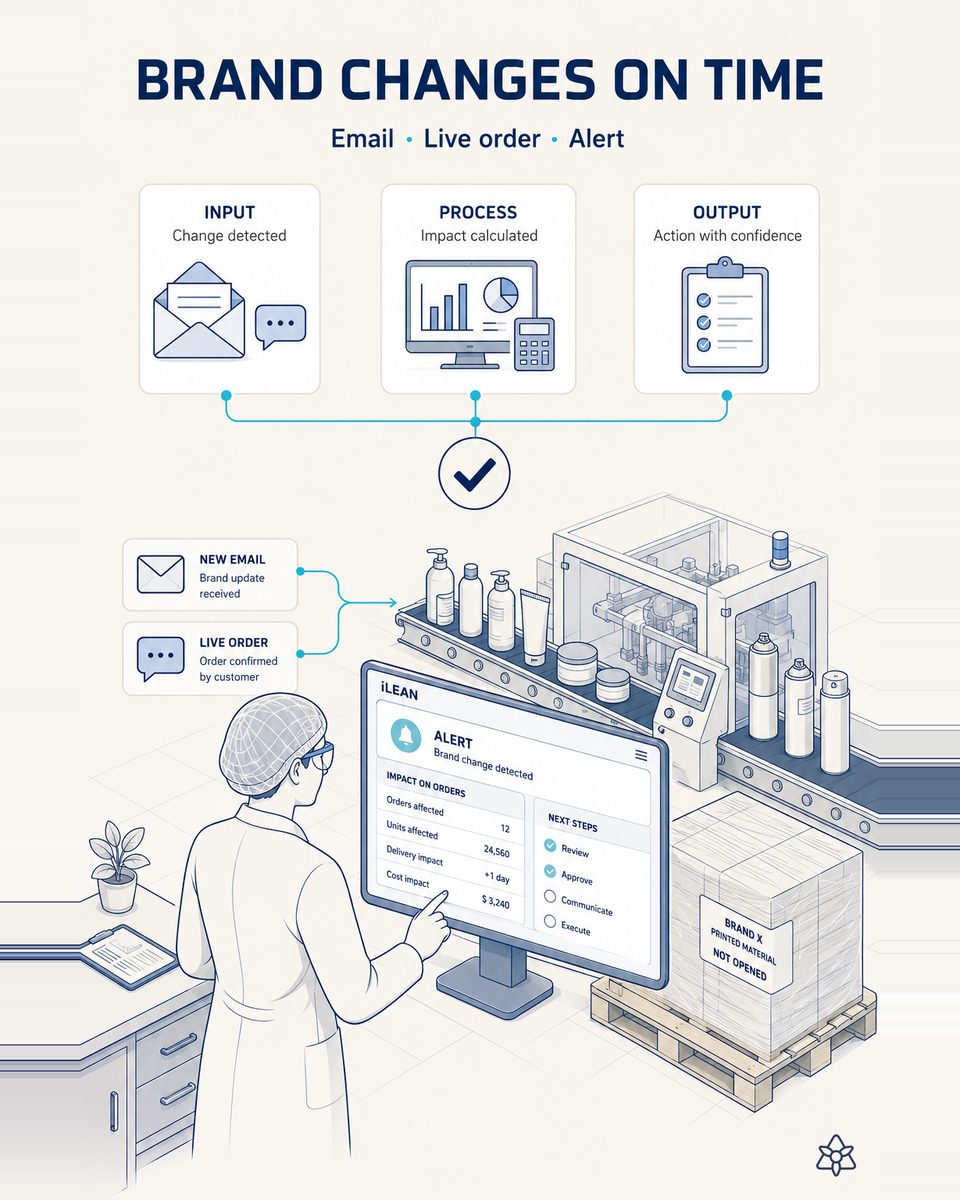
In contract manufacturing the change is decided outside the plant, and it travels outside the ERP.
In an own-brand plant, changes are decided by the plant. In contract manufacturing they are not: the customer decides, and every customer has their own contact and their own channel. The critical information does not travel through the ERP: it travels by email and by messaging, mixed in with ordinary conversation. With a dozen active accounts, nobody can read it all in time. And a lost alert is not lost quietly: it comes back as obsolete printed material, as an emergency reschedule, or as product that has to be relabelled. When that happens, the department that pays for it is planning, which learns about the change once nothing can be done about it.
- Every account has its own contact and its own channel: an email here, a message there, a phone call to somebody who was in a meeting.
- The critical line is buried in ordinary conversation, three paragraphs into a message that also asks about an invoice and a delivery date.
- With a dozen live accounts nobody reads it all in time, and a missed alert does not stay quiet: it comes back as printed material to destroy.
- Planning is the department that pays for it, and it finds out once the line has already started with the previous component.
Connect in chaotic-sources mode — the brand manager keeps writing exactly where they write today.
Connect in chaotic-sources mode. iLEAN is silently copied on a dedicated mailbox and on the account team's messaging channel. The moment a message arrives it extracts the intent — artwork change, component change, formula change, pulled-in or pushed-out delivery, non-conformity — cross-checks it against live data (which orders for that brand are scheduled, which components are reserved, how much printed material is in the warehouse) and alerts planning, purchasing and the account owner with the suggested action and its impact already calculated.
What reaches planning is not a notification. It is which orders are affected, how many cartons of the old artwork sit in the warehouse, and what to do about it.
A change read late vs. a change cross-checked
| Aspect | Today | With iLEAN Connect |
|---|---|---|
| From the customer's email to the alert | Hours or days | Minutes |
| Who has to notice | Whoever owns the account | Nobody: it is extracted |
| Impact on live orders | Estimated by hand | Calculated against the schedule |
| Printed material in stock | Checked afterwards | Part of the alert itself |
| Where the change ends up | One person's inbox | Planning, purchasing and the account |
| The customer's habits | Theirs | Theirs, untouched |
from an alert read hours or days late to a notification in minutes · from finding out once the line has started to finding out while rescheduling is still possible · from a guessed impact to an impact calculated against real orders.
Impact estimate — to validate against your numbers.
The block below is an estimate to be validated against your plant's actual data. We put it forward so the committee has an order of magnitude; we refine it during the assessment.
- Contract manufacturers with ten or more live brand accounts, each with its own channel.
- Indicative payback between 3 and 8 months.
- Around 30% less obsolete printed material and less late-change rework.
- The harder number to put in a spreadsheet: the reschedules that stop being emergencies.
estimated payback of 3 to 8 months, with around 30% less obsolete printed material and late-change rework. *Estimate to validate.*
And the fair question from the production manager
“Are you going to read my team's email?” — what gets read is a dedicated mailbox and the account channel set up for customer traffic. Nobody's personal inbox is touched and no private conversation is accessed. And what comes out is a proposed action for a role — planning, purchasing, the account owner — not a report about a person.
[1] OpenAI paper "Why Language Models Hallucinate", 2025 — on the reliability of AI in anchored tasks.
What people ask about catching the brand owner's changes
Does the brand manager have to write in a set format?
No, and that is the whole point. The customer is not going to adopt your form: they write as they always have, mid-afternoon, mixing the change in with two other topics. The model extracts intent and entities from that message however it arrives.
What if the message is in another language?
It is processed the same way. Brand owners in this sector are frequently international and it is normal for one account to write in two languages depending on who sends it. That is one of the reasons nobody normalizes these alerts by hand today.
Can it reschedule an order by itself?
No. It proposes — hold this order, release the printed material of the old artwork, pull that one forward — and a planner decides. The rule holds across the whole matrix: the AI supplies the cross-referenced data and the proposal, never the signature.
What kinds of change does it pick up?
Artwork and claims, component swaps, formula revisions, coding format changes, pulled-in or pushed-out deliveries and non-conformities. Those are the ones that hurt, because each invalidates something physical that is already in the warehouse or already on the line.
What happens with an ambiguous message?
It gets routed anyway, flagged as ambiguous, rather than discarded. A doubtful alert reviewed by a human beats a lost one, and the role receiving it decides. What the system does not do is act on a reading it is unsure about.
More cases from this series
- A dozen customers auditing and not one week lostEvery batch dossier builds itself while production runs, indexed by standard and separated by brand. The…
- The failure that ruins the year is not scrapFour coordinated verification rings — intake, changeover, start-up and output — against the error that…
- The batch record exists at second zero, not eight hours laterThree photos at start-up and the batch record exists at second zero, with the real lot of every raw…
- The most expensive error in this sector starts at an industrial keyboardBatch, expiry and period-after-opening flow from the ERP to the coder using each brand's template. Zero…
- The truck does not wait and the lot is properly tracedPhoto the delivery note and the lot labels: iLEAN extracts, links the certificate of analysis and posts…
- The person who knows the plant best records the leastThe supervisor dictates while walking: iLEAN listens, structures by line and item, and answers back…
Tell us how many customer changes you found out about too late this year.
We work on your plant's real data, not ours. Assessment with no commitment.
Request estimated ROI within 48h ‹ See all cases of personal care See cosmetics