The AI captures, but a human signs
This is what separates iLEAN from an autonomous agent that writes data without a signature and ends up contaminating the master. In a personal care plant one triad can never enter alone: which bulk is being filled, which bottle, cap and label are mounted, and which batch code, expiry and period-after-opening are about to be printed. If that goes in wrong, it goes in wrong for the whole batch.
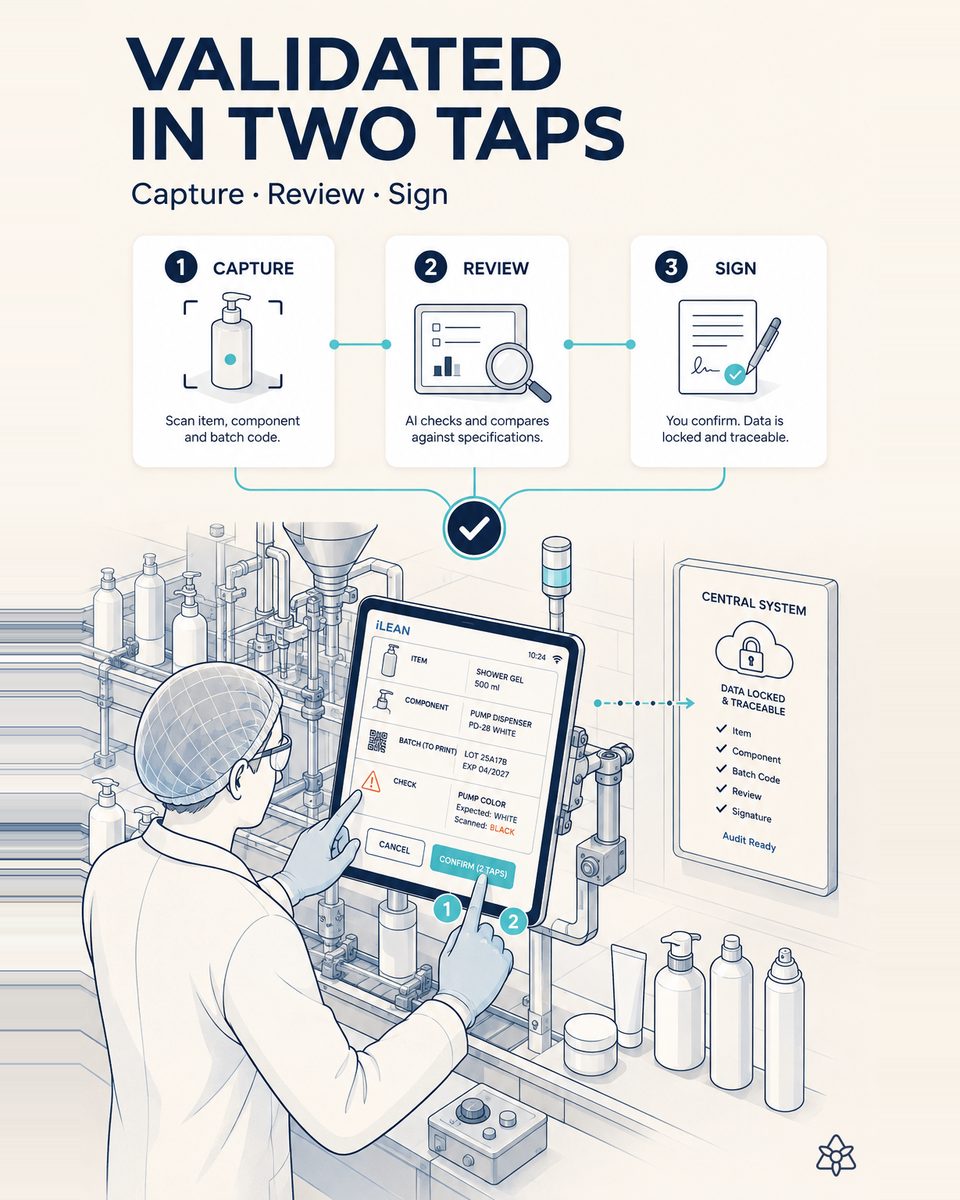
Start-up is the moment of maximum risk and minimum attention.
Start-up is the moment of maximum risk and minimum attention. A changeover has just finished, the line has been down for an hour, everyone is in a hurry, and that is when somebody confirms from memory that the mounted component is the right one. In contract manufacturing that error is not a quality defect: it is one brand's product going out with another brand's component. And it does not affect one unit, it affects the entire batch. The classic alternative — a paper checklist plus a double check — takes time from the operator and leaves no usable evidence, which is exactly what the second-party audit will ask for.
- The changeover has just finished, the line has been down an hour and everybody is in a hurry. That is when the mounted component gets confirmed from memory.
- In contract manufacturing that error is not a quality defect: it is one brand's product carrying another brand's component.
- And it does not affect one unit: it affects the whole batch, because nothing downstream is looking for it.
- The paper checklist plus double check costs operator time and leaves precisely the kind of evidence a second-party audit will not accept.
Connect brings it all onto one screen at the line, and the line leader decides.
Connect brings together on one screen everything captured by any route: the photo of the mounted component and its lot label, the reading of the printed code, the live ERP order and the current item specification. It presents it on an industrial tablet at the line as a visual summary with discrepancies highlighted. The line leader confirms with two taps — accept or correct — and only then does the data cross into the ERP or MES. Corrections are logged too and feed back into capture.
This is what separates iLEAN from an autonomous agent that writes data with no signature and quietly contaminates the master. Humans in command, always.
Confirming from memory vs. validating on screen
| Aspect | Today | With iLEAN Connect |
|---|---|---|
| When the data enters the ERP | When the order closes | Second zero, once validated |
| Mounted component | Confirmed from memory | Photo, lot label and specification side by side |
| Batch code, expiry and PAO | Read at final inspection | Read before the first unit is filled |
| A wrong start-up | Found at the customer | Intercepted before filling |
| Evidence of the check | A signature on paper | Traceable, with who and when |
| Corrections | Left no trace | Logged, and fed back into capture |
from "the system learns what was on the line when the order closes" to data validated at second zero · from a start-up error found at final inspection (or at the customer) to an error intercepted before the first unit is filled · from a paper signature to a traceable one.
Impact estimate — to validate against your numbers.
The block below is an estimate to be validated against your plant's actual data. We put it forward so the committee has an order of magnitude; we refine it during the assessment.
- Lines with several format changeovers a day and a dozen brands sharing similar components.
- Indicative payback between 3 and 7 months.
- It intercepts practically every component and batch-code error at start-up, which is where they originate.
- Plus the signed evidence, which is the first thing the brand owner's auditor asks for.
estimated payback of 3 to 7 months. It intercepts practically every component and batch-code error at start-up, plus the human signature evidence available for audit. *Estimate to validate.*
And the fair question from the production manager
“Two more taps at the worst moment of the day — will the line leader really do it?” — it is the fair objection. The taps replace a paper checklist that takes longer and proves less, and what is on screen is already assembled: the leader is confirming, not filling anything in. Where it does get resisted is where the screen shows too much, so the summary is cut down to the triad that actually ruins a batch.
[1] OpenAI paper "Why Language Models Hallucinate", 2025 — on the reliability of AI in anchored tasks.
What people ask about validating at the line
What exactly gets validated?
The triad that can never enter wrong: which bulk is being filled, which bottle, cap, pump and label are mounted with their lots, and which batch code, expiry and period-after-opening are about to be printed. Everything else can be fixed later; those three cannot.
What happens when the leader rejects something?
The correction is recorded too and it feeds back into capture. That is not a formality: the corrections are the map of where the reading or the specification is weak, and after a few weeks they are the reason the summary gets things right first time.
Does it slow the start-up down?
Less than the checklist it replaces. What takes time today is not the signature, it is walking over to look at each thing and then writing it down. Here it is already on screen with the discrepancies highlighted, so the check is a comparison rather than a search.
Can the operator sign instead of the line leader?
It is each plant's decision, and the usual choice is the line leader precisely because their signature is the one quality recognizes. Whoever it is has to be the person who is accountable — a validation delegated to whoever happens to be nearest is a signature with no meaning.
Does this apply to the rest of the matrix?
Yes, and it is why the case exists on its own. No capture from any other piece crosses into the ERP unvalidated. That is what stops an unattended agent from writing into the master, which in a multi-brand plant would be worse than the problem it set out to solve.
More cases from this series
- A dozen customers auditing and not one week lostEvery batch dossier builds itself while production runs, indexed by standard and separated by brand. The…
- The failure that ruins the year is not scrapFour coordinated verification rings — intake, changeover, start-up and output — against the error that…
- The batch record exists at second zero, not eight hours laterThree photos at start-up and the batch record exists at second zero, with the real lot of every raw…
- In contract manufacturing, the customer decides the changeiLEAN reads the brand owner's email, extracts the artwork or component change and cross-checks it…
- The most expensive error in this sector starts at an industrial keyboardBatch, expiry and period-after-opening flow from the ERP to the coder using each brand's template. Zero…
- The truck does not wait and the lot is properly tracedPhoto the delivery note and the lot labels: iLEAN extracts, links the certificate of analysis and posts…
Tell us what would happen today if the mounted component were not that brand's.
We work on your plant's real data, not ours. Assessment with no commitment.
Request estimated ROI within 48h ‹ See all cases of personal care See cosmetics