The twenty-year-old vessel that finally reports what it does
The mixing vessel where cream or shampoo bulk is made is ten to twenty-five years old, lives on an isolated network by its manufacturer's decision, and displays the only thing that explains why a batch turns out well: vacuum, jacket temperature, rotor-stator speed, homogenisation time and cooling ramp. Replacing it costs hundreds of thousands of euros and weeks of downtime. With iLEAN Connect all it takes is an external camera pointed at the panel.
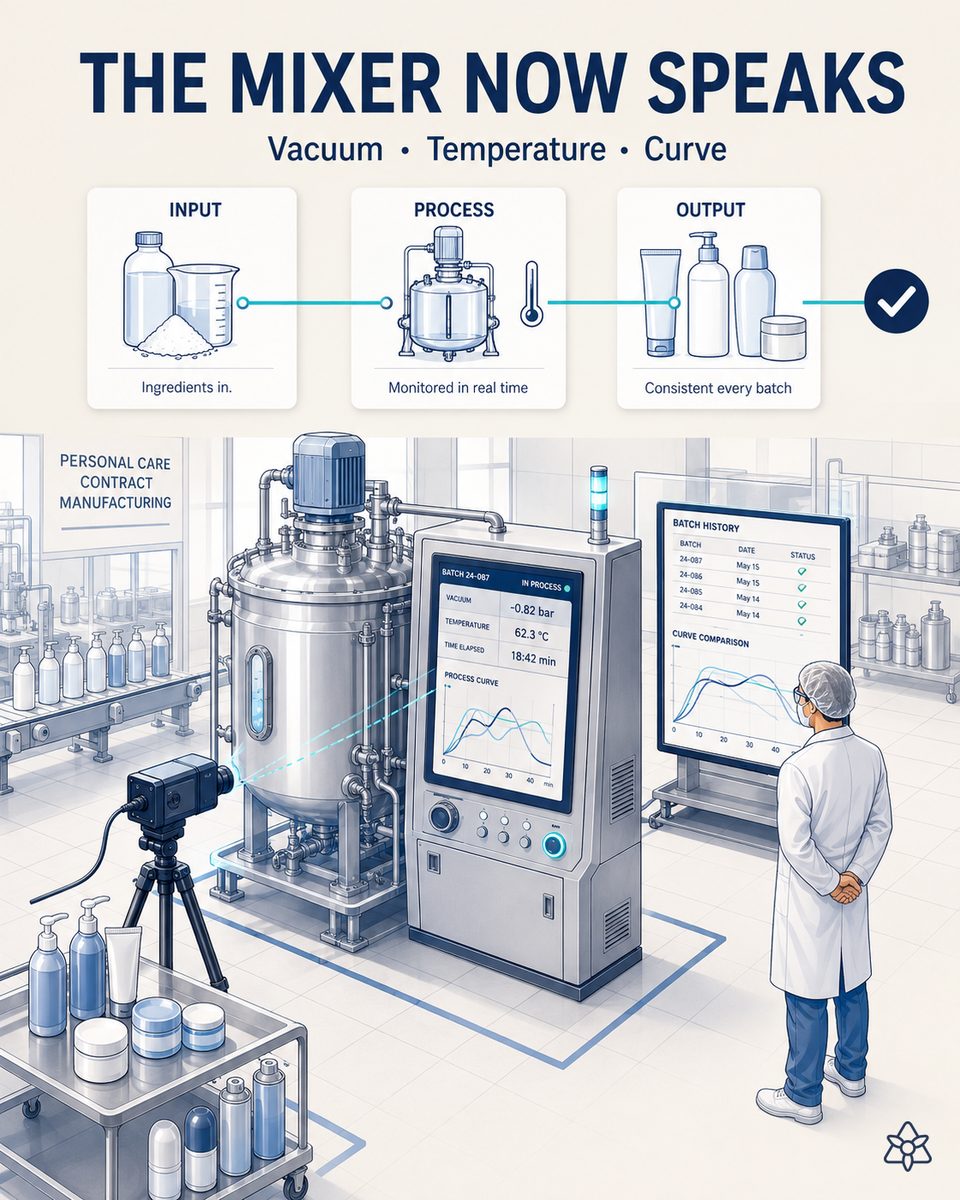
When the emulsion drifts, production and the lab argue with no data in the room.
When an emulsion batch comes out with viscosity outside specification, the argument between production and the lab has no data behind it. Nobody knows whether vacuum was held, whether the cooling ramp ran faster than usual, or whether the rotor turned for less time, because the panel keeps no exportable history and what is written by hand is a single point, not a curve. The practical result is reworking bulk — adding thickener, re-homogenising — without knowing why it drifted, and therefore without being able to stop it happening again. The classic answer is to replace the vessel with a modern connected one. That is hundreds of thousands of euros and weeks of compounding downtime. No plant signs that off just to get data.
- The panel keeps no exportable history. What gets written by hand is one reading, and a single point is not a curve — an emulsion is explained by the curve.
- Nobody can say whether vacuum held, whether the cooling ramp ran faster than usual, or whether the rotor-stator turned for less time than in the batch before.
- So the bulk gets reworked blind: add thickener, re-homogenize, ship it. With no cause identified, it happens again next month.
- The textbook answer is to replace the vessel: hundreds of thousands of euros and weeks of downtime, purely to obtain data. No plant signs that off.
Connect in panel-photo mode — a camera looking at the screen, exactly as a person would.
Connect in panel photo mode. A fixed industrial camera with controlled lighting points at the vessel screen; an anchored reading model interprets every frame and rebuilds the full time curve of the batch. It is cross-referenced with the ERP to know which item and brand were in the vessel at that moment. The machine is not touched: no network, no driver, no warranty at risk. Flow: camera → anchored frame-by-frame reading → time curve per batch → ERP cross-reference → correlation with the lab result.
What does not happen matters as much as what does: no cable, no driver, no firmware change, nothing that puts the manufacturer's warranty on the table.
A curve that vanishes vs. a curve on record
| Aspect | Today | With iLEAN Connect |
|---|---|---|
| The batch curve | On the screen, then gone | Recorded batch by batch |
| Vacuum, temperature, cooling ramp | One handwritten reading | The full time curve |
| Root cause of an out-of-spec batch | An argument between departments | Minutes of analysis |
| Work on the machine | — | None: no cable, no firmware |
| The same formula in two vessels | No way to compare | Curve against curve |
| Vessel replacement CAPEX | On the plan for years | Deferred |
from zero correlation between process and quality to root-cause analysis per batch in minutes · from blind rework to explained rework · from vessel replacement CAPEX to CAPEX deferred indefinitely.
Impact estimate — to validate against your numbers.
The block below is an estimate to be validated against your plant's actual data. We put it forward so the committee has an order of magnitude; we refine it during the assessment.
- Vacuum emulsifiers ten to twenty-five years old, the bottleneck of the bulk room.
- Indicative payback between 5 and 10 months.
- Around 30% less reworked bulk on the process-sensitive items — emulsions and thickened systems.
- Plus the deferred replacement CAPEX, which is the large number on the page.
estimated payback of 5 to 10 months. Around 30% less reworked bulk on process-sensitive items, plus avoidance of a replacement investment in the hundreds of thousands of euros. *Estimate to validate.*
And the fair question from the production manager
“Is a camera reading a screen actually reliable?” — it depends more on the mounting than on the model: fixed camera, stable framing, controlled lighting. Under those conditions reading digits off a panel is about as anchored as a task gets. It is checked in the first week against manual readings, and if a particular panel will not read, we say so before anything is committed.
[1] OpenAI paper "Why Language Models Hallucinate", 2025 — on the reliability of AI in anchored tasks.
What people ask about reading the vessel panel
Does it affect the machine's warranty?
No, because nothing is touched. The camera is an external element pointed at the screen, external in the same sense that an operator looking at it is. That is what makes the case viable at all: any integration with the control opens a discussion with the manufacturer that has been stalling for years.
Why not just put the panel on the network?
On vessels of this age the manufacturer often keeps it isolated by design, and where it can be done the work touches the control of the most expensive asset in the bulk room. It has been on the improvement list for years and never reaches the top. The camera sidesteps the discussion entirely.
How often does it read?
Every few seconds, which is the resolution at which emulsification decisions are actually made. It is not video: they are discrete readings, assembled afterwards into the batch's time curve.
How does it know which batch the curve belongs to?
It is cross-referenced with the ERP to tie it to the item, brand and order that were in the vessel at that moment. Without that link a curve is a nice chart; with it, it is the reason the batch came out the way it did.
What does the lab get out of it?
The other half of the correlation. Today the lab holds the result and production holds the process, and the two only meet in a meeting. With the curve on record, a viscosity out of range is read against the actual cooling ramp of that batch, and the specification gets tightened where it matters instead of everywhere.
More cases from this series
- A dozen customers auditing and not one week lostEvery batch dossier builds itself while production runs, indexed by standard and separated by brand. The…
- The failure that ruins the year is not scrapFour coordinated verification rings — intake, changeover, start-up and output — against the error that…
- The batch record exists at second zero, not eight hours laterThree photos at start-up and the batch record exists at second zero, with the real lot of every raw…
- In contract manufacturing, the customer decides the changeiLEAN reads the brand owner's email, extracts the artwork or component change and cross-checks it…
- The most expensive error in this sector starts at an industrial keyboardBatch, expiry and period-after-opening flow from the ERP to the coder using each brand's template. Zero…
- The truck does not wait and the lot is properly tracedPhoto the delivery note and the lot labels: iLEAN extracts, links the certificate of analysis and posts…
Tell us which vessel you have and we will say within 48h whether its panel reads.
We work on your plant's real data, not ours. Assessment with no commitment.
Request estimated ROI within 48h ‹ See all cases of personal care See cosmetics