The lab spreadsheet is not the problem — transcribing it is
In practically every personal care plant there is a spreadsheet in a shared folder where the lab records, batch by batch, pH, Brookfield viscosity, density, solids, colour, odour and microbiology. It is live, trusted data. But the ERP demands somebody transcribe it, so it gets transcribed late and in bulk, and the real value and the ERP value end up weeks apart.
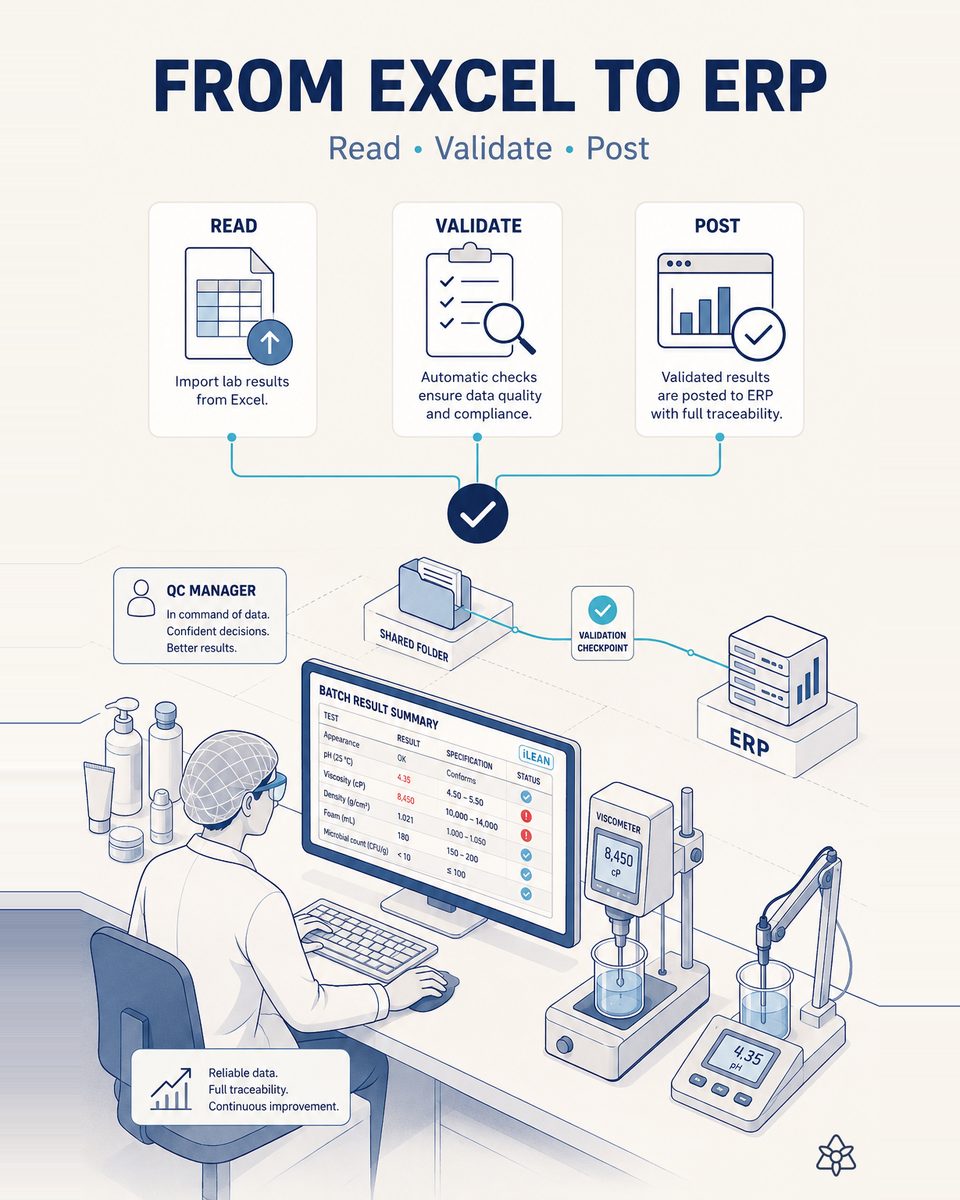
The spreadsheet is not a bad habit. The person copying cells out of it is the problem.
The lab uses a spreadsheet because it is flexible and fast, and that is a good reason, not a bad habit. The problem is the bridge: a person copying cells from the spreadsheet into the ERP. That bridge delays batch releases, introduces keying errors into critical results and burns something like half a day a month just copying. And because it happens in bulk, production works for days with information the ERP does not yet hold. On top of that there is a silent cost: every lab person who enters the ERP purely to key in data is a quality module licence the plant pays for every year.
- The lab uses a spreadsheet because it is fast and flexible, and that is a good reason. Nobody is giving it up for a rigid form with fewer columns.
- The bridge is human: somebody copies pH, viscosity, density, solids and microbiology into the ERP, in bulk, when they get to it.
- Batch releases queue behind that bridge, and the certificate of analysis the customer is chasing queues behind the release.
- And there is a silent line item: every lab person who opens the ERP purely to type is a quality module license paid for every year.
Connect in listen-inward mode — it watches the folder, not the people.
Connect in listen-inward mode. iLEAN watches the shared folder — not the people — and reads the file the moment it is saved. It parses it with a model anchored to that particular sheet's structure, normalises values against the item specification and shows the quality manager a summary with out-of-range values flagged. They validate and only then does Connect post to the ERP via API. The lab does not change tool.
The lab does not change tool, does not change file and does not change routine. What disappears is the person copying cells.
Transcribing vs. reading at source
| Aspect | Today | With iLEAN Connect |
|---|---|---|
| Lag between the real value and the ERP | Days or weeks | Minutes |
| Transcription time | About half a day a month | Zero |
| Keying errors in release results | Possible and invisible | Values read at source |
| Certificate of analysis for the customer | The customer waits | Immediate |
| An out-of-range value | Noticed when keyed in | Flagged before validating |
| Quality module licenses | One per person who types | One, for whoever validates |
from days or weeks of lag between real and ERP data to minutes · from half a day a month of transcription to zero · from keying errors in release results to values read at source · from certificates of analysis that make the customer wait to immediate certificates.
Impact estimate — to validate against your numbers.
The block below is an estimate to be validated against your plant's actual data. We put it forward so the committee has an order of magnitude; we refine it during the assessment.
- Labs recording pH, viscosity, density, solids, color, odor and microbiology in a shared spreadsheet.
- CFO angle: from five quality module licenses to one, a recurring −50% to −80% line.
- Indicative payback between 3 and 6 months, among the fastest in the catalogue.
- To be validated against your vendor's actual price list, which is where the figure becomes real.
CFO angle — direct, recurring ERP licence saving: if five lab people hold a quality module licence today purely to key in results, with Connect only the validating manager needs one: from 5 to 1. Typical range for this archetype: −50% to −80% of quality/lab module licences, several thousand euros a year recurring per licence released (to validate against the vendor's actual price list). Estimated payback of 3 to 6 months, one of the fastest in the catalogue. *Estimate to validate.*
And the fair question from the production manager
“What if it reads a decimal wrong on a release result?” — the value is read from the cell, not from a photo of a sheet, so there is no character to guess at. And it does not post on its own: the quality manager sees the summary with out-of-range values flagged and validates. The gain is not that a machine reads better than a person — it is that the person now reads a summary instead of retyping two hundred cells.
[1] OpenAI paper "Why Language Models Hallucinate", 2025 — on the reliability of AI in anchored tasks.
What people ask about the lab spreadsheet and the ERP
Does the lab have to move to a LIMS?
No, and that is the point of the case. A LIMS is a good project and a long one; this is the bridge that pays for itself in months while that decision gets made. If a LIMS does arrive later, the same capture points at it instead.
What if somebody adds a column to the spreadsheet?
It is anchored to that sheet's structure, so a new column is flagged rather than silently misread. In practice these files change a couple of times a year and the adjustment takes minutes — the important part is that a change never posts wrong data quietly.
How does it know which batch each row belongs to?
From the batch identifier the lab already writes in the row, normalized against the item specification and cross-checked with the ERP. Where a row cannot be matched it goes to the validation screen instead of being posted against a guess.
Do we really drop from five licenses to one?
That is the typical shape when the only reason those five people enter the ERP is to key in results. If some of them use the module for other work, the saving is smaller and it is worth counting before promising it in committee. The range for this archetype is 50% to 80%.
Can it release a batch on its own?
No. Release stays with the quality manager, who signs; the system's job is to put everything needed to sign into a single view. In a plant releasing bulk for third-party brands, an automatic release would not survive its first audit.
More cases from this series
- A dozen customers auditing and not one week lostEvery batch dossier builds itself while production runs, indexed by standard and separated by brand. The…
- The failure that ruins the year is not scrapFour coordinated verification rings — intake, changeover, start-up and output — against the error that…
- The batch record exists at second zero, not eight hours laterThree photos at start-up and the batch record exists at second zero, with the real lot of every raw…
- In contract manufacturing, the customer decides the changeiLEAN reads the brand owner's email, extracts the artwork or component change and cross-checks it…
- The most expensive error in this sector starts at an industrial keyboardBatch, expiry and period-after-opening flow from the ERP to the coder using each brand's template. Zero…
- The truck does not wait and the lot is properly tracedPhoto the delivery note and the lot labels: iLEAN extracts, links the certificate of analysis and posts…
Tell us how many ERP licenses you pay for just so somebody can type.
We work on your plant's real data, not ours. Assessment with no commitment.
Request estimated ROI within 48h ‹ See all cases of personal care See cosmetics