Child dermo pH 5.5 and hypoallergenic — an excipient that slips into a bath or diaper product is not an incident, it is a damaged brand.
The child dermo standard demands pH 5.5 ± an agreed range and a closed list of permitted excipients. iLEAN Edge captures the tank's pH curve throughout the whole mix, cross-checks the actual INCI of the raw-material lot against the current formula and the hypoallergenic list, and holds the batch before packing if something drifts. The person signs.
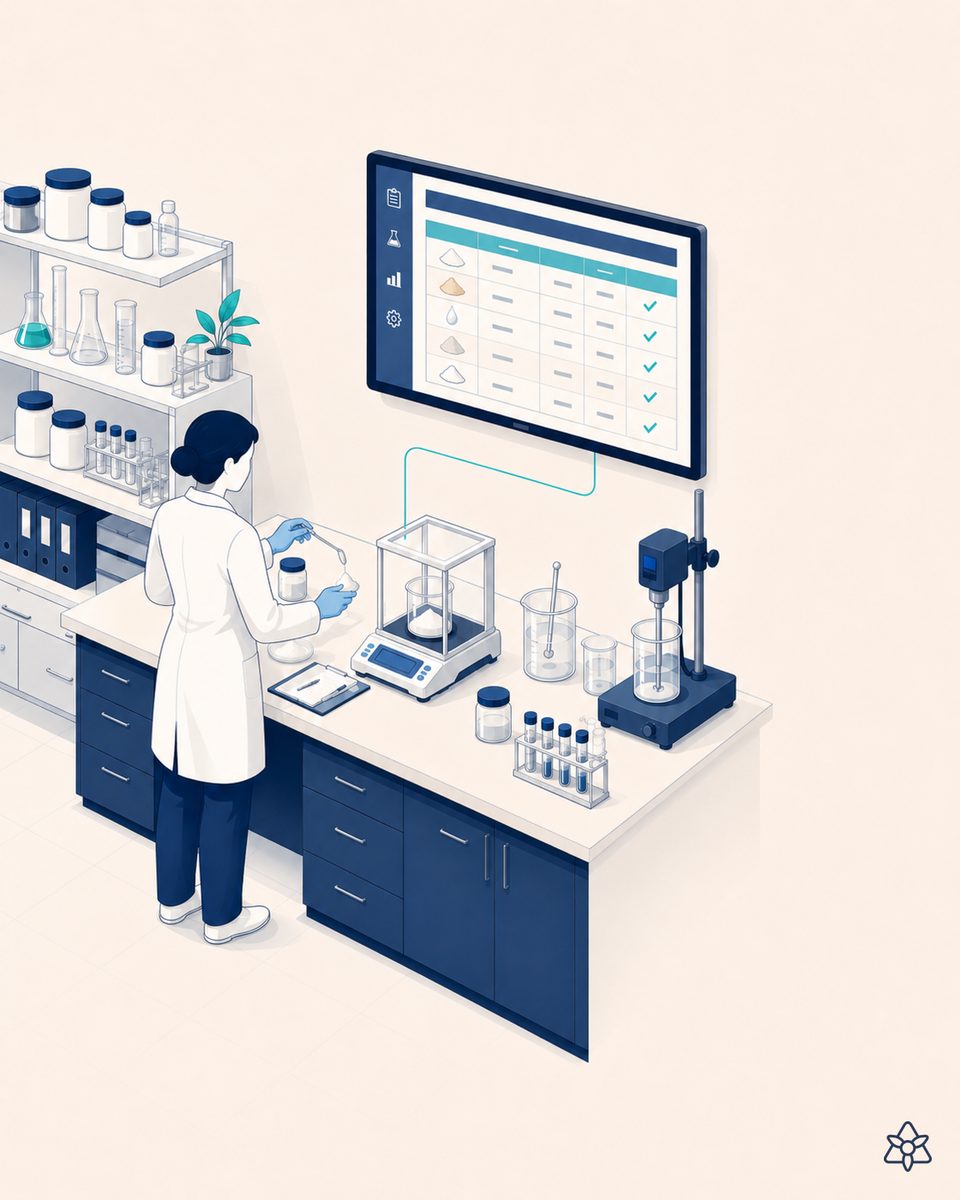
Child dermo does not allow "more or less" — and the classic control falls short at the two key moments.
A child dermo product (bath gel, tear-free shampoo, body lotion, diaper-care wipe) carries two hard requirements that the classic system only half-watches:
- pH 5.5 ± an agreed range in the final product — and, what almost nobody controls, across the whole mixing curve, not just the closing value. A mix that spends 20 minutes in an alkaline stretch can degrade sensitive molecules even if it ends at the correct pH.
- A hypoallergenic formulation — a closed list of permitted excipients and preservatives. What is banned (long-chain parabens, fragrance allergens from Annex III of 1223/2009, harsh sulfates, certain isothiazolinones) cannot sneak in through a silent supplier lot change.
The quality manager knows this. But the classic control takes a single pH measurement at batch closing and looks at the supplier's certificate when there is time. The classic system works 99% of the time. That 1% is what comes back as a cosmetovigilance ticket — irritations reported by pediatricians, returns at the pharmacy, a precautionary recall that stains the entire child dermo brand. In pediatric dermo, trust is built over years and broken in one.
iLEAN Edge does not replace your pH meter — it captures the whole curve and cross-checks it against the formula and the actual lot.
The child dermo control problem is not a lack of sensors: it is that pH gets checked at closing while the supplier's certificates live in another folder. iLEAN acts as the putty that seals the crack between the tank, R&D, purchasing and packing, without asking you to change anything on the floor.
Edge captures the tank's pH curve. Connect captures the lot's actual INCI. The agent cross-checks both against the current formula and the hypoallergenic list. If something drifts, the batch is held. The person signs — never the other way around.
The iLEAN pieces applied to pH control and hypoallergenic verification in child dermo:
- Edge — a terminal in the mixing room with an input for the tank's existing pH meter. It captures the complete curve throughout the whole mix, not just the closing value. A CNN trained on curves from batches that reached the customer in good condition: it learns which curve shape produces stable product. When the curve drifts (a prolonged alkaline stretch, an anomalous oscillation, an out-of-range closing value), it holds the batch. It works without a network.
- Connect — captures the supplier's lot certificate whether it comes from the EDI portal, a PDF email or a WhatsApp from the sales rep. It extracts the actual INCI and cross-checks it against the child dermo product's current formula and the brand's hypoallergenic list. If a non-permitted excipient or an unexpected INCI appears, it raises the alert before the lot enters the mix.
- Tracer agent — assembles the per-batch dossier: formula, actual INCI of every raw material, pH curve, in-line controls and human signature. When a cosmetovigilance ticket arrives, the team opens the batch and the root cause is visible in minutes.
Manual child dermo control vs. cross-checked control with iLEAN Edge
| Aspect | Closing check + certificates in email | With iLEAN Edge + Connect |
|---|---|---|
| pH measurement | Single value at batch closing | Complete curve throughout the whole mix |
| Silent supplier lot change | Certificate in a PDF, depends on who opens it | Captured and cross-checked against the hypoallergenic list |
| Banned excipient detection | When someone reviews the certificate by hand | Before the lot enters the mix |
| Traceability for cosmetovigilance | Manual reconstruction, weeks | Per-batch dossier, opened in minutes |
| Degrading pH curve | Invisible if the closing value adds up | Learned from the curves of good batches |
| Operation without a network | n/a | Edge keeps running on the cabinet's own power |
Impact estimate for your plant — to be validated with your numbers.
The block below is an estimate to be validated with the specific data of your plant. We put it forward so the committee has an order of magnitude; we refine it during the diagnostic.
- A child dermo line with two or three families (bath gel, lotion, diaper care), surfactant and preservative suppliers with frequent lot changes, occasional cosmetovigilance tickets today.
- Edge pilot on one mixing tank (input to the existing pH meter + Connect for lot INCIs + a per-batch dossier agent). First value expected within a few weeks: the pH curve captured and cross-checked against outcomes for the first time.
- Indicative payback between 4 and 9 months, dominated by the elimination of the cosmetovigilance recall risk and the reduction of response time when a ticket does occur.
- The hard lever is a single avoided cosmetovigilance recall: in child dermo a mass recall is not measured in product alone, it is measured in years of brand. That pays for the entire pilot.
And the quality manager's reasonable doubt
"What if the AI misreads an INCI or a pH curve?" — hallucination is a problem of free generation, not of anchored tasks. In tasks where the AI merely recontextualizes structured data (reading a certificate, comparing against the hypoallergenic list, reading a curve against a pattern), the best models brought error below 1.5% [1]. And even so, what is critical is never decided alone: Edge holds the batch and the person signs. The three safety rings are there for this.
[1] OpenAI paper “Why Language Models Hallucinate”, 2025 — on the reliability of AI in anchored tasks.
What people ask about child dermo control with AI
Why is pH critical in child dermo products?
A baby's skin has a weaker acid mantle than an adult's and a skin pH of roughly 5.5. Bath, lotion and diaper-care products must respect that pH so they neither irritate nor disturb the skin barrier — a pH out of range (more alkaline from a surfactant dosing error, more acidic from overcorrection) can pass the initial sensory test yet generate cosmetovigilance tickets weeks later, irritations reported by pediatricians, returns at the pharmacy. The child dermo standard does not allow "more or less": either the batch is at pH 5.5 ± the agreed range, or it does not ship.
How do you verify in line that the formulation is truly hypoallergenic?
"Hypoallergenic" in child dermo translates into a closed list of permitted excipients and preservatives and another closed list of banned ones (long-chain parabens, fragrance allergens from Annex III of 1223/2009, harsh sulfates, MIT/MCI depending on the brand). iLEAN Connect cross-checks the product's current formula against the actual INCI of each raw-material lot and against the brand's child dermo excipient list. If the surfactant or preservative supplier silently changed a composition and a non-permitted INCI appears, the system holds the batch before packing.
What about pediatric batches and cosmetovigilance?
Batches intended for pediatric use carry extra cosmetovigilance requirements: any reported irritation ticket must be narrowed down to the batch in hours, not weeks. iLEAN Tracer assembles the per-batch dossier with the formula, the actual INCI, the tank's pH curve, the in-line controls and the human signature. When a ticket arrives, the cosmetovigilance team opens the batch, sees the pattern, decides in hours. A bounded recall costs infinitely less than a precautionary recall of the entire brand.
Do we have to replace the plant's pH meter?
No. iLEAN Edge connects to the mixing tank's existing pH meter, or to the in-line sensor if there is one. It captures the pH curve throughout the whole mix, not just the final closing value — because a batch that ends at pH 5.5 but passed through an alkaline stretch during mixing may have damaged sensitive molecules (vitamins, peptides) without the final check ever seeing it. Edge cross-checks the curve against the current recipe and flags the drift before closing. It works without a network: if the plant loses WiFi, Edge keeps capturing and holding if needed.
How much does Edge pH and hypoallergenic control cost on a child dermo line?
The order of magnitude of an Edge pilot on a child dermo line covers the terminal with a pH meter input, the Connect connectors to the formula system and the ERP, the hold actuator and the MES integration, plus an annual license. The reasonable payback to present to the committee is several months — the hard lever is a single avoided cosmetovigilance recall, which in child dermo is devastating for the brand. We ask for your line's data and send you the estimated ROI in 48h, with your numbers.
More cases in cosmetics
- SMED for multi-SPF sunscreen tube lines with AI — in the summer campaign, every minute down is a SKU that doesn't ship.How iLEAN Agents orchestrates the SMED format change on a multi-SPF sunscreen tube line during the…
- Pressure and valve crimping in cosmetic aerosols with AI — the shelf leak is born on the line, not in the truck.How iLEAN Edge controls internal pressure and valve crimping on cosmetic aerosol lines (hairspray,…
- Fill level in opaque perfume bottles with AI — reading what the classic optical sensor cannot.How iLEAN Vision reads the fill level in black or opaque glass perfume bottles where the classic optical…
- ISO 8 cleanroom for cosmetic powder: see particles and PPE at second zero, not at the audit.How iLEAN Vision reads particles and PPE in real time in an ISO 8 compact-powder cleanroom — the quality…
- Foundation color matching with AI — today's N3 the same as tomorrow's N3, batch after batch.How iLEAN Vision verifies color batch by batch in foundation and multicultural makeup bases — no drift,…
- Multibrand cosmetic contract manufacturing — two competing brands on the same line, one traceability trail per customer.How iLEAN Tracer secures cross-customer traceability in a cosmetic contract manufacturing plant with…
Tell us your case and in 48h we'll send you the estimated ROI of this AI project for your child dermo line.
We work on your plant's real data, not ours. Diagnostic with no commitment.
Request estimated ROI in 48h See cosmetics