Foundation color matching with AI — today's N3 the same as tomorrow's N3, batch after batch.
In foundation and multicultural makeup bases, a minimal drift between batches comes back as a consumer return — the lab spectrophotometer measures well but measures late. iLEAN Vision (the computer vision layer of iLEAN Edge) verifies color in line, batch by batch, before packing, and holds the batch when the ΔE goes past threshold. The color manager signs.
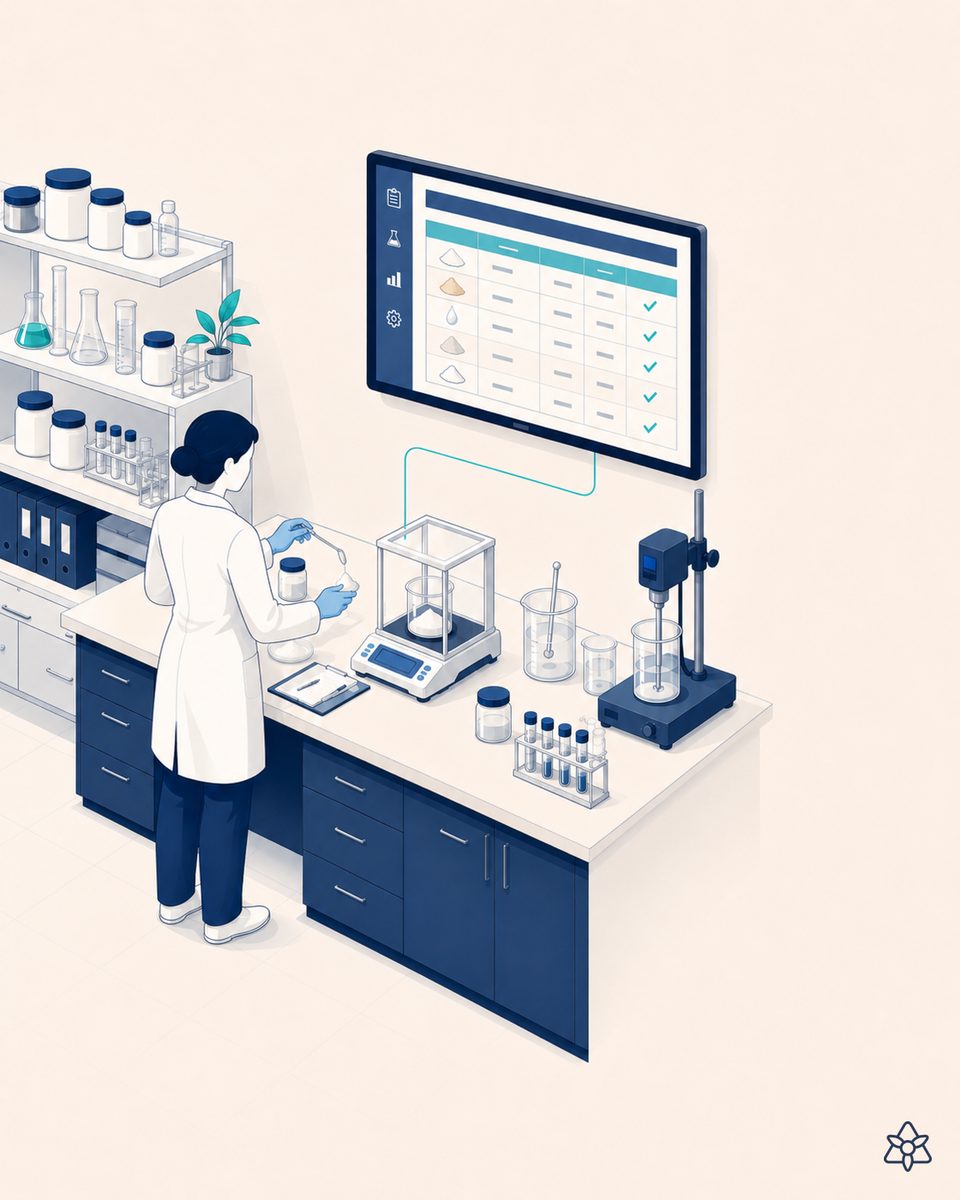
The consumer buys by shade name — the batch has to keep that promise.
Foundation color matching is not a brand whim: it is a brand promise. The consumer found “her shade” after trying several references, buys it by name and expects the same result on her skin every time. A drift the lab chemist's eye considers within technical tolerance can be perceptible to her — and come back as a complaint, a bad review or a brand switch.
- The spectrophotometer measures well but arrives late — the start-of-batch sample passes the test, the batch is packed, and the drift appears in an intermediate stretch (pigment settling when agitation dropped, a formula correction that did not blend in, residue of the previous SKU in the piping).
- Wide ranges multiply the risk — 40+ shades on the same line, frequent SKU changes, residual pigment cross-contamination in dosers. Mid and dark shades are the most sensitive: a small numerical ΔE is more visible to the eye.
- Multicultural formulas shift the problem — the same pigment in a warmer or cooler base moves the final result; bulk color control does not always capture how the packed product will look under different lighting.
Every drift complaint is hard cost (reverse logistics, replacement, customer service) plus brand cost, which weighs more in the medium term. The classic system works 99% of the time. That 1% is what ends up in a bad review — and every bad review costs more than catching it in time.
iLEAN Vision extends your color control to 100% of the flow — the putty between the lab and the filler.
The color matching problem is not a lack of judgment: it is that the color manager's judgment does not scale to the pace of the line. iLEAN acts as the putty that fills the gap between the sample spectrophotometer and the packing head, without asking you to change the LIMS, the ERP or the filler.
Vision looks at the color on every SKU, every batch, every shade change. The agents cross-reference the ΔE with the master standard and the historical trend. If the drift passes threshold, the batch is held. The person signs — never the other way around.
The specific piece for this pain:
- iLEAN Vision — the computer vision layer of iLEAN Edge, colorimetrically calibrated: an industrial camera with controlled lighting over the dosing head or the transfer piping, a CNN trained with your master standards, live ΔE calculation against the SKU's reference. It works with wide ranges (40+ shades) — the network learns your product, not a generic one. It works without a network. If the plant loses WiFi, Vision keeps measuring and holding.
- iLEAN Connect — captures the master standards whether they come from the LIMS, from the color manager's Excel file or from the ERP recipe; and captures the traceability of the previous SKU change (what was packed before, what pipe cleaning was done).
- Color agent — cross-references the Vision image, the master standard from Connect, the historical trend of the same SKU over recent batches and the current formula. If there is a deviation, it holds the batch and alerts the color manager with the data — measured ΔE, comparison against the last N batches, proposed action. The human signature decides to pack, adjust or discard.
Classic color control vs. in-line verification with iLEAN Vision
| Aspect | Spectrophotometer + lab sample | With iLEAN Vision over the head |
|---|---|---|
| Share of the batch inspected | Spot sample at the start (~0.1%) | 100% of the flow, before packing |
| SKU change in a multi-shade range | A single measurement; intermediate drift not captured | Continuous shade-by-shade verification |
| Moment the drift is detected | Consumer complaint | Before packing, in line |
| Residual cross-contamination | Risk accepted between SKUs | Detected at the new SKU's startup |
| History per SKU and per batch | LIMS logbook, rebuilt by hand | Automatic per-batch dossier with photo and ΔE |
| Decision on an out-of-threshold batch | Verbal, not always traceable | Color manager's signature, on record |
Impact estimate for your plant — to be validated with your numbers.
The block below is an estimate to be validated with the specific data of your plant. We put it forward so the executive committee has an order of magnitude; we refine it during the diagnostic.
- Makeup brand with a 30-50 shade range of foundations and bases, 2 packing lines, frequent SKU changes.
- Vision pilot on one dosing head with a calibrated camera and controlled lighting, trained with your master standards from the LIMS. First value expected within a few weeks.
- Indicative payback between 4 and 9 months, depending on the annual volume of documented drift complaints and the average reverse-logistics cost per unit.
- Defensible floor for the reduction in drift complaints: ≥ 30%. The hard lever is the hard cost of reverse logistics plus the soft cost of brand and reviews.
And the color manager's reasonable doubt
“What if the AI gets it wrong and holds a batch that is fine?” — hallucination is a problem of free generation, not of anchored tasks. In tasks where the AI merely compares an image against a master color standard, the best models brought error below 1.5% [1]. And even so, what is critical is never decided alone: iLEAN reports the measured ΔE with its history and the color manager signs. The three safety rings exist precisely for this.
[1] OpenAI paper “Why Language Models Hallucinate”, 2025 — on the reliability of AI in anchored tasks.
What people ask about in-line foundation color matching
What is batch-to-batch color drift in foundation and why is it critical?
Color drift is the perceptible difference between the shade packed in one batch and the same SKU in another batch — March's N3 is not exactly June's N3. In foundation and multicultural makeup bases it is critical because the consumer buys by shade name and expects the same result on her skin: a minimal drift (a small ΔE, but above her perceptual threshold) triggers a return, a bad review and lost trust in the brand. Wide ranges (40+ shades) multiply the problem, especially in mid and dark shades where drift is most perceptible.
Why is lab colorimetric control not enough?
The lab spectrophotometer measures well, but it measures late: by the time the result comes in, the line has already packed thousands of units. And it measures little: one sample at the start of the batch, another at the end. If the drift appears in an intermediate stretch (a pigment that settled when agitation dropped, a formula correction that did not blend in) the sample does not capture it. iLEAN Vision measures 100% of the batch in line, not 0.1% in the lab, and cross-references the live ΔE against the shade's master standard.
How does iLEAN Vision work over the foundation packing line?
A colorimetrically calibrated industrial camera, mounted over the bulk → filler transfer piping or over the dosing cup itself, captures images under controlled lighting. The CNN — trained with real samples of your product and your shade range — compares the image against the SKU's master standard and calculates the deviation. If the ΔE exceeds the configured threshold (typically ΔE ≤ 1 for critical shades), the agent holds the batch and alerts the color manager. It does not replace your spectrophotometer: it extends it to 100% of the in-line flow.
Does it work for wide multicultural ranges (40+ shades)?
Yes — in fact that is the scenario where it delivers the most. A wide range means frequent SKU changes on the same line, a high risk of residual pigment cross-contamination in piping and dosers, and higher drift perceptibility in mid and dark shades (where the same numerical ΔE is more visible to the eye). iLEAN Vision is trained with your 40+ master standards and verifies every shade change at batch startup, not just the first one of the shift.
What happens if the batch already has a drift but is within commercial tolerance?
That decision belongs to the person, not the machine. iLEAN reports the deviation with data (measured ΔE, comparison against the last N batches of the same shade, trend) and the color manager decides whether to pack with an internal note, adjust the bulk, or discard. The three safety rings are designed precisely for this: the AI proposes, the person decides. And the reasoning is recorded, not just the outcome — that protects you in an audit and gives you a history to understand why you decided that way next time.
More cases in cosmetics
- Fill level in opaque perfume bottles with AI — reading what the classic optical sensor cannot.How iLEAN Vision reads the fill level in black or opaque glass perfume bottles where the classic optical…
- Child dermo pH 5.5 and hypoallergenic — an excipient that slips into a bath or diaper product is not an incident, it is a damaged brand.How iLEAN Edge controls pH 5.5 and verifies the hypoallergenic formulation on child dermo lines for…
- ISO 8 cleanroom for cosmetic powder: see particles and PPE at second zero, not at the audit.How iLEAN Vision reads particles and PPE in real time in an ISO 8 compact-powder cleanroom — the quality…
- Multibrand cosmetic contract manufacturing — two competing brands on the same line, one traceability trail per customer.How iLEAN Tracer secures cross-customer traceability in a cosmetic contract manufacturing plant with…
- Multichannel cosmetovigilance: the adverse event reaches the safety officer — it doesn't die in an inbox.How iLEAN Connect captures cosmetic adverse events from email, WhatsApp and web forms, classifies…
- Eyeshadow and blush compaction with AI — the crack is born in the press and paid for by the customer on the shelf.How iLEAN Edge controls compaction press force on eyeshadows and blushes to prevent cracks, waste and…
Tell us your case and in 48h we'll send you the estimated ROI of this AI project for your makeup range.
We work on your plant's real data, not ours. Diagnostic with no commitment.
Request estimated ROI in 48h See cosmetics