Fill level in opaque perfume bottles with AI — reading what the classic optical sensor cannot.
Premium perfume bottles in black glass, dark amber or enameled finishes are a blind spot for the classic optical sensor: the beam does not pass through the material and the level check fails. iLEAN Vision (the machine-vision layer of iLEAN Edge) reads the exterior signature of a properly filled bottle versus a badly filled one, rejects whatever does not match and leaves a record for every unit. The quality manager signs off on the criterion.
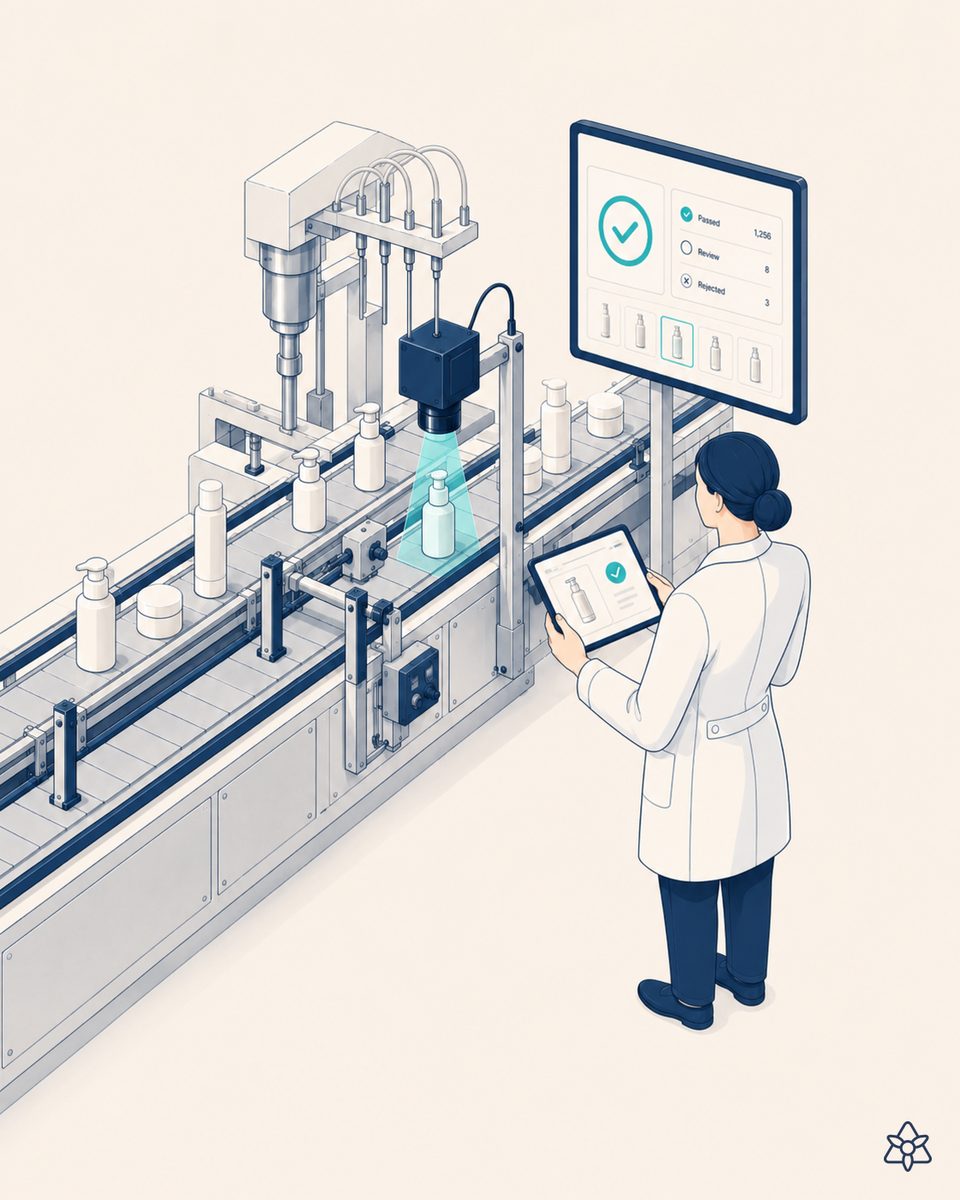
The bottle's premium finish is a blind spot for classic control.
In high-end perfumery the bottle is not just packaging — it is product. Glossy black glass, deep amber, matte satin, side enameling, opaque decorative vinyl: every finish is an aesthetic decision. And every one of those finishes is also a scenario where the classic optical level sensor loses reliability:
- The laser/infrared beam does not pass through opaque material — or it reflects erratically, and the sensor returns a false value. It happens with black glass, very dark amber and enameled finishes.
- Side decoration confuses the sensor — even on clear bottles, opaque screen printing or a decorative vinyl shifts the reading. The line accepts a short-filled bottle as good, or rejects as bad one that was fine.
- The operator's visual check does not scale — a technician spots a short-filled bottle at a glance, but not at 60-120 bottles a minute for a full shift. Final sample-based quality control catches only a fraction.
The cost comes in two forms: a short-filled bottle that reaches the premium perfume consumer comes back as a complaint and as a bad review — and the brand cost for a premium brand is very high. An acceptable bottle wrongly rejected by the sensor is direct scrap of a high-value decorated package. The classic system works 99% of the time. That 1% is what ends up as a €120 bottle that does not sell or that comes back.
iLEAN Vision does not see through the glass — it learns the exterior signature of a good bottle.
The problem with fill level in opaque bottles is not a lack of vision technology — it is that the classic approach (going through the material to measure the liquid) does not work here. iLEAN changes the approach: it acts as the putty that fills the gap the optical sensor left behind, without asking you to change the filler or the bottle material that is precisely what your brand wants to keep.
Vision learns the visual signature of a good bottle. If the bottle going past does not match that signature, it comes off the line. When there is doubt, the agent cross-references the filler's load cell. The person signs off — never the other way round.
The specific piece for this pain point:
- iLEAN Vision — an inspection booth with an industrial camera and dedicated lighting (backlight, side light, or both depending on the bottle finish), downstream of the filling head. The CNN is trained with good and badly filled bottles of the same SKU, with the same finish, and learns to tell them apart from the exterior visual signature. It triggers the reject actuator in milliseconds. It works with no network. If the plant loses WiFi, Vision keeps inspecting and rejecting.
- iLEAN Connect — captures the instant weight from the filler's load cell (where one exists) when the Vision reading has low confidence; captures the active SKU from the ERP/MES to load the correct visual signature; and captures the retraining samples when a new finish comes in, stopping the line only for as long as it takes to capture them.
- Quality agent — cross-references the image, the weight (if available) and the active SKU. If there is a deviation, it sends the bottle to manual refilling or to scrap, according to the quality manager's criterion. And it leaves a record for every unit: image, decision, criterion applied — auditable.
Classic optical sensor vs. learned vision with iLEAN Vision
| Aspect | Classic optical sensor + operator visual check | With iLEAN Vision in a dedicated booth |
|---|---|---|
| Black glass / dark amber bottle | Erratic reading, false value | Reliable reading from the exterior visual signature |
| Clear bottle with opaque decoration | Sensor gets confused by the decoration | Learns decoration and level separately |
| Share of the batch inspected | 100% by sensor + operator sample | 100% with the full visual signature |
| False positive (good bottle rejected) | Frequent on opaque finishes | Reduced by tuning the threshold per SKU |
| Record per unit | Rejected units only | Image + decision for every bottle, archived |
| New SKU with a new finish | Recalibrate and pray | Sample capture + targeted retraining |
Impact estimate for your plant — to be validated with your numbers.
The block below is an estimate to be validated with the specific data of your plant. We put it forward so the committee has an order of magnitude; we refine it during the diagnostic.
- Premium perfume brand, 1-2 packing lines, a range with opaque bottles (black, amber, enameled) and complex side decoration.
- Vision pilot as a dedicated inspection booth downstream of the filling head, without touching the filler. First value expected within a few weeks.
- Indicative payback between 4 and 9 months, depending on the annual number of units scrapped through false positives from your current optical sensor + complaints about short-filled bottles.
- Defensible floor for the combined reduction (false positives + short-filled bottles reaching the consumer): ≥ 30%. The hard lever is the unit cost of the decorated premium bottle.
And the quality manager's reasonable doubt
“What if the AI gets it wrong and lets a short-filled bottle through?” — hallucination is a problem of free generation, not of anchored tasks. In tasks where the AI merely compares an image against a visual signature learned from real samples of the SKU itself, the best models brought error below 1.5% [1]. And even so, for critical SKUs a double check is configured (vision + load-cell weight), and the quality manager signs off on the criterion. The three safety rings exist precisely for this.
[1] OpenAI paper “Why Language Models Hallucinate”, 2025 — on the reliability of AI in anchored tasks.
What people ask about fill level in opaque perfume bottles
Why does the classic optical sensor fail on black glass perfume bottles?
The classic optical sensor (laser or infrared beam) reads the level by optical contrast between liquid and air through the glass. On clear bottles it works well. On black glass, very dark amber, satin finishes, externally enameled bottles or bottles decorated with opaque vinyl, the beam either does not pass through or reflects erratically, and the sensor returns a false value. Premium perfume brands use precisely those finishes as an aesthetic differentiator — and they create a blind spot in the final fill verification.
How does iLEAN Vision read the level when the optical sensor cannot?
iLEAN Vision does not try to see through the glass: it reads the exterior visual signature of a full bottle versus a badly filled one. The CNN is trained with correctly filled bottles and bottles with a level deviation (above, below) of the same SKU, under the same booth lighting, and it learns to tell them apart from the external cues: the lighter appearance of the lower ring when the liquid line drops, the subtle difference in transmission at the neck when backlit, the angle of the meniscus shadow if the finish is semi-translucent. When there is genuine doubt, it complements the reading with the instant weight from the filler's load cell.
Does the filler have to be changed to add iLEAN Vision?
No. iLEAN Vision is installed as an inspection booth downstream of the filling head, without touching the filler or the capping line. The industrial camera with dedicated lighting goes into a standalone module and is wired to the control cabinet to trigger the reject actuator when there is a deviation. The filler keeps working exactly as it does today; iLEAN Vision adds the verification the optical sensor could not perform.
What level tolerances can be discriminated in premium perfume?
It depends on the bottle and the SKU, but the typical order of magnitude is deviations of a few milliliters on 30-100 ml bottles — the threshold below which the consumer perceives that “this bottle came up short” compared with another of the same reference. iLEAN Vision is trained with samples of the bottle itself, and the quality manager sets the hold threshold per SKU. Above the threshold, the agent rejects the bottle at the outfeed or diverts it to manual refilling; the person signs off on the criterion.
Does it also work for clear bottles with opaque side decoration?
Yes. The trickiest case in premium perfumery is usually exactly that one: the clear bottle screen-printed on the side with opaque ink or covered with decorative vinyl — the optical sensor gets confused by the decoration, not by the glass. iLEAN Vision reads from the angle and the lighting that best distinguish a full bottle from a badly filled one for that specific decoration — and it is retrained when a new SKU with a new finish comes out, stopping the line only for as long as it takes to capture the samples.
More cases in cosmetics
- Shampoo viscosity out of range: correct it in line, not as scrap at the end of the shift.How iLEAN Edge reads an in-line shampoo and hair-mask viscometer, cross-references recipe and…
- SMED for multi-SPF sunscreen tube lines with AI — in the summer campaign, every minute down is a SKU that doesn't ship.How iLEAN Agents orchestrates the SMED format change on a multi-SPF sunscreen tube line during the…
- Pressure and valve crimping in cosmetic aerosols with AI — the shelf leak is born on the line, not in the truck.How iLEAN Edge controls internal pressure and valve crimping on cosmetic aerosol lines (hairspray,…
- Child dermo pH 5.5 and hypoallergenic — an excipient that slips into a bath or diaper product is not an incident, it is a damaged brand.How iLEAN Edge controls pH 5.5 and verifies the hypoallergenic formulation on child dermo lines for…
- ISO 8 cleanroom for cosmetic powder: see particles and PPE at second zero, not at the audit.How iLEAN Vision reads particles and PPE in real time in an ISO 8 compact-powder cleanroom — the quality…
- Foundation color matching with AI — today's N3 the same as tomorrow's N3, batch after batch.How iLEAN Vision verifies color batch by batch in foundation and multicultural makeup bases — no drift,…
Tell us your case and in 48h we'll send you the estimated ROI of this AI project for your perfume line.
We work on your plant's real data, not ours. Diagnostic with no commitment.
Request estimated ROI in 48h See cosmetics