Pressure and valve crimping in cosmetic aerosols with AI — the shelf leak is born on the line, not in the truck.
A micro-leak in a cosmetic aerosol — hairspray, deodorant, foam — is not visible at the crimping outfeed: it shows up on the pallet, in the truck or, worse, on the customer's shelf. iLEAN Edge cross-references crimp vision and internal pressure reading in milliseconds and holds the unit before packing. A person signs every rejection.
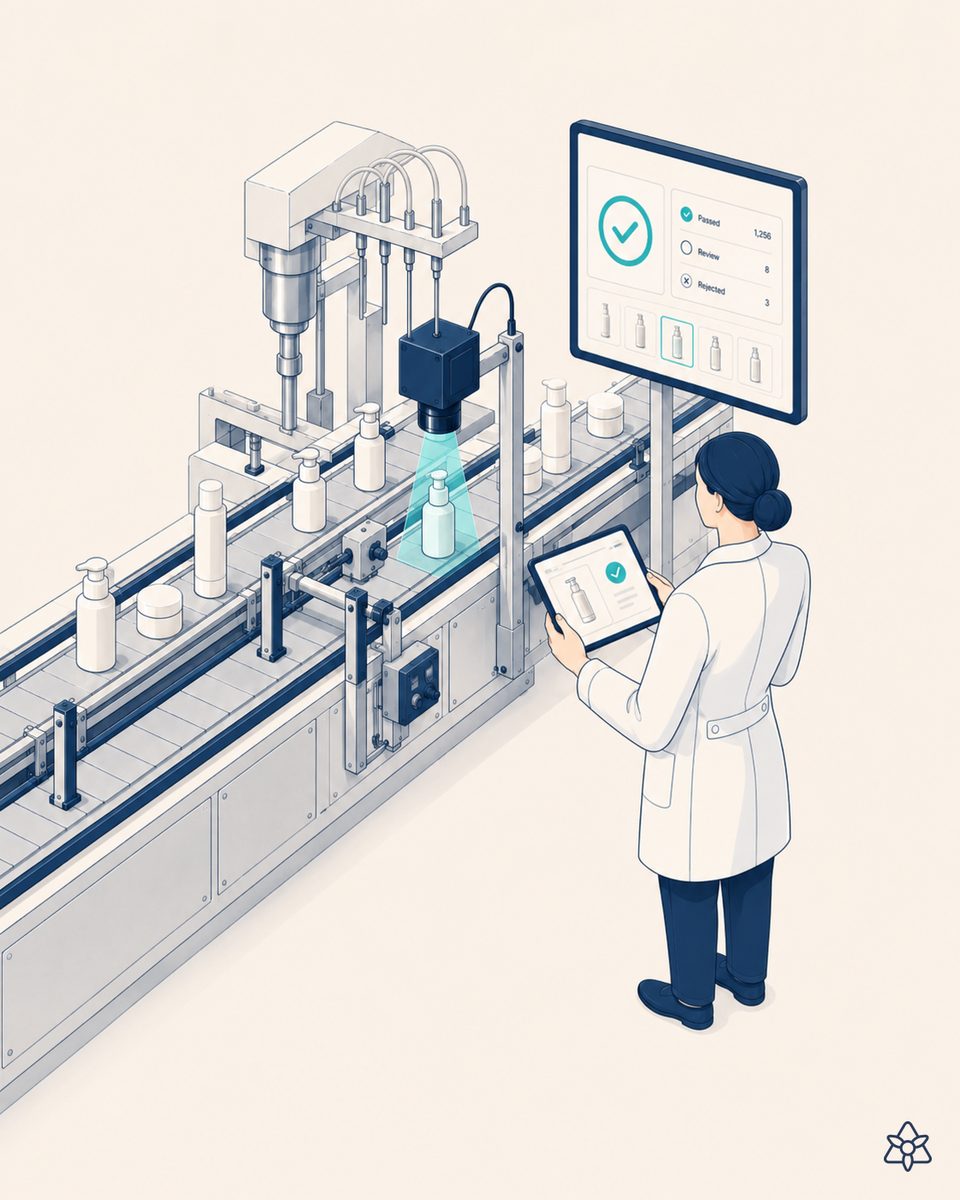
The crimping defect is silent — which is why it always reaches the customer.
Valve crimping is the aerosol's critical operation: a collet presses the valve flange against the can neck and seals the pressurized system. Done right, the unit works for months and dispenses product without losing gas. Done wrong by a small margin — an aging collet, a valve with a slightly different tolerance from a new supplier, a temperature variation during gassing — the unit looks perfect at the outfeed and loses gas over the following days.
The three realities that are almost never in the same place:
- The seal geometry — flange height, collet deformation, crimp symmetry. The operator sees it in visual inspection, usually by sampling.
- The internal pressure — set by the gasser. Read by a sensor or by the line's own gauge. Often logged in a separate system.
- The defect on the shelf — the return, the retailer complaint, the call from the brand manager. It arrives weeks later, and reconstructing what happened in that run costs the plant manager half a morning.
The classic system (sampling + visual inspection + manual adjustment between batches) works 99% of the time. That 1% is what reaches the shelf, where the damage is multiplied by the cost of the return and the cost to the brand.
iLEAN doesn't change your crimper — it closes the loop between the crimp, the pressure and the rejected unit.
The problem with cosmetic aerosols is not a lack of machines: it is information living on islands that, at the critical moment (the unit leaving with an invisible defect), does not reach the decision-maker in time. iLEAN acts as the putty that fills the gaps between the crimper, the gasser, the operator and the MES, without asking you to replace any of them.
Edge sees the crimping and reads the pressure. The actuator rejects the unit before packing. The agent prepares the per-batch dossier — and a person signs every rejection.
The iLEAN pieces applied to cosmetic aerosols:
- Edge — a terminal with computer vision (CNN) over the aerosol neck after crimping. It measures the seal geometry — flange height, symmetry, collet deformation — and triggers the actuator (rejector) if it is out of tolerance. In parallel it reads the internal pressure after gassing, via sensor or via vision on the line's own gauge. Reaction time in milliseconds. It works without a network — the non-negotiable rule: what is critical cannot depend on WiFi.
- Connect — captures the valve supplier's data (batch change, tolerance change notified by email), the shift's ambient temperature, the wear reported by maintenance. At second zero. Without asking anyone to forward anything.
- Agent — cross-references crimp geometry + pressure + shift conditions + defect history. When a drift starts to appear (the geometry runs toward the high limit in the fourth hour of the shift, just as the collet heats up), the agent warns before the drift becomes a defect. Maintenance acts on data, not hunches.
- Three safety rings — the critical crimping parameters live in the isolated ring 1. Whatever comes from outside (supplier notifications, parameters suggested by the agent) goes through ring 2 first. For IT/CAIO: it fits the AI Act and regulatory traceability.
Sampling + manual adjustment vs. in-line control with iLEAN
| Aspect | Sampling + visual inspection | With iLEAN Edge + Connect + Agent |
|---|---|---|
| Crimp geometry verification | Sampling every N units, operator's eye | 100% in line, in milliseconds |
| Internal pressure reading | Sensor → separate system | Cross-referenced at second zero with the crimp |
| Drift detection from collet wear | Reactive, after a run of defects | Predictive, before the drift becomes a defect |
| Valve supplier change | Manual adjustment, trial and error | The model adapts with data from the new batch |
| Operation without a network | n/a | Edge keeps running on panel power alone |
| Dossier for the auditor / customer complaint | Rebuilt by hand, weeks | Per-batch dossier, automatic, with geometry + pressure |
Impact estimate for your plant — to be validated with your numbers.
The block below is an estimate to be validated with the specific data of your plant. We put it forward so the committee has an order of magnitude; we refine it during the diagnostic.
- Cosmetic aerosol packing line, multi-format (hairspray + deodorant or deodorant + foam), modern filler and gasser, crimper with a history of manual micro-adjustments.
- Edge pilot on one line (camera over the crimp + pressure reading + actuator + MES integration). First value expected within a few weeks: the first shift with 100% geometry and pressure verification.
- Indicative payback between 4 and 9 months, depending on last year's volume of leak returns and the average cost of a returned run.
- Hard lever: a single avoided leak-return run pays for the pilot. Maintenance starts acting on data, not hunches, and defensive over-crimping drops.
- Expected reduction in crimping out-of-tolerance units ≥ 30% once the model has its first full shift and the agent starts anticipating wear.
And the operations director's reasonable doubt
“What if the AI rejects good units or, worse, lets a bad one through?” — hallucination is a problem of free generation, not of anchored tasks. In tasks where the AI merely measures a geometry and compares it against a known tolerance, the best models brought error below 1.5% [1]. And even so, what is critical is never decided alone: doubtful units go through a validation screen before the actuator. The three safety rings exist precisely for this.
[1] OpenAI paper “Why Language Models Hallucinate”, 2025 — on the reliability of AI in anchored tasks.
What people ask about pressure and crimping in cosmetic aerosols
Why does valve crimping fail in cosmetic aerosols?
Crimping is the operation that presses the valve flange against the aerosol neck to seal it. It fails through several combined causes: collet wear, a valve supplier change with slightly different tolerances, temperature variation during propellant gas filling, manual adjustment between batches. The defect can be invisible to the eye — a micro-leak that only shows up days later on the pallet, in the truck or on the store shelf. When it reaches the customer, the cost is a return and a lost customer.
How does iLEAN cross-reference pressure and crimping in line?
iLEAN Edge installs two parallel readings on the line: (1) computer vision (CNN) over the aerosol neck right after crimping — it measures seal geometry, flange height, deformation; (2) internal pressure reading after gassing, via sensor or via vision on the line's own gauge. It cross-references both data points in milliseconds. If the crimp geometry is out of tolerance or the pressure drifts out of range, the actuator rejects the unit before packing. The doubtful unit never reaches the pallet.
Does it work equally for hairspray, deodorant and foam?
Yes. The Edge piece is the same — a terminal with vision and signal capture — but the CNN model is trained with real samples from your line: hairspray valve geometry, deodorant valve (narrower, lower gas pressure), shaving foam valve (with an internal ball). The tolerances and gassing pressure differ, which is why the model is tuned during the initial immersion. The rule is the same: the model learns from your plant's data, not from generic data.
What if the line loses the network during the shift?
Edge keeps working. It is a physical terminal with local inference — if the plant loses WiFi, the Internet, the central server, as long as power reaches the panel, the vision + pressure + actuator cycle keeps running. iLEAN's non-negotiable rule: in a factory, what is critical cannot depend on the network. Once the connection returns, Edge syncs the history to the central system; nothing is lost.
How much does it cost to deploy AI pressure and crimping control on a cosmetic aerosol line?
The order of magnitude is that of an Edge pilot on a cosmetics line: an initial investment covering the terminal, the cameras, the sensors (or vision reading of the gauge), the actuator and the MES integration, plus an annual license. A reasonable payback is several months — the hard lever is the avoided cost of a single run of leak returns from the shelf, plus the drop in scrap from defensive over-crimping. We ask for your plant's data and send you the estimated ROI in 48h, with your numbers, not ours.
More cases in cosmetics
- Multi-batch cosmetic PIF: the dossier ready when the authority calls, not weeks later.How iLEAN Agents compiles the cosmetic Product Information File batch by batch from your ERP, MES and…
- Shampoo viscosity out of range: correct it in line, not as scrap at the end of the shift.How iLEAN Edge reads an in-line shampoo and hair-mask viscometer, cross-references recipe and…
- SMED for multi-SPF sunscreen tube lines with AI — in the summer campaign, every minute down is a SKU that doesn't ship.How iLEAN Agents orchestrates the SMED format change on a multi-SPF sunscreen tube line during the…
- Fill level in opaque perfume bottles with AI — reading what the classic optical sensor cannot.How iLEAN Vision reads the fill level in black or opaque glass perfume bottles where the classic optical…
- Child dermo pH 5.5 and hypoallergenic — an excipient that slips into a bath or diaper product is not an incident, it is a damaged brand.How iLEAN Edge controls pH 5.5 and verifies the hypoallergenic formulation on child dermo lines for…
- ISO 8 cleanroom for cosmetic powder: see particles and PPE at second zero, not at the audit.How iLEAN Vision reads particles and PPE in real time in an ISO 8 compact-powder cleanroom — the quality…
Tell us your case and in 48h we'll send you the estimated ROI of this AI project for your cosmetic aerosol line.
We work on your plant's real data, not ours. Diagnostic with no commitment.
Request estimated ROI in 48h See cosmetics